

u
300
280
260
240
220
200
180
160
140
120
100 ~
80
60
40
20
0 1958
~
1960 1962 1964
Year
1966 1968 1970
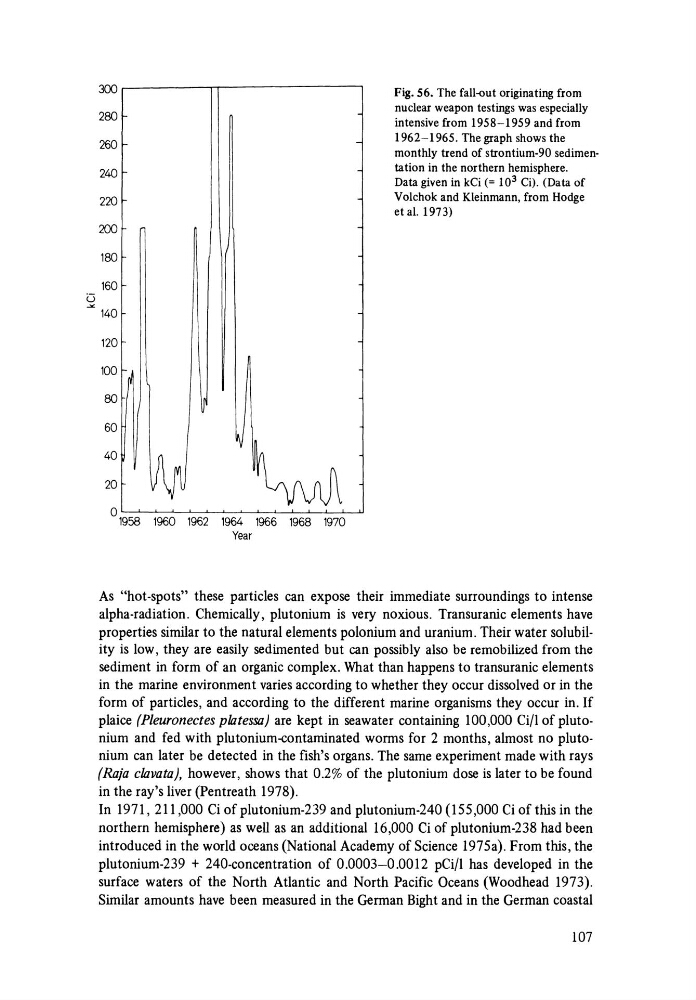
Fig. 56. The fall-out originating from
nuclear weapon testings was especially
intensive from 1958-1959 and from
1962-1965. The graph shows the
monthly trend of strontium-90 sedimentation in the northern hemisphere.
Data given in kCi (= 10 3 Ci). (Data of
Volchok and Kleinmann, from Hodge
et al. 1973)
As "hot-spots" these particles can expose their immediate surroundings to intense
alpha-radiation. Chemically, plutonium is very noxious. Transuranic elements have
properties similar to the natural elements polonium and uranium. Their water solubility is low, they are easily sedimented but can possibly also be remobilized from the
sediment in form of an organic complex. What than happens to transuranic elements
in the marine environment varies according to whether they occur dissolved or in the
form of particles, and according to the different marine organisms they occur in. If
plaice (Pleuronectes pkItessa) are kept in seawater containing 100,000 Cifl of plutonium and fed with plutonium-contarninated worms for 2 months, almost no plutonium can later be detected in the fish's organs. The same experiment made with rays
(Raja ckIvata), however, shows that 0.2% of the plutonium dose is later to be found
in the ray's liver (Pentreath 1978).
In 1971, 211,000 Ci of plutonium-239 and plutonium-240 (155,000 Ci of this in the
northern hemisphere) as well as an additional 16,000 Ci of plutonium-238 had been
introduced in the world oceans (National Academy of Science 1975a). From this, the
plutonium-239 + 240-concentration of 0.0003-0.0012 pCi/1 has developed in the
surface waters of the North Atlantic and North Pacific Oceans (Woodhead 1973).
Similar amounts have been measured in the German Bight and in the German coastal
107
300
280
260
240
220
200
180
160
140
120
100 ~
80
60
40
20
0 1958
~
1960 1962 1964
Year
1966 1968 1970
Fig. 56. The fall-out originating from
nuclear weapon testings was especially
intensive from 1958-1959 and from
1962-1965. The graph shows the
monthly trend of strontium-90 sedimentation in the northern hemisphere.
Data given in kCi (= 10 3 Ci). (Data of
Volchok and Kleinmann, from Hodge
et al. 1973)
As "hot-spots" these particles can expose their immediate surroundings to intense
alpha-radiation. Chemically, plutonium is very noxious. Transuranic elements have
properties similar to the natural elements polonium and uranium. Their water solubility is low, they are easily sedimented but can possibly also be remobilized from the
sediment in form of an organic complex. What than happens to transuranic elements
in the marine environment varies according to whether they occur dissolved or in the
form of particles, and according to the different marine organisms they occur in. If
plaice (Pleuronectes pkItessa) are kept in seawater containing 100,000 Cifl of plutonium and fed with plutonium-contarninated worms for 2 months, almost no plutonium can later be detected in the fish's organs. The same experiment made with rays
(Raja ckIvata), however, shows that 0.2% of the plutonium dose is later to be found
in the ray's liver (Pentreath 1978).
In 1971, 211,000 Ci of plutonium-239 and plutonium-240 (155,000 Ci of this in the
northern hemisphere) as well as an additional 16,000 Ci of plutonium-238 had been
introduced in the world oceans (National Academy of Science 1975a). From this, the
plutonium-239 + 240-concentration of 0.0003-0.0012 pCi/1 has developed in the
surface waters of the North Atlantic and North Pacific Oceans (Woodhead 1973).
Similar amounts have been measured in the German Bight and in the German coastal
107