

100
80
.. n! > 60
~
C
.. ~O
u
Oi 020
123 4 5
o
24
72
r:::=J lAJ\lAE 'W1T H .... -
N()IM.A. $,WIMMING
UHA.VIOI
o
2~
72
I
123456789'1:)11 12 days
H
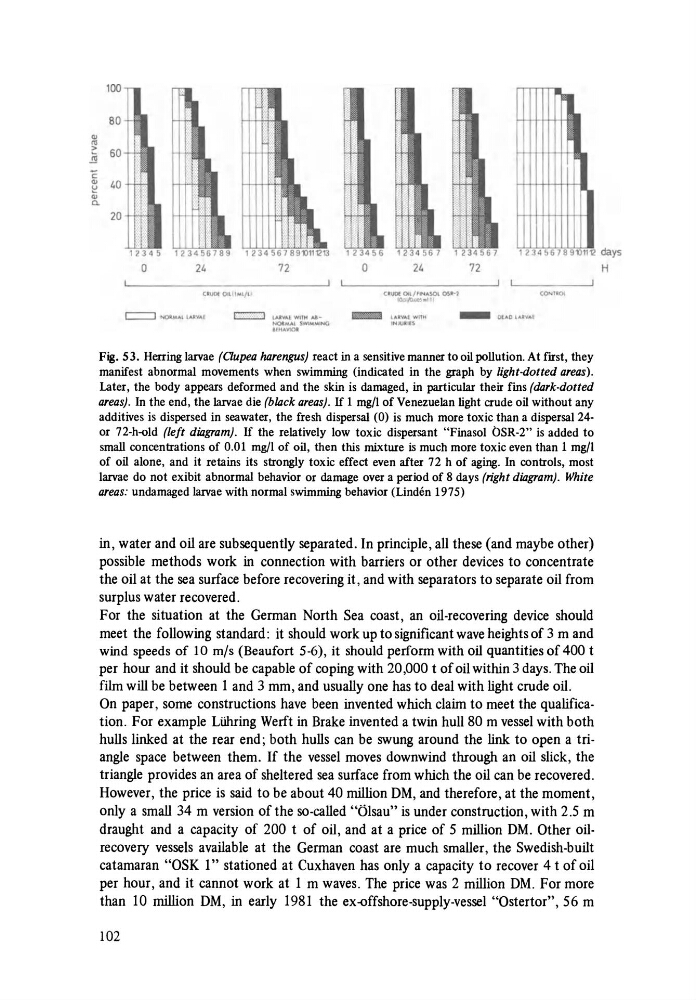
Fig. 53. Herring larvae (Qupea harengus) react in a sensitive manner to oil pollution. At lust, they
manifest abnormal movements when swimming (indicated in the graph by light·dotted areas).
Later, the body appears deformed and the skin is damaged, in particular their fins (dark·dotted
areas). In the end, the larvae die (black areas). If 1 mg/I of Venezuelan light crude oil without any
additives is dispersed in seawater, the fresh dispersal (0) is much more toxic than a dispersal 24or 72-h-old (left diagram). If the relatively low toxic dispersant "Finasol bSR-2" is added to
small concentrations of 0.01 mg/I of oil, then this mixture is much more toxic even than 1 mg/I
of oil alone, and it retains its strongly toxic effect even after 72 h of aging. In controls, most
larvae do not exibit abnormal behavior or damage over a period of 8 days (right diagram). White
areas: undamaged larvae with normal swimming behavior (Linden 1975)
in, water and oil are subsequently separated. In principle, all these (and maybe other)
possible methods work in connection with barriers or other devices to concentrate
the oil at the sea surface before recovering it, and with separators to separate oil from
surplus water recovered.
For the situation at the German North Sea coast, an oil-recovering device should
meet the following standard: it should work up to significant wave heights of 3 m and
wind speeds of 10 mls (Beaufort 5-6), it should perform with oil quantities of 400 t
per hour and it should be capable of coping with 20,000 t of oil within 3 days. The oil
film will be between 1 and 3 mm, and usually one has to deal with light crude oil.
On paper, some constructions have been invented which claim to meet the qualification. For example Liihring Werft in Brake invented a twin hull 80 m vessel with both
hulls linked at the rear end; both hulls can be swung around the link to open a triangle space between them. If the vessel moves downwind through an oil slick, the
triangle provides an area of sheltered sea surface from which the oil can be recovered.
However, the price is said to be about 40 million OM, and therefore, at the moment,
only a small 34 m version of the so-called "Olsau" is under construction, with 2.5 m
draught and a capacity of 200 t of oil, and at a price of 5 million OM. Other oilrecovery vessels available at the German coast are much smaller, the Swedish-built
catamaran "OSK 1" stationed at Cuxhaven has only a capacity to recover 4 t of oil
per hour, and it cannot work at 1 m waves. The price was 2 million OM. For more
than 10 million OM, in early 1981 the ex-offshore-supply-vessel "Ostertor", 56 m
102
80
.. n! > 60
~
C
.. ~O
u
Oi 020
123 4 5
o
24
72
r:::=J lAJ\lAE 'W1T H .... -
N()IM.A. $,WIMMING
UHA.VIOI
o
2~
72
I
123456789'1:)11 12 days
H
Fig. 53. Herring larvae (Qupea harengus) react in a sensitive manner to oil pollution. At lust, they
manifest abnormal movements when swimming (indicated in the graph by light·dotted areas).
Later, the body appears deformed and the skin is damaged, in particular their fins (dark·dotted
areas). In the end, the larvae die (black areas). If 1 mg/I of Venezuelan light crude oil without any
additives is dispersed in seawater, the fresh dispersal (0) is much more toxic than a dispersal 24or 72-h-old (left diagram). If the relatively low toxic dispersant "Finasol bSR-2" is added to
small concentrations of 0.01 mg/I of oil, then this mixture is much more toxic even than 1 mg/I
of oil alone, and it retains its strongly toxic effect even after 72 h of aging. In controls, most
larvae do not exibit abnormal behavior or damage over a period of 8 days (right diagram). White
areas: undamaged larvae with normal swimming behavior (Linden 1975)
in, water and oil are subsequently separated. In principle, all these (and maybe other)
possible methods work in connection with barriers or other devices to concentrate
the oil at the sea surface before recovering it, and with separators to separate oil from
surplus water recovered.
For the situation at the German North Sea coast, an oil-recovering device should
meet the following standard: it should work up to significant wave heights of 3 m and
wind speeds of 10 mls (Beaufort 5-6), it should perform with oil quantities of 400 t
per hour and it should be capable of coping with 20,000 t of oil within 3 days. The oil
film will be between 1 and 3 mm, and usually one has to deal with light crude oil.
On paper, some constructions have been invented which claim to meet the qualification. For example Liihring Werft in Brake invented a twin hull 80 m vessel with both
hulls linked at the rear end; both hulls can be swung around the link to open a triangle space between them. If the vessel moves downwind through an oil slick, the
triangle provides an area of sheltered sea surface from which the oil can be recovered.
However, the price is said to be about 40 million OM, and therefore, at the moment,
only a small 34 m version of the so-called "Olsau" is under construction, with 2.5 m
draught and a capacity of 200 t of oil, and at a price of 5 million OM. Other oilrecovery vessels available at the German coast are much smaller, the Swedish-built
catamaran "OSK 1" stationed at Cuxhaven has only a capacity to recover 4 t of oil
per hour, and it cannot work at 1 m waves. The price was 2 million OM. For more
than 10 million OM, in early 1981 the ex-offshore-supply-vessel "Ostertor", 56 m
102