

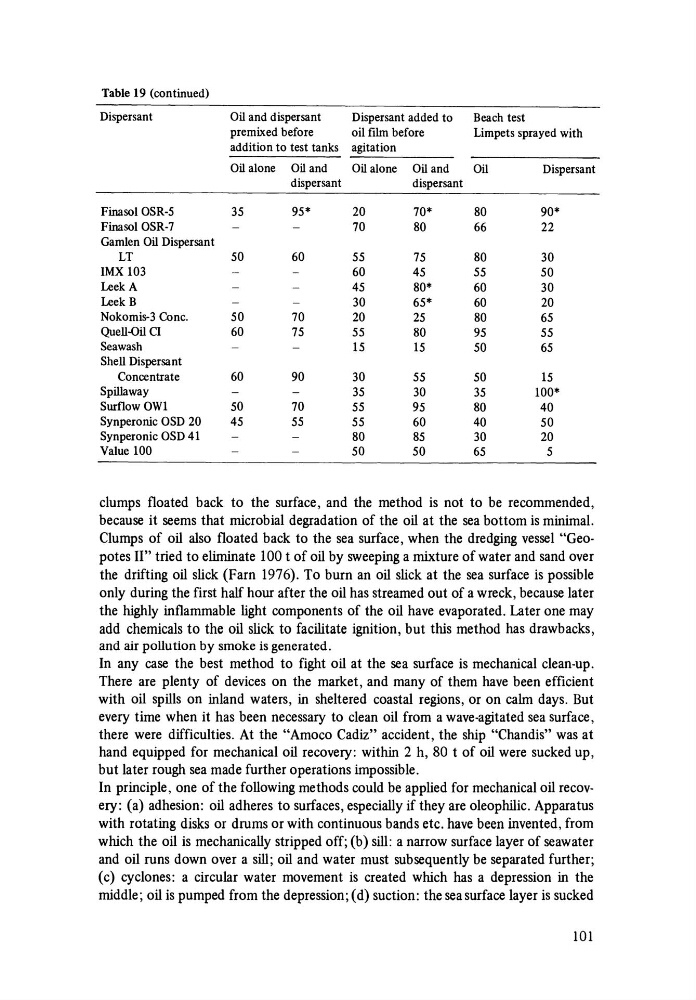
Table 19 (continued)
Dispersant
Oil and dispersant
Dispersant added to
Beach test
premixed before
oil fIlm before
Limpets sprayed with
addition to test tanks agitation
Oil alone Oil and
Oil alone Oil and
Oil
Dispersant
dispersant
dispersant
Finasol OSR-5
35
95*
20
70*
80
90*
FinasoIOSR-7
70
80
66
22
Gamlen Oil Dispersant
LT
50
60
55
75
80
30
IMX 103
60
45
55
50
Leek A
45
80*
60
30
LeekB
30
65*
60
20
Nokomis-3 Conc.
50
70
20
25
80
65
Quell-Oil CI
60
75
55
80
95
55
Seawash
15
15
50
65
Shell Dispersant
Concentrate
60
90
30
55
50
15
Spillaway
35
30
35
100*
Surflow OWl
50
70
55
95
80
40
Synperonic OSD 20
45
55
55
60
40
50
Synperonic OSD 41
80
85
30
20
Value 100
50
50
65
5
clumps floated back to the surface, and the method is not to be recommended,
because it seems that microbial degradation of the oil at the sea bottom is minimal.
Clumps of oil also floated back to the sea surface, when the dredging vessel "Geopotes II" tried to eliminate 100 t of oil by sweeping a mixture of water and sand over
the drifting oil slick (Faro 1976). To burn an oil slick at the sea surface is possible
only during the first half hour after the oil has streamed out of a wreck, because later
the highly inflammable light components of the oil have evaporated. Later one may
add chemicals to the oil slick to facilitate ignition, but this method has drawbacks,
and air pollution by smoke is generated.
In any case the best method to fight oil at the sea surface is mechanical clean-up.
There are plenty of devices on the market, and many of them have been efficient
with oil spills on inland waters, in sheltered coastal regions, or on calm days. But
every time when it has been necessary to clean oil from a wave-agitated sea surface,
there were difficulties. At the "Amoco Cadiz" accident, the ship "Chandis" was at
hand equipped for mechanical oil recovery: within 2 h, 80 t of oil were sucked up,
but later rough sea made further operations impossible.
In principle, one of the following methods could be applied for mechanical oil recovery: (a) adhesion: oil adheres to surfaces, especially if they are oleophilic. Apparatus
with rotating disks or drums or with continuous bands etc. have been invented, from
which the oil is mechanically stripped off; (b) sill: a narrow surface layer of seawater
and oil runs down over a sill; oil and water must subsequently be separated further;
(c) cyclones: a circular water movement is created which has a depression in the
middle; oil is pumped from the depression; (d) suction: the sea surface layer is sucked
101
Dispersant
Oil and dispersant
Dispersant added to
Beach test
premixed before
oil fIlm before
Limpets sprayed with
addition to test tanks agitation
Oil alone Oil and
Oil alone Oil and
Oil
Dispersant
dispersant
dispersant
Finasol OSR-5
35
95*
20
70*
80
90*
FinasoIOSR-7
70
80
66
22
Gamlen Oil Dispersant
LT
50
60
55
75
80
30
IMX 103
60
45
55
50
Leek A
45
80*
60
30
LeekB
30
65*
60
20
Nokomis-3 Conc.
50
70
20
25
80
65
Quell-Oil CI
60
75
55
80
95
55
Seawash
15
15
50
65
Shell Dispersant
Concentrate
60
90
30
55
50
15
Spillaway
35
30
35
100*
Surflow OWl
50
70
55
95
80
40
Synperonic OSD 20
45
55
55
60
40
50
Synperonic OSD 41
80
85
30
20
Value 100
50
50
65
5
clumps floated back to the surface, and the method is not to be recommended,
because it seems that microbial degradation of the oil at the sea bottom is minimal.
Clumps of oil also floated back to the sea surface, when the dredging vessel "Geopotes II" tried to eliminate 100 t of oil by sweeping a mixture of water and sand over
the drifting oil slick (Faro 1976). To burn an oil slick at the sea surface is possible
only during the first half hour after the oil has streamed out of a wreck, because later
the highly inflammable light components of the oil have evaporated. Later one may
add chemicals to the oil slick to facilitate ignition, but this method has drawbacks,
and air pollution by smoke is generated.
In any case the best method to fight oil at the sea surface is mechanical clean-up.
There are plenty of devices on the market, and many of them have been efficient
with oil spills on inland waters, in sheltered coastal regions, or on calm days. But
every time when it has been necessary to clean oil from a wave-agitated sea surface,
there were difficulties. At the "Amoco Cadiz" accident, the ship "Chandis" was at
hand equipped for mechanical oil recovery: within 2 h, 80 t of oil were sucked up,
but later rough sea made further operations impossible.
In principle, one of the following methods could be applied for mechanical oil recovery: (a) adhesion: oil adheres to surfaces, especially if they are oleophilic. Apparatus
with rotating disks or drums or with continuous bands etc. have been invented, from
which the oil is mechanically stripped off; (b) sill: a narrow surface layer of seawater
and oil runs down over a sill; oil and water must subsequently be separated further;
(c) cyclones: a circular water movement is created which has a depression in the
middle; oil is pumped from the depression; (d) suction: the sea surface layer is sucked
101