

Ecological Constraints for Sound Communication: From Grasshoppers to Elephants 67
wind as the ground warms. By contrast, temperature increases with height from the
ground at night. Strong temperature inversions form at the surface shortly after
sunset and decay with sunrise, accompanied by calm wind conditions during early
to late evening. The consequences of these contrasting conditions for sound
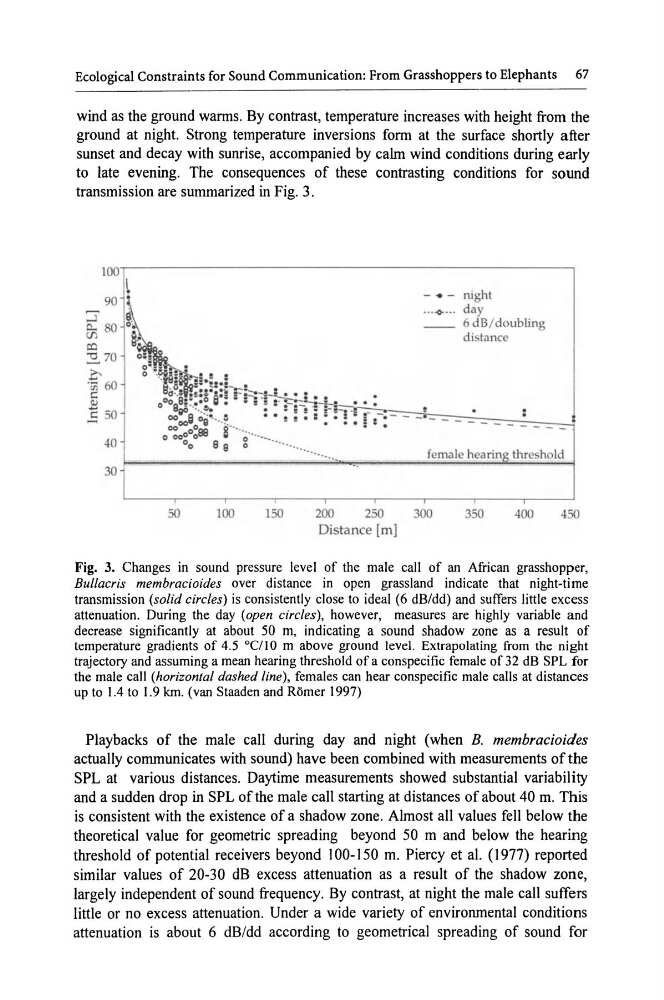
transmission are summarized in Fig. 3.
30
50
100
150
- .. - night
···.O.··· day
6 dB/ doubling
distance
fe!Tiale hearing threshold
200
250
300
350
400
4.50
Distance [m]
Fig. 3. Changes in sound pressure level of the male call of an African grasshopper,
Bullacris membracioides over distance in open grassland indicate that night-time
transmission (solid circles) is consistently close to ideal (6 dB/dd) and suffers little excess
attenuation. During the day (open circles), however, measures are highly variable and
decrease significantly at about 50 m, indicating a sound shadow zone as a result of
temperature gradients of 4.5 °C/IO m above ground level. Extrapolating from the night
trajectory and assuming a mean hearing threshold of a conspecific female of 32 dB SPL for
the male call (horizontal dashed line), females can hear conspecific male calls at distances
up to 1.4 to I. 9 km. (van Staaden and Romer I 997)
Playbacks of the male call during day and night (when B. membracioides
actually communicates with sound) have been combined with measurements of the
SPL at various distances. Daytime measurements showed substantial variability
and a sudden drop in SPL of the male call starting at distances of about 40 m. This
is consistent with the existence of a shadow zone. Almost all values fell below the
theoretical value for geometric spreading beyond 50 m and below the hearing
threshold of potential receivers beyond I 00-150 m. Piercy et a!. (1977) reported
similar values of 20-30 dB excess attenuation as a result of the shadow zone,
largely independent of sound frequency. By contrast, at night the male call suffers
little or no excess attenuation. Under a wide variety of environmental conditions
attenuation is about 6 dB/dd according to geometrical spreading of sound for
wind as the ground warms. By contrast, temperature increases with height from the
ground at night. Strong temperature inversions form at the surface shortly after
sunset and decay with sunrise, accompanied by calm wind conditions during early
to late evening. The consequences of these contrasting conditions for sound
transmission are summarized in Fig. 3.
30
50
100
150
- .. - night
···.O.··· day
6 dB/ doubling
distance
fe!Tiale hearing threshold
200
250
300
350
400
4.50
Distance [m]
Fig. 3. Changes in sound pressure level of the male call of an African grasshopper,
Bullacris membracioides over distance in open grassland indicate that night-time
transmission (solid circles) is consistently close to ideal (6 dB/dd) and suffers little excess
attenuation. During the day (open circles), however, measures are highly variable and
decrease significantly at about 50 m, indicating a sound shadow zone as a result of
temperature gradients of 4.5 °C/IO m above ground level. Extrapolating from the night
trajectory and assuming a mean hearing threshold of a conspecific female of 32 dB SPL for
the male call (horizontal dashed line), females can hear conspecific male calls at distances
up to 1.4 to I. 9 km. (van Staaden and Romer I 997)
Playbacks of the male call during day and night (when B. membracioides
actually communicates with sound) have been combined with measurements of the
SPL at various distances. Daytime measurements showed substantial variability
and a sudden drop in SPL of the male call starting at distances of about 40 m. This
is consistent with the existence of a shadow zone. Almost all values fell below the
theoretical value for geometric spreading beyond 50 m and below the hearing
threshold of potential receivers beyond I 00-150 m. Piercy et a!. (1977) reported
similar values of 20-30 dB excess attenuation as a result of the shadow zone,
largely independent of sound frequency. By contrast, at night the male call suffers
little or no excess attenuation. Under a wide variety of environmental conditions
attenuation is about 6 dB/dd according to geometrical spreading of sound for