

66
Heiner Romer
loud calling song with a carrier frequency of about 1.7 kHz and a SPL of98 dB at
a distance of I m.
.:c 800
00
. Qi 600
=E::A~
::r: 00
.,
17.00
4
- ~ I
200
20.00 ~
22
24
26
28
30
32 34
10 20 30 40 50 60
Range (m]
Temperature [ 0 C)
350 r - - - - - - - - - - - - - - ,
300 c
1250
::::.200
m 1so
...
<100
50
12.00
...
~,
.. '
... :··. .... ..
18.00
00.00
6.00
Time of day
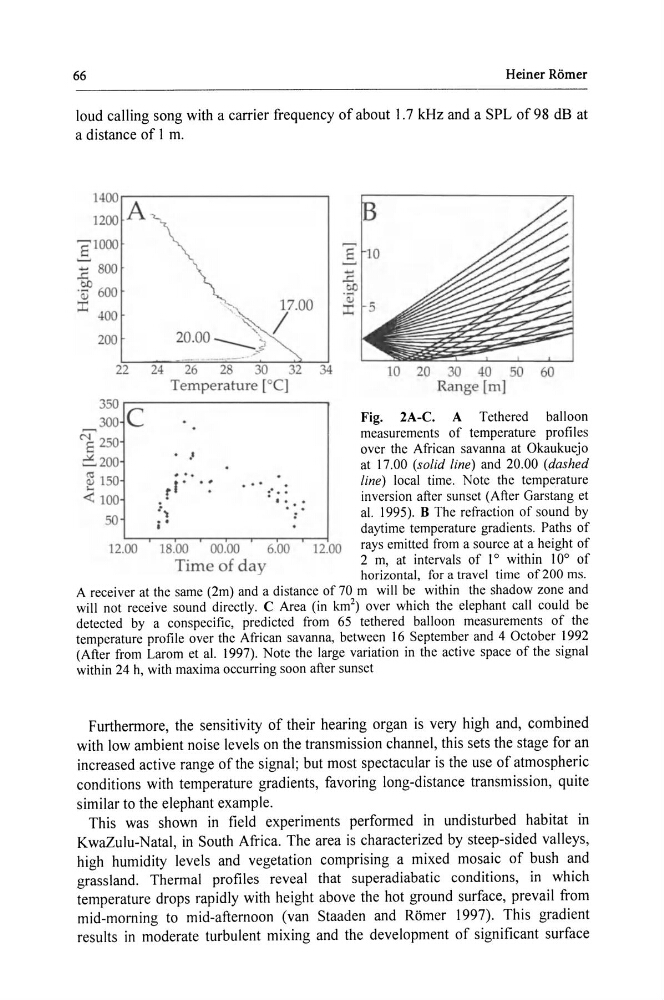
Fig. 2A-C. A Tethered balloon
measurements of temperature profiles
over the African savanna at Okaukuejo
at 17.00 (solid line) and 20.00 (dashed
line) local time. Note the temperature
inversion after sunset (After Garstang et
al. 1995). B The refraction of sound by
daytime temperature gradients. Paths of
12.00
rays emitted from a source at a height of
2 m, at intervals of I o within I 0° of
horizontal, for a travel time of200 ms.
A receiver at the same (2m) and a distance of 70 m will be within the shadow zone and
will not receive sound directly. C Area (in km 2 ) over which the elephant call could be
detected by a conspecific, predicted from 65 tethered balloon measurements of the
temperature profile over the African savanna, between 16 September and 4 October 1992
(After from Larom et al. 1997). Note the large variation in the active space of the signal
within 24 h, with maxima occurring soon after sunset
Furthermore, the sensitivity of their hearing organ is very high and, combined
with low ambient noise levels on the transmission channel, this sets the stage for an
increased active range of the signal; but most spectacular is the use of atmospheric
conditions with temperature gradients, favoring long-distance transmission, quite
similar to the elephant example.
This was shown in field experiments performed in undisturbed habitat in
KwaZulu-Natal, in South Africa. The area is characterized by steep-sided valleys,
high humidity levels and vegetation comprising a mixed mosaic of bush and
grassland. Thermal profiles reveal that superadiabatic conditions, in which
temperature drops rapidly with height above the hot ground surface, prevail from
mid-morning to mid-afternoon (van Staaden and Romer 1997). This gradient
results in moderate turbulent mixing and the development of significant surface
Heiner Romer
loud calling song with a carrier frequency of about 1.7 kHz and a SPL of98 dB at
a distance of I m.
.:c 800
00
. Qi 600
=E::A~
::r: 00
.,
17.00
4
- ~ I
200
20.00 ~
22
24
26
28
30
32 34
10 20 30 40 50 60
Range (m]
Temperature [ 0 C)
350 r - - - - - - - - - - - - - - ,
300 c
1250
::::.200
m 1so
...
<100
50
12.00
...
~,
.. '
... :··. .... ..
18.00
00.00
6.00
Time of day
Fig. 2A-C. A Tethered balloon
measurements of temperature profiles
over the African savanna at Okaukuejo
at 17.00 (solid line) and 20.00 (dashed
line) local time. Note the temperature
inversion after sunset (After Garstang et
al. 1995). B The refraction of sound by
daytime temperature gradients. Paths of
12.00
rays emitted from a source at a height of
2 m, at intervals of I o within I 0° of
horizontal, for a travel time of200 ms.
A receiver at the same (2m) and a distance of 70 m will be within the shadow zone and
will not receive sound directly. C Area (in km 2 ) over which the elephant call could be
detected by a conspecific, predicted from 65 tethered balloon measurements of the
temperature profile over the African savanna, between 16 September and 4 October 1992
(After from Larom et al. 1997). Note the large variation in the active space of the signal
within 24 h, with maxima occurring soon after sunset
Furthermore, the sensitivity of their hearing organ is very high and, combined
with low ambient noise levels on the transmission channel, this sets the stage for an
increased active range of the signal; but most spectacular is the use of atmospheric
conditions with temperature gradients, favoring long-distance transmission, quite
similar to the elephant example.
This was shown in field experiments performed in undisturbed habitat in
KwaZulu-Natal, in South Africa. The area is characterized by steep-sided valleys,
high humidity levels and vegetation comprising a mixed mosaic of bush and
grassland. Thermal profiles reveal that superadiabatic conditions, in which
temperature drops rapidly with height above the hot ground surface, prevail from
mid-morning to mid-afternoon (van Staaden and Romer 1997). This gradient
results in moderate turbulent mixing and the development of significant surface