

Impedance Matching in Sound Production and Hearing: a Comparative Study
41
2.2 Transfer of Sound Power Between Different Media
The maximum power transfer theorem (Langford-Smith 1953) states that, for
optimal source-to-load coupling, the source and load resistances should be equal,
or, extended to oscillatory systems, if the source also has a reactive component
such as a mass, there should be a matching spring component in the load and vice
versa. Thus, for maximal power transfer, the source and load impedances should
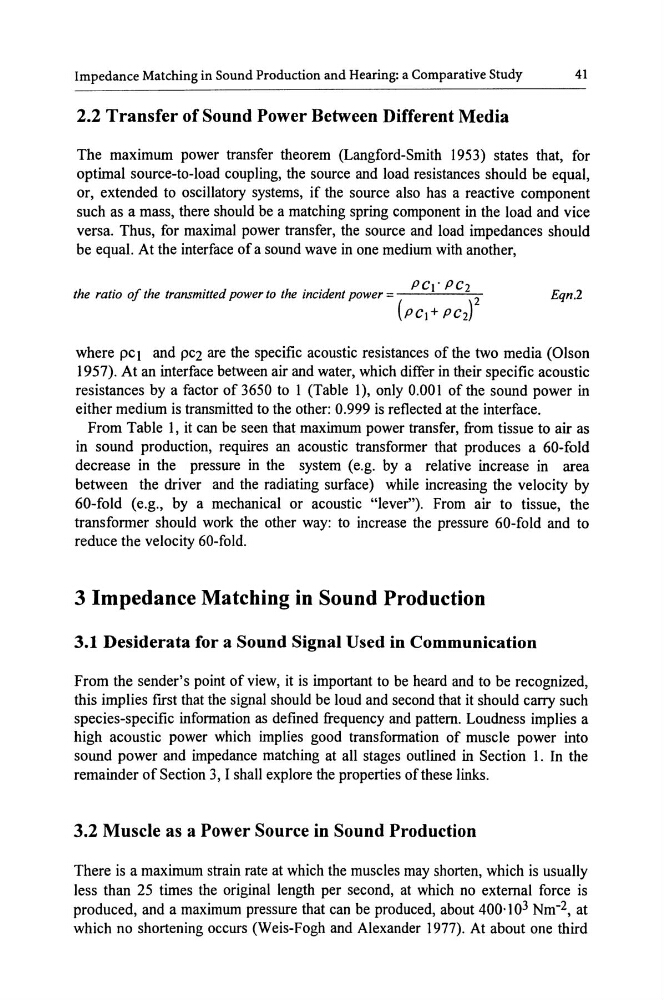
be equal. At the interface of a sound wave in one medium with another,
.
.
. .
Pc1·Pc2
the rat1o of the transmitted power to the mctdent power =
2
(Pci+ Pc2)
Eqn.2
where pq and pc2 are the specific acoustic resistances of the two media (Olson
1957). At an interface between air and water, which differ in their specific acoustic
resistances by a factor of 3650 to 1 (Table 1), only 0.001 of the sound power in
either medium is transmitted to the other: 0.999 is reflected at the interface.
From Table I, it can be seen that maximum power transfer, from tissue to air as
in sound production, requires an acoustic transformer that produces a 60-fold
decrease in the pressure in the system (e.g. by a relative increase in area
between the driver and the radiating surface) while increasing the velocity by
60-fold (e.g., by a mechanical or acoustic "lever"). From air to tissue, the
transformer should work the other way: to increase the pressure 60-fold and to
reduce the velocity 60-fold.
3 Impedance Matching in Sound Production
3.1 Desiderata for a Sound Signal Used in Communication
From the sender's point of view, it is important to be heard and to be recognized,
this implies first that the signal should be loud and second that it should carry such
species-specific information as defined frequency and pattern. Loudness implies a
high acoustic power which implies good transformation of muscle power into
sound power and impedance matching at all stages outlined in Section 1. In the
remainder of Section 3, I shall explore the properties of these links.
3.2 Muscle as a Power Source in Sound Production
There is a maximum strain rate at which the muscles may shorten, which is usually
less than 25 times the original length per second, at which no external force is
produced, and a maximum pressure that can be produced, about 400·1 o3 Nm-2, at
which no shortening occurs (Weis-Fogh and Alexander 1977). At about one third
41
2.2 Transfer of Sound Power Between Different Media
The maximum power transfer theorem (Langford-Smith 1953) states that, for
optimal source-to-load coupling, the source and load resistances should be equal,
or, extended to oscillatory systems, if the source also has a reactive component
such as a mass, there should be a matching spring component in the load and vice
versa. Thus, for maximal power transfer, the source and load impedances should
be equal. At the interface of a sound wave in one medium with another,
.
.
. .
Pc1·Pc2
the rat1o of the transmitted power to the mctdent power =
2
(Pci+ Pc2)
Eqn.2
where pq and pc2 are the specific acoustic resistances of the two media (Olson
1957). At an interface between air and water, which differ in their specific acoustic
resistances by a factor of 3650 to 1 (Table 1), only 0.001 of the sound power in
either medium is transmitted to the other: 0.999 is reflected at the interface.
From Table I, it can be seen that maximum power transfer, from tissue to air as
in sound production, requires an acoustic transformer that produces a 60-fold
decrease in the pressure in the system (e.g. by a relative increase in area
between the driver and the radiating surface) while increasing the velocity by
60-fold (e.g., by a mechanical or acoustic "lever"). From air to tissue, the
transformer should work the other way: to increase the pressure 60-fold and to
reduce the velocity 60-fold.
3 Impedance Matching in Sound Production
3.1 Desiderata for a Sound Signal Used in Communication
From the sender's point of view, it is important to be heard and to be recognized,
this implies first that the signal should be loud and second that it should carry such
species-specific information as defined frequency and pattern. Loudness implies a
high acoustic power which implies good transformation of muscle power into
sound power and impedance matching at all stages outlined in Section 1. In the
remainder of Section 3, I shall explore the properties of these links.
3.2 Muscle as a Power Source in Sound Production
There is a maximum strain rate at which the muscles may shorten, which is usually
less than 25 times the original length per second, at which no external force is
produced, and a maximum pressure that can be produced, about 400·1 o3 Nm-2, at
which no shortening occurs (Weis-Fogh and Alexander 1977). At about one third