

40
Henry C. Bennet-Clark
vibration; (3) the radiation of sound. In sound reception the stages are: (1) sound
power is collected; (2) it is converted into mechanical vibration; (3) the vibration
stimulates the sensory cells. For all these stages, efficiency is desirable. I shall
endeavour to show that in both sound production and hearing, efficiency depends
on impedance matching between the animal and the medium in which the
communication takes place.
2 Physics of Transfer of Sound Between Different
Media
2.1 Sound Waves and Sound Intensity
Sound is propagated as a wave of compression and rarefaction of the fluid medium
which travels outwards from the source at the speed of sound. Because sound
depends on the compressibility of the medium, a sound wave has two components:
the sound pressure that causes the compression, and the effective velocity of the
particles of the medium under compression. In the transfer of power between two
media, such as air and water, it is necessary to consider the different acoustic
properties of the media. In a sound wave, the sound intensity is expressed, by
reference to the pressure (force/area) and fluid particle velocity, as power per unit
area: values for sound intensity are usually given in decibels (dB) relative to
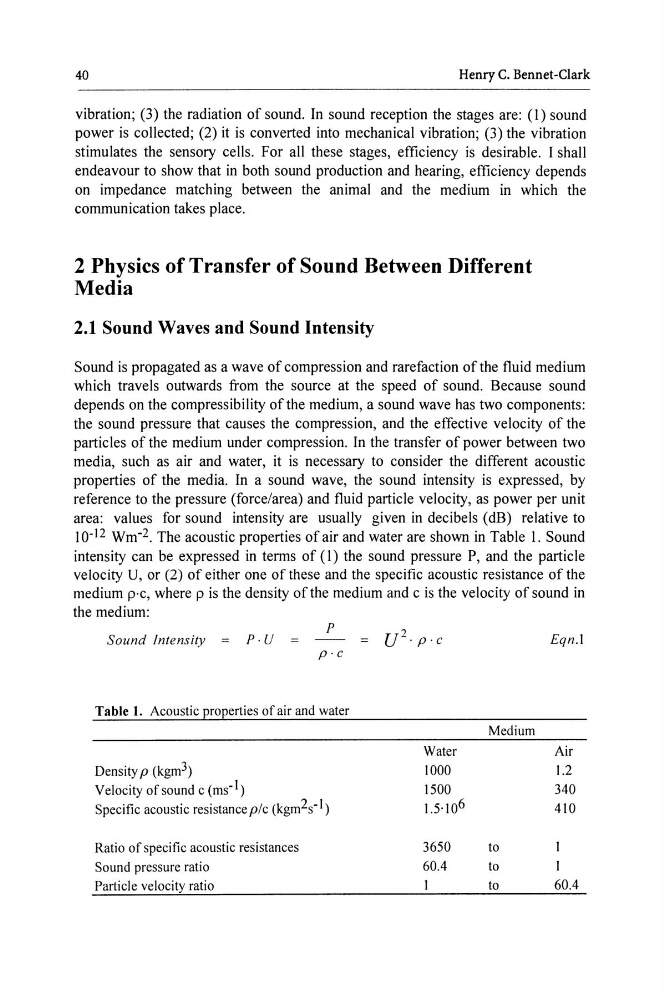
J0-12 wm-2. The acoustic properties of air and water are shown in Table 1. Sound
intensity can be expressed in terms of (I) the sound pressure P, and the particle
velocity U, or (2) of either one of these and the specific acoustic resistance of the
medium p·c, where p is the density of the medium and c is the velocity of sound in
the medium:
p
Sound Intensity = P · U
p·c
Table 1. Acoustic properties of air and water
Density p (kgm 3 )
Velocity of sound c (ms-1)
Specific acoustic resistance pic (kgm2s-1)
Ratio of specific acoustic resistances
Sound pressure ratio
Particle velocity ratio
?
u-. p·c
Eqn.l
Medium
Water
Air
1000
1.2
1500
340
1.5·106
410
3650
to
60.4
I
to
to
1
60.4
Henry C. Bennet-Clark
vibration; (3) the radiation of sound. In sound reception the stages are: (1) sound
power is collected; (2) it is converted into mechanical vibration; (3) the vibration
stimulates the sensory cells. For all these stages, efficiency is desirable. I shall
endeavour to show that in both sound production and hearing, efficiency depends
on impedance matching between the animal and the medium in which the
communication takes place.
2 Physics of Transfer of Sound Between Different
Media
2.1 Sound Waves and Sound Intensity
Sound is propagated as a wave of compression and rarefaction of the fluid medium
which travels outwards from the source at the speed of sound. Because sound
depends on the compressibility of the medium, a sound wave has two components:
the sound pressure that causes the compression, and the effective velocity of the
particles of the medium under compression. In the transfer of power between two
media, such as air and water, it is necessary to consider the different acoustic
properties of the media. In a sound wave, the sound intensity is expressed, by
reference to the pressure (force/area) and fluid particle velocity, as power per unit
area: values for sound intensity are usually given in decibels (dB) relative to
J0-12 wm-2. The acoustic properties of air and water are shown in Table 1. Sound
intensity can be expressed in terms of (I) the sound pressure P, and the particle
velocity U, or (2) of either one of these and the specific acoustic resistance of the
medium p·c, where p is the density of the medium and c is the velocity of sound in
the medium:
p
Sound Intensity = P · U
p·c
Table 1. Acoustic properties of air and water
Density p (kgm 3 )
Velocity of sound c (ms-1)
Specific acoustic resistance pic (kgm2s-1)
Ratio of specific acoustic resistances
Sound pressure ratio
Particle velocity ratio
?
u-. p·c
Eqn.l
Medium
Water
Air
1000
1.2
1500
340
1.5·106
410
3650
to
60.4
I
to
to
1
60.4