

Electric Fields and Electroreception
323
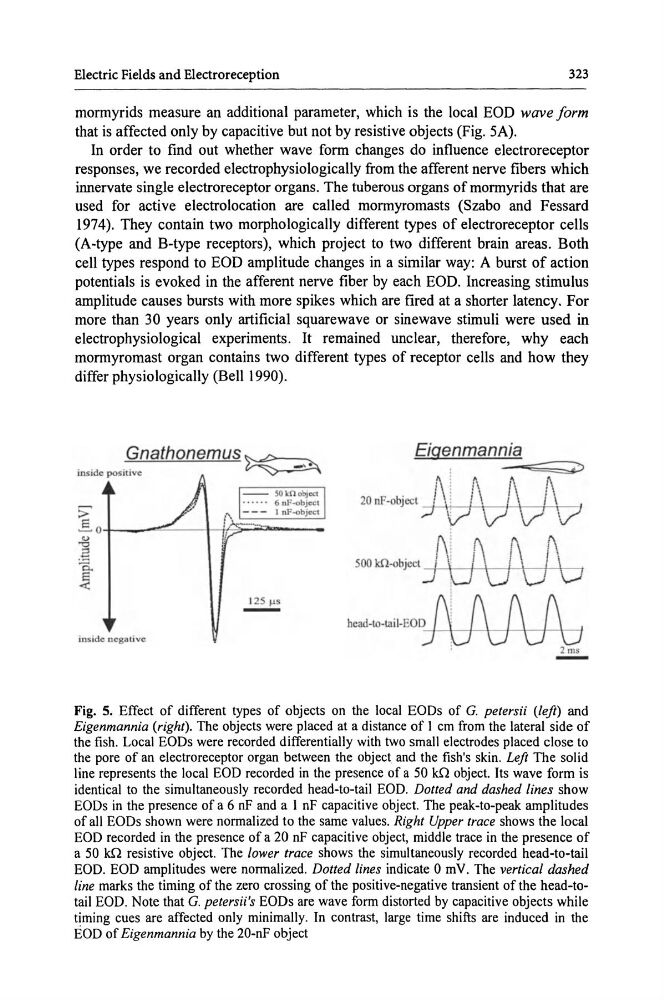
mormyrids measure an additional parameter, which is the local EOD wave form
that is affected only by capacitive but not by resistive objects (Fig. 5A).
In order to find out whether wave form changes do influence electroreceptor
responses, we recorded electrophysiologically from the afferent nerve fibers which
innervate single electroreceptor organs. The tuberous organs of mormyrids that are
used for active electrolocation are called mormyromasts (Szabo and Fessard
1974). They contain two morphologically different types of electroreceptor cells
(A-type and B-type receptors), which project to two different brain areas. Both
cell types respond to EOD amplitude changes in a similar way: A burst of action
potentials is evoked in the afferent nerve fiber by each EOD. Increasing stimulus
amplitude causes bursts with more spikes which are fired at a shorter latency. For
more than 30 years only artificial squarewave or sinewave stimuli were used in
electrophysiological experiments. It remained unclear, therefore, why each
mormyromast organ contains two different types of receptor cells and how they
differ physiologically (Bell 1990).
Gnathonemus~
-·
inside positive
125 J.lS
-
ins ide negative
Fig. 5. Effect of different types of objects on the local EODs of G. petersii (left) and
Eigenmannia (right). The objects were placed at a distance of I em from the lateral side of
the fish. Local EODs were recorded differentially with two small electrodes placed close to
the pore of an electroreceptor organ between the object and the fish's skin. Left The solid
line represents the local EOD recorded in the presence of a 50 kQ object. Its wave form is
identical to the simultaneously recorded head-to-tail EOD. Dotted and dashed lines show
EODs in the presence of a 6 nF and a I nF capacitive object. The peak-to-peak amplitudes
of all EODs shown were normalized to the same values. Right Upper trace shows the local
EOD recorded in the presence of a 20 nF capacitive object, middle trace in the presence of
a 50 kQ resistive object. The lower trace shows the simultaneously recorded head-to-tail
EOD. EOD amplitudes were normalized. Dotted lines indicate 0 mV. The vertical dashed
line marks the timing of the zero crossing of the positive-negative transient of the head-totail EOD. Note that G. p etersii's EODs are wave form distorted by capacitive objects while
timing cues are affected only minimally. In contrast, large time shifts are induced in the
EOD of Eigenmannia by the 20-nF object
323
mormyrids measure an additional parameter, which is the local EOD wave form
that is affected only by capacitive but not by resistive objects (Fig. 5A).
In order to find out whether wave form changes do influence electroreceptor
responses, we recorded electrophysiologically from the afferent nerve fibers which
innervate single electroreceptor organs. The tuberous organs of mormyrids that are
used for active electrolocation are called mormyromasts (Szabo and Fessard
1974). They contain two morphologically different types of electroreceptor cells
(A-type and B-type receptors), which project to two different brain areas. Both
cell types respond to EOD amplitude changes in a similar way: A burst of action
potentials is evoked in the afferent nerve fiber by each EOD. Increasing stimulus
amplitude causes bursts with more spikes which are fired at a shorter latency. For
more than 30 years only artificial squarewave or sinewave stimuli were used in
electrophysiological experiments. It remained unclear, therefore, why each
mormyromast organ contains two different types of receptor cells and how they
differ physiologically (Bell 1990).
Gnathonemus~
-·
inside positive
125 J.lS
-
ins ide negative
Fig. 5. Effect of different types of objects on the local EODs of G. petersii (left) and
Eigenmannia (right). The objects were placed at a distance of I em from the lateral side of
the fish. Local EODs were recorded differentially with two small electrodes placed close to
the pore of an electroreceptor organ between the object and the fish's skin. Left The solid
line represents the local EOD recorded in the presence of a 50 kQ object. Its wave form is
identical to the simultaneously recorded head-to-tail EOD. Dotted and dashed lines show
EODs in the presence of a 6 nF and a I nF capacitive object. The peak-to-peak amplitudes
of all EODs shown were normalized to the same values. Right Upper trace shows the local
EOD recorded in the presence of a 20 nF capacitive object, middle trace in the presence of
a 50 kQ resistive object. The lower trace shows the simultaneously recorded head-to-tail
EOD. EOD amplitudes were normalized. Dotted lines indicate 0 mV. The vertical dashed
line marks the timing of the zero crossing of the positive-negative transient of the head-totail EOD. Note that G. p etersii's EODs are wave form distorted by capacitive objects while
timing cues are affected only minimally. In contrast, large time shifts are induced in the
EOD of Eigenmannia by the 20-nF object