

Electric Fields and Electroreception
319
voltage drop across the fish's skin that excites the tuberous electroreceptor organs,
which are distributed over almost the entire body surface of the fish. Each
discharge of the electric organ thus causes a locally occurring electric signal at
each electroreceptor organ which serves as stimulus for the electroreceptors. The
afferent nerve fibers innervating the receptor cells report the amplitude or the
timing of the local signal to the brain. If an object with electrical properties
different from those of the water comes close to a fish, it will distort the electrical
field lines (Fig. 2). As a result, the voltage pattern at skin regions opposite the
object will change and the affected electroreceptors will experience an altered
local signal. The area on the skin surface thus affected by an object is called its
electric image (Rasnow 1996; Caputi et al. 1998; von der Emde et a!. 1998).
B
A
smal l object
smal l distance
small object
large distance
-~-~-c
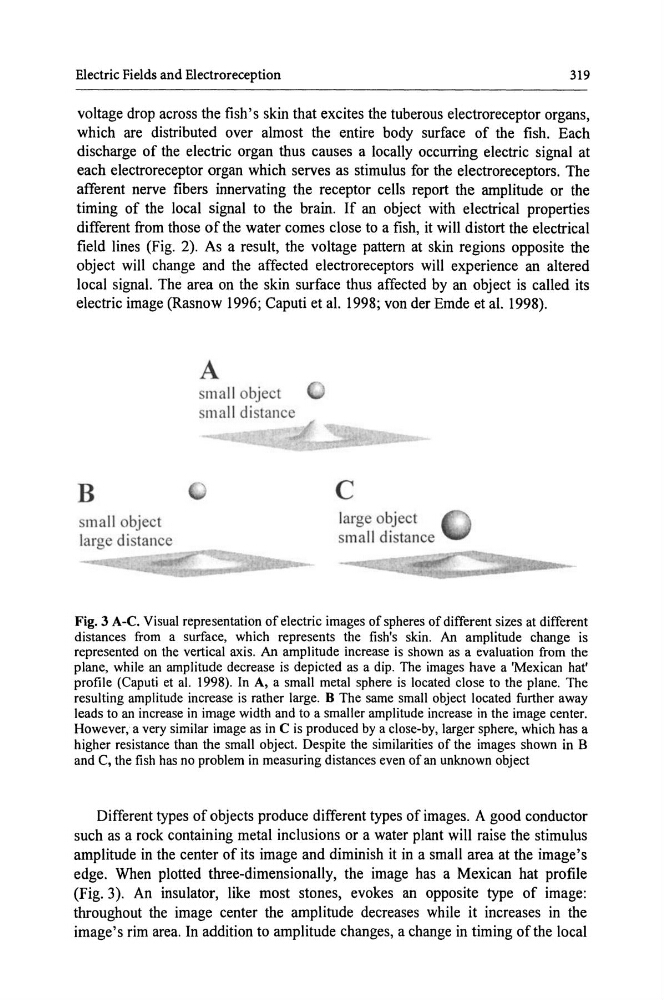
Fig. 3 A-C. Visual representation of electric images of spheres of different sizes at different
distances from a surface, which represents the fish's skin. An amplitude change is
represented on the vertical axis. An amplitude increase is shown as a evaluation from the
plane, while an amplitude decrease is depicted as a dip. The images have a 'Mexican hat'
profile (Caputi et al. 1998). In A, a small metal sphere is located close to the plane. The
resulting amplitude increase is rather large. 8 The same small object located further away
leads to an increase in image width and to a smaller amplitude increase in the image center.
However, a very similar image as in C is produced by a close-by, larger sphere, which has a
higher resistance than the small object. Despite the similarities of the images shown in B
and C, the fish has no problem in measuring distances even of an unknown object
Different types of objects produce different types of images. A good conductor
such as a rock containing metal inclusions or a water plant will raise the stimulus
amplitude in the center of its image and diminish it in a small area at the image' s
edge. When plotted three-dimensionally, the image has a Mexican hat profile
(Fig. 3). An insulator, like most stones, evokes an opposite type of image:
throughout the image center the amplitude decreases while it increases in the
image's rim area. In addition to amplitude changes, a change in timing ofthe local
319
voltage drop across the fish's skin that excites the tuberous electroreceptor organs,
which are distributed over almost the entire body surface of the fish. Each
discharge of the electric organ thus causes a locally occurring electric signal at
each electroreceptor organ which serves as stimulus for the electroreceptors. The
afferent nerve fibers innervating the receptor cells report the amplitude or the
timing of the local signal to the brain. If an object with electrical properties
different from those of the water comes close to a fish, it will distort the electrical
field lines (Fig. 2). As a result, the voltage pattern at skin regions opposite the
object will change and the affected electroreceptors will experience an altered
local signal. The area on the skin surface thus affected by an object is called its
electric image (Rasnow 1996; Caputi et al. 1998; von der Emde et a!. 1998).
B
A
smal l object
smal l distance
small object
large distance
-~-~-c
Fig. 3 A-C. Visual representation of electric images of spheres of different sizes at different
distances from a surface, which represents the fish's skin. An amplitude change is
represented on the vertical axis. An amplitude increase is shown as a evaluation from the
plane, while an amplitude decrease is depicted as a dip. The images have a 'Mexican hat'
profile (Caputi et al. 1998). In A, a small metal sphere is located close to the plane. The
resulting amplitude increase is rather large. 8 The same small object located further away
leads to an increase in image width and to a smaller amplitude increase in the image center.
However, a very similar image as in C is produced by a close-by, larger sphere, which has a
higher resistance than the small object. Despite the similarities of the images shown in B
and C, the fish has no problem in measuring distances even of an unknown object
Different types of objects produce different types of images. A good conductor
such as a rock containing metal inclusions or a water plant will raise the stimulus
amplitude in the center of its image and diminish it in a small area at the image' s
edge. When plotted three-dimensionally, the image has a Mexican hat profile
(Fig. 3). An insulator, like most stones, evokes an opposite type of image:
throughout the image center the amplitude decreases while it increases in the
image's rim area. In addition to amplitude changes, a change in timing ofthe local