

318
Gerhard von der Emde
dominate the large rivers while pulse fish are mainly found in smaller rivers. One
of the reasons why pulse fish are rarely found in the large rivers may be the
presence of catfishes, which detect the low frequencies present in the spectra of
pulse-type EODs but not in those of wavetype signals (Mary Hagedorn, Kip
Keller, pers. comm.).
2.2 Active Electrolocation: Sensing of Self-Produced Electrical
Fields
The process of actively probing the environment by emitting an electrical signal
and perceiving it with one's own tuberous electroreceptors was called active
electrolocation by Lissmann and Machin (1958). The evolution of this ability
constituted a qualitative step forward from the use of passive electrolocation.
Passive electrolocation depends on existing electrical fields. In contrast, during
active electrolocation, the fish provides its own source of electricity, using it to
actively probe the environment and to detect and analyze objects even if these do
not emit electrical energy.
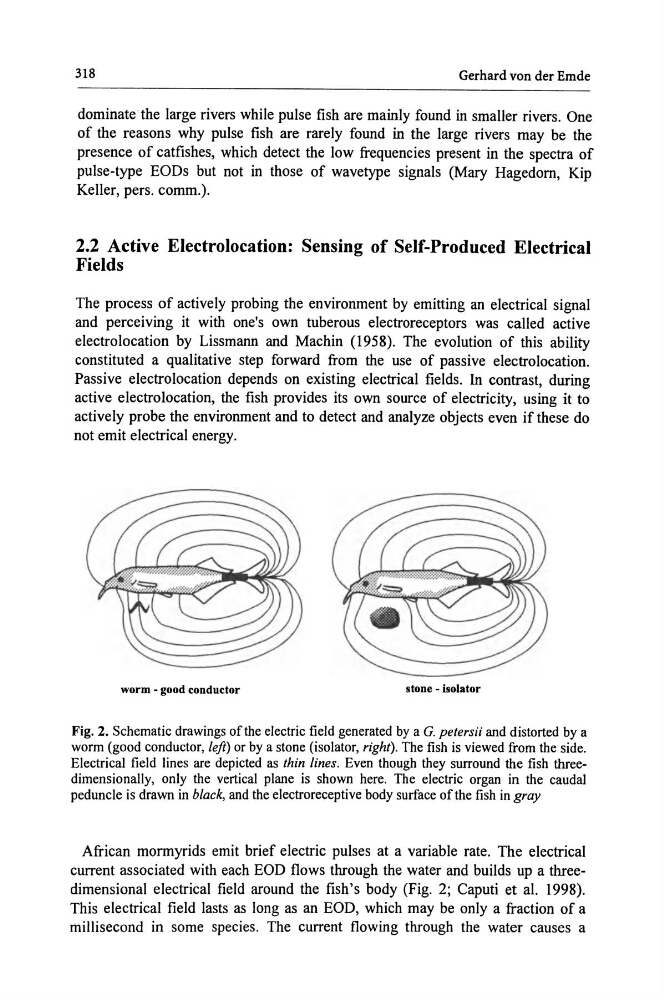
worm - good conductor
stone - isolator
Fig. 2. Schematic drawings of the electric field generated by a G. petersii and distorted by a
worm (good conductor, left) or by a stone (isolator, right). The fish is viewed from the side.
Electrical field lines are depicted as thin lines. Even though they surround the fish threedimensionally, only the vertical plane is shown here. The electric organ in the caudal
peduncle is drawn in black, and the electroreceptive body surface of the fish in gray
African mormyrids emit brief electric pulses at a variable rate. The electrical
current associated with each EOD flows through the water and builds up a threedimensional electrical field around the fish's body (Fig. 2; Caputi et al. 1998).
This electrical field lasts as long as an EOD, which may be only a fraction of a
millisecond in some species. The current flowing through the water causes a
Gerhard von der Emde
dominate the large rivers while pulse fish are mainly found in smaller rivers. One
of the reasons why pulse fish are rarely found in the large rivers may be the
presence of catfishes, which detect the low frequencies present in the spectra of
pulse-type EODs but not in those of wavetype signals (Mary Hagedorn, Kip
Keller, pers. comm.).
2.2 Active Electrolocation: Sensing of Self-Produced Electrical
Fields
The process of actively probing the environment by emitting an electrical signal
and perceiving it with one's own tuberous electroreceptors was called active
electrolocation by Lissmann and Machin (1958). The evolution of this ability
constituted a qualitative step forward from the use of passive electrolocation.
Passive electrolocation depends on existing electrical fields. In contrast, during
active electrolocation, the fish provides its own source of electricity, using it to
actively probe the environment and to detect and analyze objects even if these do
not emit electrical energy.
worm - good conductor
stone - isolator
Fig. 2. Schematic drawings of the electric field generated by a G. petersii and distorted by a
worm (good conductor, left) or by a stone (isolator, right). The fish is viewed from the side.
Electrical field lines are depicted as thin lines. Even though they surround the fish threedimensionally, only the vertical plane is shown here. The electric organ in the caudal
peduncle is drawn in black, and the electroreceptive body surface of the fish in gray
African mormyrids emit brief electric pulses at a variable rate. The electrical
current associated with each EOD flows through the water and builds up a threedimensional electrical field around the fish's body (Fig. 2; Caputi et al. 1998).
This electrical field lasts as long as an EOD, which may be only a fraction of a
millisecond in some species. The current flowing through the water causes a