

The Geomagnetic Field and its Role in Directional Orientation
305
4.2.1 Innate Courses of Migration
Where a stable geographic relationship exists between the starting area and a
distant goal, animals may rely on innate infonnation on the compass course to be
pursued. For young, naive animals, this is the only possible way to reach distant
goals where they have never been before. The magnetic field serves as reference
for the innate infonnation.
N
N
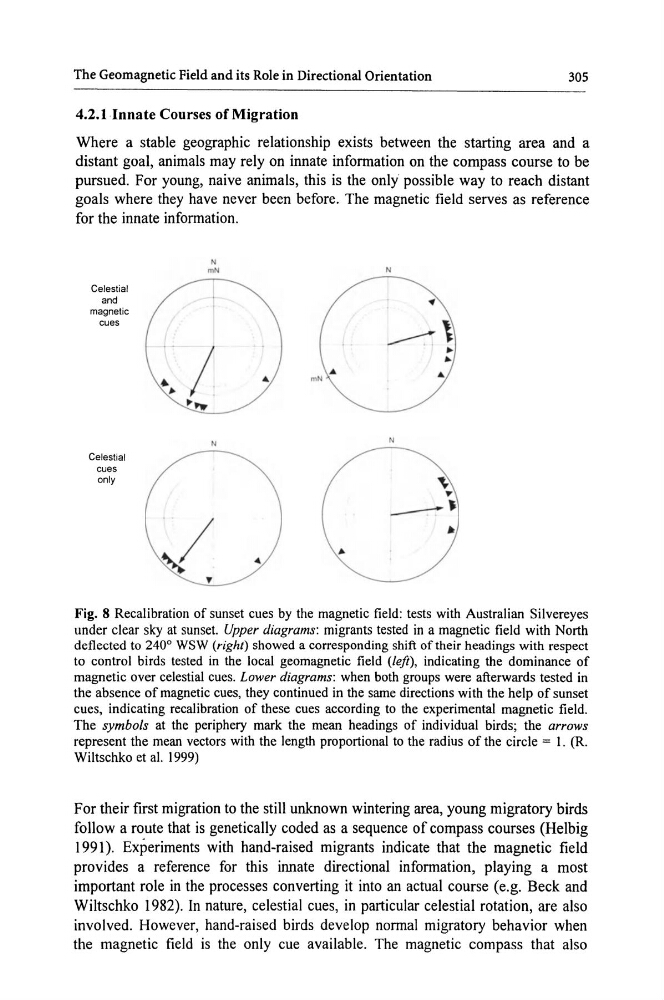
Fig. 8 Recalibration of sunset cues by the magnetic field : tests with Australian Silvereyes
under clear sky at sunset. Upper diagrams: migrants tested in a magnetic field with North
deflected to 240° WSW (rig ht) showed a corresponding shift of their headings with respect
to control birds tested in the local geomagnetic field (left), indicating the dominance of
magnetic over celestial cues. Lower diagrams: when both groups were afterwards tested in
the absence of magnetic cues, they continued in the same directions with the help of sunset
cues, indicating recalibration of these cues according to the experimental magnetic field.
The symbols at the periphery mark the mean headings of individual birds; the arrows
represent the mean vectors with the length proportional to the radius of the circle = I. (R.
Wiltschko et al. 1999)
For their first migration to the still unknown wintering area, young migratory birds
follow a route that is genetically coded as a sequence of compass courses (Helbig
1991 ). Experiments with hand-raised migrants indicate that the magnetic field
provides a reference for this innate directional infonnation, playing a most
important role in the processes converting it into an actual course (e.g. Beck and
Wiltschko 1982). In nature, celestial cues, in particular celestial rotation, are also
involved. However, hand-raised birds develop normal migratory behavior when
the magnetic field is the only cue available. The magnetic compass that also
305
4.2.1 Innate Courses of Migration
Where a stable geographic relationship exists between the starting area and a
distant goal, animals may rely on innate infonnation on the compass course to be
pursued. For young, naive animals, this is the only possible way to reach distant
goals where they have never been before. The magnetic field serves as reference
for the innate infonnation.
N
N
Fig. 8 Recalibration of sunset cues by the magnetic field : tests with Australian Silvereyes
under clear sky at sunset. Upper diagrams: migrants tested in a magnetic field with North
deflected to 240° WSW (rig ht) showed a corresponding shift of their headings with respect
to control birds tested in the local geomagnetic field (left), indicating the dominance of
magnetic over celestial cues. Lower diagrams: when both groups were afterwards tested in
the absence of magnetic cues, they continued in the same directions with the help of sunset
cues, indicating recalibration of these cues according to the experimental magnetic field.
The symbols at the periphery mark the mean headings of individual birds; the arrows
represent the mean vectors with the length proportional to the radius of the circle = I. (R.
Wiltschko et al. 1999)
For their first migration to the still unknown wintering area, young migratory birds
follow a route that is genetically coded as a sequence of compass courses (Helbig
1991 ). Experiments with hand-raised migrants indicate that the magnetic field
provides a reference for this innate directional infonnation, playing a most
important role in the processes converting it into an actual course (e.g. Beck and
Wiltschko 1982). In nature, celestial cues, in particular celestial rotation, are also
involved. However, hand-raised birds develop normal migratory behavior when
the magnetic field is the only cue available. The magnetic compass that also