

304
Wolfgang Wiltschko and Roswitha Wiltschko
N
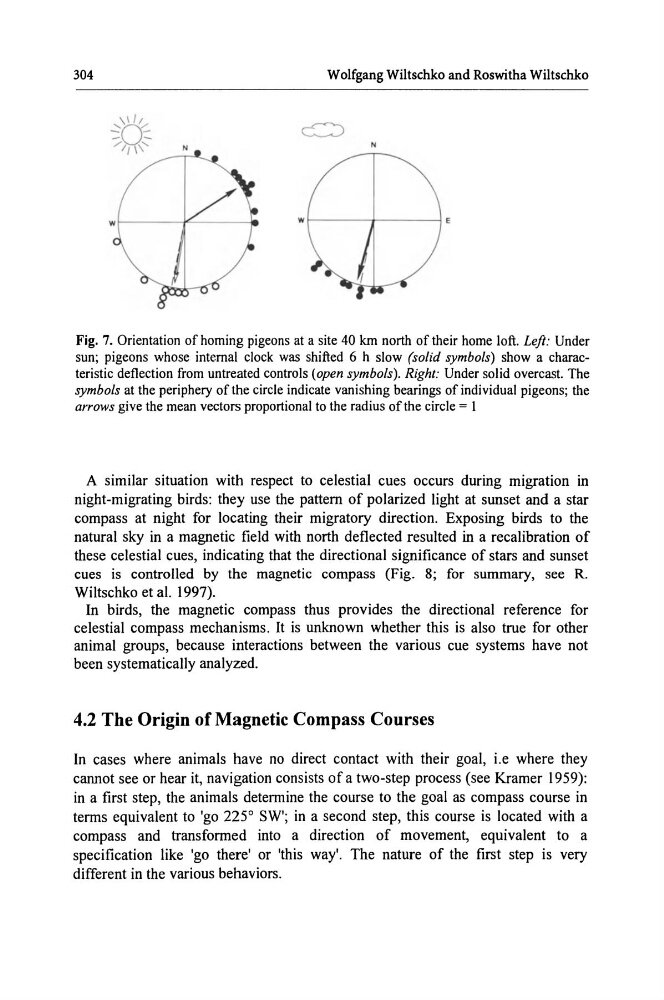
Fig. 7. Orientation of homing pigeons at a site 40 km north of their home loft. Left: Under
sun; pigeons whose internal clock was shifted 6 h slow (solid symbols) show a characteristic deflection from untreated controls (open symbols). Right: Under solid overcast. The
symbols at the periphery of the circle indicate vanishing bearings of individual pigeons; the
arrows give the mean vectors proportional to the radius ofthe circle= l
A similar situation with respect to celestial cues occurs during migration in
night-migrating birds: they use the pattern of polarized light at sunset and a star
compass at night for locating their migratory direction. Exposing birds to the
natural sky in a magnetic field with north deflected resulted in a recalibration of
these celestial cues, indicating that the directional significance of stars and sunset
cues is controlled by the magnetic compass (Fig. 8; for summary, see R.
Wiltschko et al. 1997).
In birds, the magnetic compass thus provides the directional reference for
celestial compass mechanisms. It is unknown whether this is also true for other
animal groups, because interactions between the various cue systems have not
been systematically analyzed.
4.2 The Origin of Magnetic Compass Courses
In cases where animals have no direct contact with their goal, i.e where they
cannot see or hear it, navigation consists of a two-step process (see Kramer 1959):
in a first step, the animals determine the course to the goal as compass course in
terms equivalent to 'go 225° SW'; in a second step, this course is located with a
compass and transformed into a direction of movement, equivalent to a
specification like 'go there' or 'this way'. The nature of the first step is very
different in the various behaviors.
Wolfgang Wiltschko and Roswitha Wiltschko
N
Fig. 7. Orientation of homing pigeons at a site 40 km north of their home loft. Left: Under
sun; pigeons whose internal clock was shifted 6 h slow (solid symbols) show a characteristic deflection from untreated controls (open symbols). Right: Under solid overcast. The
symbols at the periphery of the circle indicate vanishing bearings of individual pigeons; the
arrows give the mean vectors proportional to the radius ofthe circle= l
A similar situation with respect to celestial cues occurs during migration in
night-migrating birds: they use the pattern of polarized light at sunset and a star
compass at night for locating their migratory direction. Exposing birds to the
natural sky in a magnetic field with north deflected resulted in a recalibration of
these celestial cues, indicating that the directional significance of stars and sunset
cues is controlled by the magnetic compass (Fig. 8; for summary, see R.
Wiltschko et al. 1997).
In birds, the magnetic compass thus provides the directional reference for
celestial compass mechanisms. It is unknown whether this is also true for other
animal groups, because interactions between the various cue systems have not
been systematically analyzed.
4.2 The Origin of Magnetic Compass Courses
In cases where animals have no direct contact with their goal, i.e where they
cannot see or hear it, navigation consists of a two-step process (see Kramer 1959):
in a first step, the animals determine the course to the goal as compass course in
terms equivalent to 'go 225° SW'; in a second step, this course is located with a
compass and transformed into a direction of movement, equivalent to a
specification like 'go there' or 'this way'. The nature of the first step is very
different in the various behaviors.