

292
Wolfgang Wiltschko and Roswitha Wiltschko
animal's response is about 1: 1. This means that testing for a magnetic compass is
only possible when the test animals show a suitable orientation response that is
reliably found and, in control tests, provides the reference against which the
response in the experimentally altered magnetic field can be compared. This basic
requirement has not always been easy to meet. In most behavioral situations, the
various directions are equivalent, and there is no reason why an animal should
prefer one direction over the others. However, certain behaviors, like the
migration of birds, lead to strong spontaneous preferences of specific headings and
thus provide a useful starting point for analysis.
Magnetic compass orientation was first demonstrated in European robins,
Erithacus rubecula (Turdidae), small passerine birds that migrate at night. Captive
individuals become restless in their cages at the times of the year when their freeliving conspecifics migrate. They prefer to stay at the side of their cage that points
towards their migratory direction. When magnetic north was deflected with the
help of coil systems, birds altered the direction of their preferences accordingly
(Fig. 2 a,b ), indicating that they oriented with the help of the magnetic field (W.
Wiltschko 1968).
Meanwhile, magnetic compass orientation has been demonstrated in a number of
other passerine migrants, in carrier pigeons, Columba Iivia f. domestica, in several
species of fish, amphibians, marine turtles and mammals (see Fig. 4). A species of
nudibranch sea slugs and, among the arthropods, various species of crustaceans
and insects have also been shown to use a magnetic compass (see R. Wiltschko
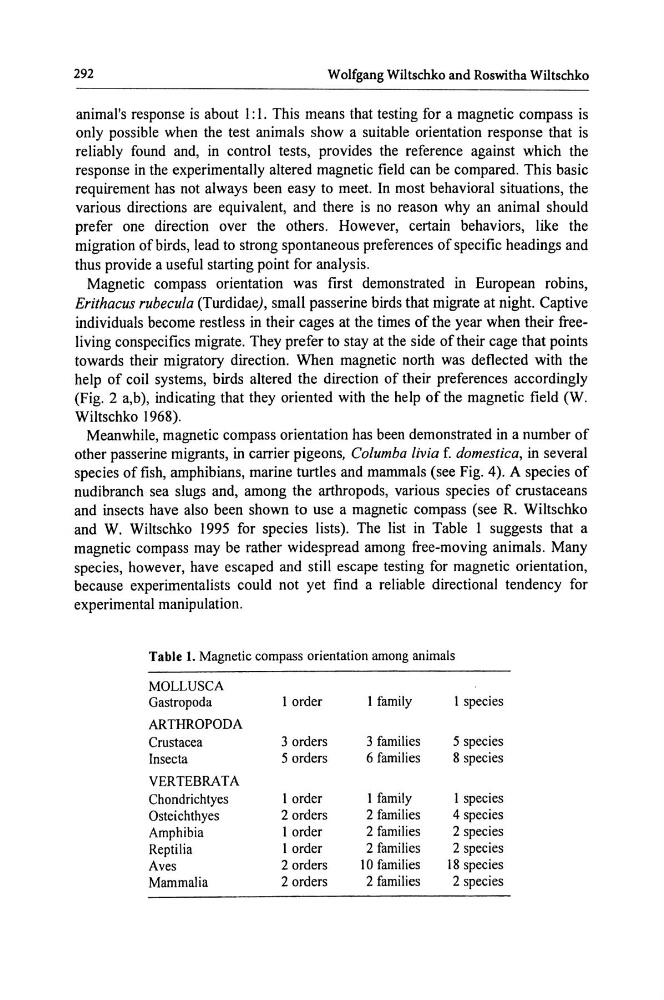
and W. Wiltschko 1995 for species lists). The list in Table 1 suggests that a
magnetic compass may be rather widespread among free-moving animals. Many
species, however, have escaped and still escape testing for magnetic orientation,
because experimentalists could not yet find a reliable directional tendency for
experimental manipulation.
Table 1. Magnetic compass orientation among animals
MOLLUSCA
Gastropoda
1 order
1 family
1 species
ARTHROPODA
Crustacea
3 orders
3 families
5 species
Insecta
5 orders
6 families
8 species
VERTEBRATA
Chondrichtyes
1 order
1 family
I species
Osteichthyes
2 orders
2 families
4 species
Amphibia
1 order
2 families
2 species
Reptilia
I order
2 families
2 species
Aves
2 orders
IO families
I8 species
Mammalia
2 orders
2 families
2 species
Wolfgang Wiltschko and Roswitha Wiltschko
animal's response is about 1: 1. This means that testing for a magnetic compass is
only possible when the test animals show a suitable orientation response that is
reliably found and, in control tests, provides the reference against which the
response in the experimentally altered magnetic field can be compared. This basic
requirement has not always been easy to meet. In most behavioral situations, the
various directions are equivalent, and there is no reason why an animal should
prefer one direction over the others. However, certain behaviors, like the
migration of birds, lead to strong spontaneous preferences of specific headings and
thus provide a useful starting point for analysis.
Magnetic compass orientation was first demonstrated in European robins,
Erithacus rubecula (Turdidae), small passerine birds that migrate at night. Captive
individuals become restless in their cages at the times of the year when their freeliving conspecifics migrate. They prefer to stay at the side of their cage that points
towards their migratory direction. When magnetic north was deflected with the
help of coil systems, birds altered the direction of their preferences accordingly
(Fig. 2 a,b ), indicating that they oriented with the help of the magnetic field (W.
Wiltschko 1968).
Meanwhile, magnetic compass orientation has been demonstrated in a number of
other passerine migrants, in carrier pigeons, Columba Iivia f. domestica, in several
species of fish, amphibians, marine turtles and mammals (see Fig. 4). A species of
nudibranch sea slugs and, among the arthropods, various species of crustaceans
and insects have also been shown to use a magnetic compass (see R. Wiltschko
and W. Wiltschko 1995 for species lists). The list in Table 1 suggests that a
magnetic compass may be rather widespread among free-moving animals. Many
species, however, have escaped and still escape testing for magnetic orientation,
because experimentalists could not yet find a reliable directional tendency for
experimental manipulation.
Table 1. Magnetic compass orientation among animals
MOLLUSCA
Gastropoda
1 order
1 family
1 species
ARTHROPODA
Crustacea
3 orders
3 families
5 species
Insecta
5 orders
6 families
8 species
VERTEBRATA
Chondrichtyes
1 order
1 family
I species
Osteichthyes
2 orders
2 families
4 species
Amphibia
1 order
2 families
2 species
Reptilia
I order
2 families
2 species
Aves
2 orders
IO families
I8 species
Mammalia
2 orders
2 families
2 species