

290
Wolfgang Wiltschko and Roswitha Wiltschko
appeared alien to most scientists. As a consequence, sensitivity to magnetic
stimuli is one of the last sensory modalities discovered in animals. Even today, the
mechanisms of magnetoreception are not known in detail, and we have only a
vague idea about the multitude of uses of the magnetic compass by animals in
their natural environment. This chapter attempts to give a brief overview of the
present state of knowledge and to outline some of the ongoing reseach.
1.1 The Magnetic Field of the Earth
To understand magnetic orientation and magnetoreception, one must be familiar
with the type of stimulus the geomagnetic field provides. A detailed description of
the geomagnetic field has been published by Skiles (1985). Here we briefly
summarize the properties of the geomagnetic field that provide directional
information.
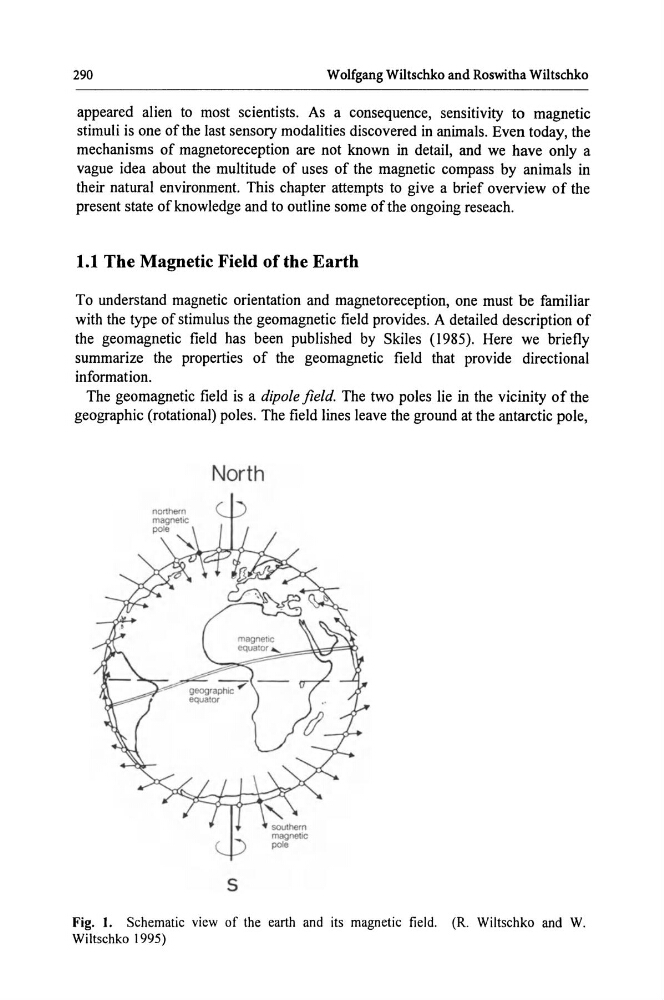
The geomagnetic field is a dipole field. The two poles lie in the vicinity of the
geographic (rotational) poles. The field lines leave the ground at the antarctic pole,
North
s
Fig. 1. Schematic view of the earth and its magnetic field. (R. Wiltschko and W.
Wiltschko 1995)
Wolfgang Wiltschko and Roswitha Wiltschko
appeared alien to most scientists. As a consequence, sensitivity to magnetic
stimuli is one of the last sensory modalities discovered in animals. Even today, the
mechanisms of magnetoreception are not known in detail, and we have only a
vague idea about the multitude of uses of the magnetic compass by animals in
their natural environment. This chapter attempts to give a brief overview of the
present state of knowledge and to outline some of the ongoing reseach.
1.1 The Magnetic Field of the Earth
To understand magnetic orientation and magnetoreception, one must be familiar
with the type of stimulus the geomagnetic field provides. A detailed description of
the geomagnetic field has been published by Skiles (1985). Here we briefly
summarize the properties of the geomagnetic field that provide directional
information.
The geomagnetic field is a dipole field. The two poles lie in the vicinity of the
geographic (rotational) poles. The field lines leave the ground at the antarctic pole,
North
s
Fig. 1. Schematic view of the earth and its magnetic field. (R. Wiltschko and W.
Wiltschko 1995)