

Selectivity in Chemical Communication Systems of Arthropods
247
biosynthesis (Schulz 1987). This may reflect different ecological constraints of the
species.
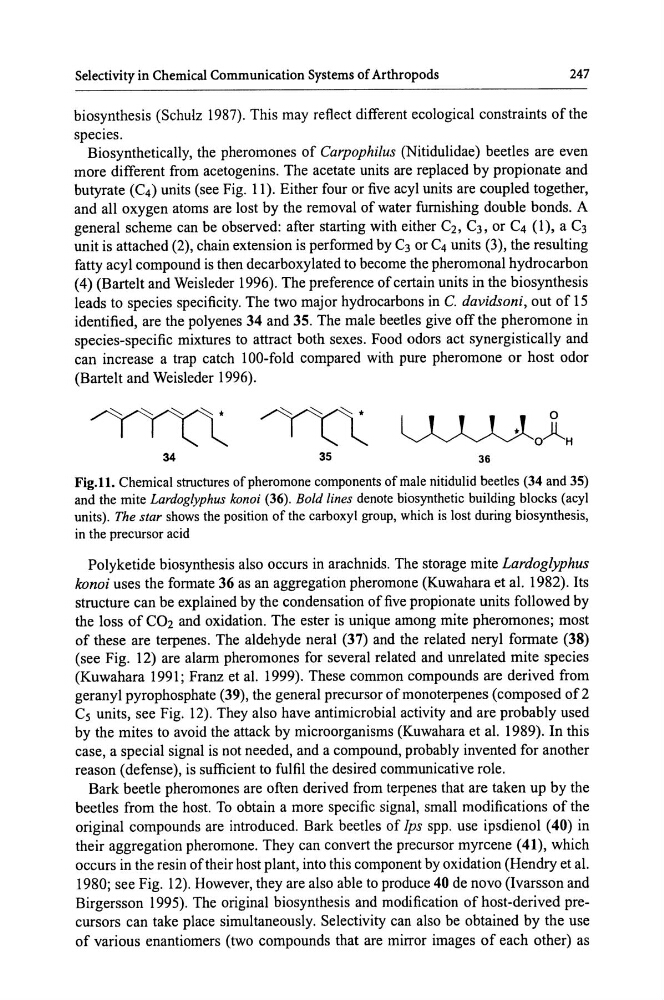
Biosynthetically, the pheromones of Carpophilus (Nitidulidae) beetles are even
more different from acetogenins. The acetate units are replaced by propionate and
butyrate (C4) units (see Fig. 11). Either four or five acyl units are coupled together,
and all oxygen atoms are lost by the removal of water furnishing double bonds. A
general scheme can be observed: after starting with either C2, C3, or C4 (1), a C3
unit is attached (2), chain extension is performed by C3 or C4 units (3), the resulting
fatty acyl compound is then decarboxylated to become the pheromonal hydrocarbon
( 4) (Bartelt and Weisleder 1996). The preference of certain units in the biosynthesis
leads to species specificity. The two major hydrocarbons in C. davidsoni, out of 15
identified, are the po1yenes 34 and 35. The male beetles give off the pheromone in
species-specific mixtures to attract both sexes. Food odors act synergistically and
can increase a trap catch 100-fo1d compared with pure pheromone or host odor
(Bartelt and Weisleder 1996).
~
35
36
Fig.ll. Chemical structures of pheromone components of male nitidulid beetles (34 and 35)
and the mite Lardoglyphus konoi (36). Bold lines denote biosynthetic building blocks (acyl
units). The star shows the position of the carboxyl group, which is lost during biosynthesis,
in the precursor acid
Polyketide biosynthesis also occurs in arachnids. The storage mite Lardoglyphus
konoi uses the formate 36 as an aggregation pheromone (Kuwahara et al. 1982). Its
structure can be explained by the condensation of five propionate units followed by
the loss of C02 and oxidation. The ester is unique among mite pheromones; most
of these are terpenes. The aldehyde neral (37) and the related neryl formate (38)
(see Fig. 12) are alarm pheromones for several related and unrelated mite species
(Kuwahara 1991; Franz et al. 1999). These common compounds are derived from
geranyl pyrophosphate (39), the general precursor of monoterpenes (composed of 2
Cs units, see Fig. 12). They also have antimicrobial activity and are probably used
by the mites to avoid the attack by microorganisms (Kuwahara et al. 1989). In this
case, a special signal is not needed, and a compound, probably invented for another
reason (defense), is sufficient to fulfil the desired communicative role.
Bark beetle pheromones are often derived from terpenes that are taken up by the
beetles from the host. To obtain a more specific signal, small modifications of the
original compounds are introduced. Bark beetles of Ips spp. use ipsdienol ( 40) in
their aggregation pheromone. They can convert the precursor myrcene (41), which
occurs in the resin of their host plant, into this component by oxidation (Hendry et al.
1980; see Fig. 12). However, they are also able to produce 40 de novo (lvarsson and
Birgersson 1995). The original biosynthesis and modification of host-derived precursors can take place simultaneously. Selectivity can also be obtained by the use
of various enantiomers (two compounds that are mirror images of each other) as
247
biosynthesis (Schulz 1987). This may reflect different ecological constraints of the
species.
Biosynthetically, the pheromones of Carpophilus (Nitidulidae) beetles are even
more different from acetogenins. The acetate units are replaced by propionate and
butyrate (C4) units (see Fig. 11). Either four or five acyl units are coupled together,
and all oxygen atoms are lost by the removal of water furnishing double bonds. A
general scheme can be observed: after starting with either C2, C3, or C4 (1), a C3
unit is attached (2), chain extension is performed by C3 or C4 units (3), the resulting
fatty acyl compound is then decarboxylated to become the pheromonal hydrocarbon
( 4) (Bartelt and Weisleder 1996). The preference of certain units in the biosynthesis
leads to species specificity. The two major hydrocarbons in C. davidsoni, out of 15
identified, are the po1yenes 34 and 35. The male beetles give off the pheromone in
species-specific mixtures to attract both sexes. Food odors act synergistically and
can increase a trap catch 100-fo1d compared with pure pheromone or host odor
(Bartelt and Weisleder 1996).
~
35
36
Fig.ll. Chemical structures of pheromone components of male nitidulid beetles (34 and 35)
and the mite Lardoglyphus konoi (36). Bold lines denote biosynthetic building blocks (acyl
units). The star shows the position of the carboxyl group, which is lost during biosynthesis,
in the precursor acid
Polyketide biosynthesis also occurs in arachnids. The storage mite Lardoglyphus
konoi uses the formate 36 as an aggregation pheromone (Kuwahara et al. 1982). Its
structure can be explained by the condensation of five propionate units followed by
the loss of C02 and oxidation. The ester is unique among mite pheromones; most
of these are terpenes. The aldehyde neral (37) and the related neryl formate (38)
(see Fig. 12) are alarm pheromones for several related and unrelated mite species
(Kuwahara 1991; Franz et al. 1999). These common compounds are derived from
geranyl pyrophosphate (39), the general precursor of monoterpenes (composed of 2
Cs units, see Fig. 12). They also have antimicrobial activity and are probably used
by the mites to avoid the attack by microorganisms (Kuwahara et al. 1989). In this
case, a special signal is not needed, and a compound, probably invented for another
reason (defense), is sufficient to fulfil the desired communicative role.
Bark beetle pheromones are often derived from terpenes that are taken up by the
beetles from the host. To obtain a more specific signal, small modifications of the
original compounds are introduced. Bark beetles of Ips spp. use ipsdienol ( 40) in
their aggregation pheromone. They can convert the precursor myrcene (41), which
occurs in the resin of their host plant, into this component by oxidation (Hendry et al.
1980; see Fig. 12). However, they are also able to produce 40 de novo (lvarsson and
Birgersson 1995). The original biosynthesis and modification of host-derived precursors can take place simultaneously. Selectivity can also be obtained by the use
of various enantiomers (two compounds that are mirror images of each other) as