

246
Stefan Schulz
D . C o A + ~CoA + ~CoA + ~CoAI
~ ~
2
I
~
~CoA
~
26
27
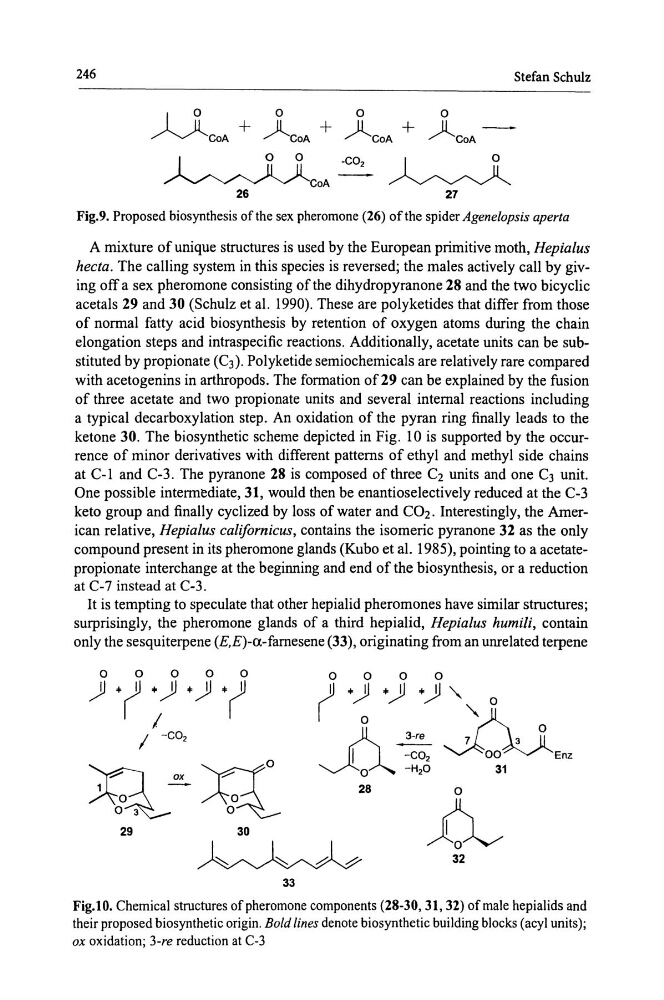
Fig.9. Proposed biosynthesis of the sex pheromone (26) of the spider Agenelopsis aperta
A mixture of unique structures is used by the European primitive moth, Hepialus
hecla. The calling system in this species is reversed; the males actively call by giving off a sex pheromone consisting of the dihydropyranone 28 and the two bicyclic
acetals 29 and 30 (Schulz et al. 1990). These are polyketides that differ from those
of normal fatty acid biosynthesis by retention of oxygen atoms during the chain
elongation steps and intraspecific reactions. Additionally, acetate units can be substituted by propionate (C3). Polyketide semiochemicals are relatively rare compared
with acetogenins in arthropods. The formation of29 can be explained by the fusion
of three acetate and two propionate units and several internal reactions including
a typical decarboxylation step. An oxidation of the pyran ring finally leads to the
ketone 30. The biosynthetic scheme depicted in Fig. 10 is supported by the occurrence of minor derivatives with different patterns of ethyl and methyl side chains
at C-1 and C-3. The pyranone 28 is composed of three C2 units and one C3 unit.
One possible intermediate, 31, would then be enantioselectively reduced at the C-3
keto group and finally cyclized by loss of water and C02. Interestingly, the American relative, Hepialus californicus, contains the isomeric pyranone 32 as the only
compound present in its pheromone glands (Kubo et al. 1985), pointing to a acetatepropionate interchange at the beginning and end of the biosynthesis, or a reduction
at C-7 instead at C-3.
It is tempting to speculate that other hepialid pheromones have similar structures;
surprisingly, the pheromone glands of a third hepialid, Hepialus humili, contain
only the sesquiterpene (E,E)-a- farnesene (33), originating from an unrelated terpene
0
0
0
0
Yl ~~0
/'\00~
,./\'00~
) +) •) +)"
r
0
~0 0
3-re
7
3
A~
00
Enz
Jo~ -H2o
31
28
0
29
30
R
~
32
33
Fig.lO. Chemical structures of pheromone components (28-30, 31, 32) of male hepialids and
their proposed biosynthetic origin. Bold lines denote biosynthetic building blocks (acyl units);
ox oxidation; 3-re reduction at C-3
Stefan Schulz
D . C o A + ~CoA + ~CoA + ~CoAI
~ ~
2
I
~
~CoA
~
26
27
Fig.9. Proposed biosynthesis of the sex pheromone (26) of the spider Agenelopsis aperta
A mixture of unique structures is used by the European primitive moth, Hepialus
hecla. The calling system in this species is reversed; the males actively call by giving off a sex pheromone consisting of the dihydropyranone 28 and the two bicyclic
acetals 29 and 30 (Schulz et al. 1990). These are polyketides that differ from those
of normal fatty acid biosynthesis by retention of oxygen atoms during the chain
elongation steps and intraspecific reactions. Additionally, acetate units can be substituted by propionate (C3). Polyketide semiochemicals are relatively rare compared
with acetogenins in arthropods. The formation of29 can be explained by the fusion
of three acetate and two propionate units and several internal reactions including
a typical decarboxylation step. An oxidation of the pyran ring finally leads to the
ketone 30. The biosynthetic scheme depicted in Fig. 10 is supported by the occurrence of minor derivatives with different patterns of ethyl and methyl side chains
at C-1 and C-3. The pyranone 28 is composed of three C2 units and one C3 unit.
One possible intermediate, 31, would then be enantioselectively reduced at the C-3
keto group and finally cyclized by loss of water and C02. Interestingly, the American relative, Hepialus californicus, contains the isomeric pyranone 32 as the only
compound present in its pheromone glands (Kubo et al. 1985), pointing to a acetatepropionate interchange at the beginning and end of the biosynthesis, or a reduction
at C-7 instead at C-3.
It is tempting to speculate that other hepialid pheromones have similar structures;
surprisingly, the pheromone glands of a third hepialid, Hepialus humili, contain
only the sesquiterpene (E,E)-a- farnesene (33), originating from an unrelated terpene
0
0
0
0
Yl ~~0
/'\00~
,./\'00~
) +) •) +)"
r
0
~0 0
3-re
7
3
A~
00
Enz
Jo~ -H2o
31
28
0
29
30
R
~
32
33
Fig.lO. Chemical structures of pheromone components (28-30, 31, 32) of male hepialids and
their proposed biosynthetic origin. Bold lines denote biosynthetic building blocks (acyl units);
ox oxidation; 3-re reduction at C-3