

The Ecology of Teleost Fish Visual Pigments
217
UV around 350-360 run (Jacobs 1992). Photons of wavelengths below ca. 310 run
would be very damaging to the retina and are inevitably absorbed by structural
components of the cornea and lens. What sets the limit to absorption at longer
wavelengths is not so clear, but no cone visual pigment has yet been identified with
a A max greater than ca. 630 nm (Bowmaker 1991 ). Given this large potential range of
visual pigment A max values one might expect every animal to possess many visual
pigments with A max values spanning the complete range. Although this is what
invertebrate mantid shrimps appear to do, possessing up to 12 distinct spectral types
of photoreceptor with A max values roughly evenly spaced between 300 and 700 run
(Marshall and Oberwinkler 1999), vertebrates are much more conservative, most
possessing only 2-4 different spectral cone types and, with the exception of some
amphibia and deep-sea fish, a single spectral class of rod (Bowmaker 1991 ).
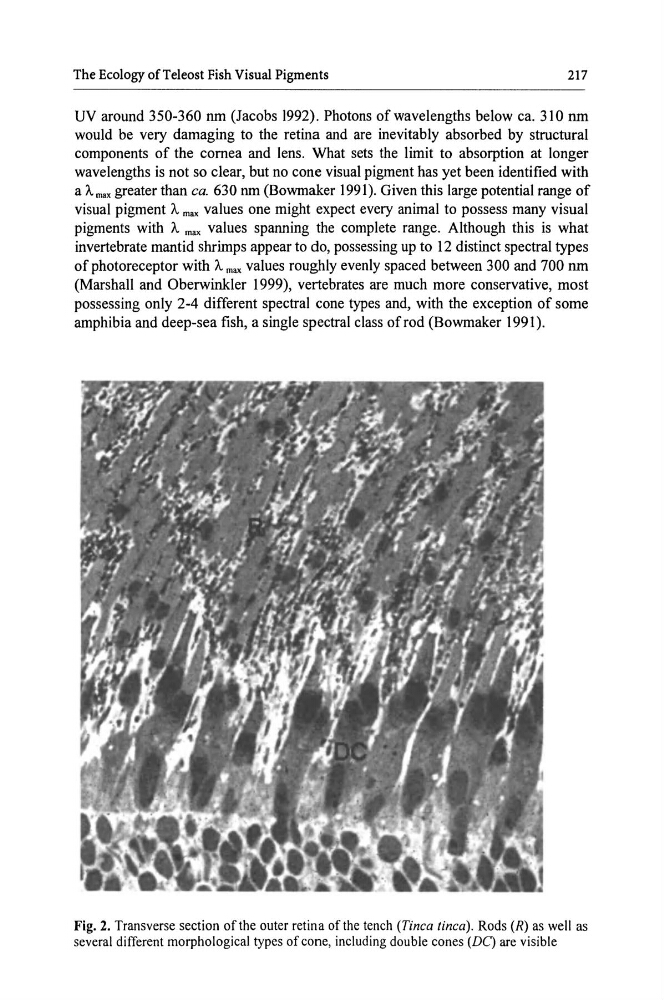
Fig. 2. Transverse section of the outer retina of the tench (Tinea tinea). Rods (R) as well as
several different morphological types of cone, including double cones (DC) are visible
217
UV around 350-360 run (Jacobs 1992). Photons of wavelengths below ca. 310 run
would be very damaging to the retina and are inevitably absorbed by structural
components of the cornea and lens. What sets the limit to absorption at longer
wavelengths is not so clear, but no cone visual pigment has yet been identified with
a A max greater than ca. 630 nm (Bowmaker 1991 ). Given this large potential range of
visual pigment A max values one might expect every animal to possess many visual
pigments with A max values spanning the complete range. Although this is what
invertebrate mantid shrimps appear to do, possessing up to 12 distinct spectral types
of photoreceptor with A max values roughly evenly spaced between 300 and 700 run
(Marshall and Oberwinkler 1999), vertebrates are much more conservative, most
possessing only 2-4 different spectral cone types and, with the exception of some
amphibia and deep-sea fish, a single spectral class of rod (Bowmaker 1991 ).
Fig. 2. Transverse section of the outer retina of the tench (Tinea tinea). Rods (R) as well as
several different morphological types of cone, including double cones (DC) are visible