

210
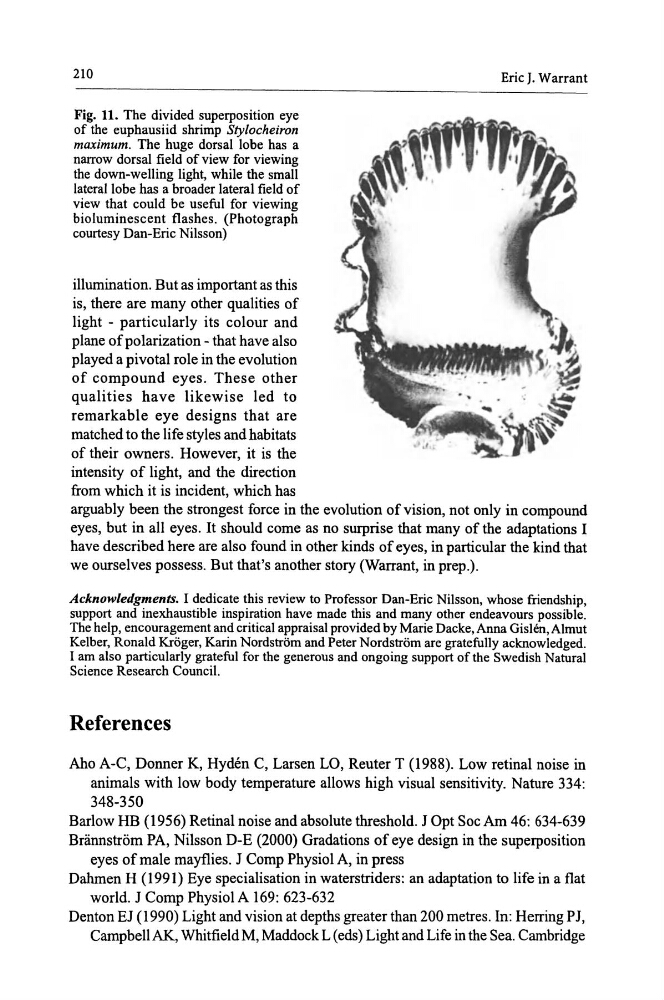
Fig. 11. The divided superposition eye
of the euphausiid shrimp Stylocheiron
maximum. The huge dorsal lobe has a
narrow dorsal field of view for viewing
the down-welling light, while the small
lateral lobe has a broader lateral field of
view that could be useful for viewing
bioluminescent flashes. (Photograph
courtesy Dan-Eric Nilsson)
illumination. But as important as this
is, there are many other qualities of
light - particularly its colour and
plane of polarization- that have also
played a pivotal role in the evolution
of compound eyes. These other
qualities have likewise led to
remarkable eye designs that are
matched to the life styles and habitats
of their owners. However, it is the
intensity of light, and the direction
from which it is incident, which has
Eric]. Warrant
arguably been the strongest force in the evolution of vision, not only in compound
eyes, but in all eyes. It should come as no surprise that many of the adaptations I
have described here are also found in other kinds of eyes, in particular the kind that
we ourselves possess. But that's another story (Warrant, in prep.).
Acknowledgments. I dedicate this review to Professor Dan-Eric Nilsson, whose friendship,
support and inexhaustible inspiration have made this and many other endeavours possible.
The help, encouragement and critical appraisal provided by Marie Dacke, Anna Gislt\n, Almut
Kelber, Ronald Kroger, Karin Nordstrom and Peter Nordstrom are gratefully acknowledged.
I am also particularly grateful for the generous and ongoing support of the Swedish Natural
Science Research Council.
References
Aho A-C, Donner K, Hyden C, Larsen LO, Reuter T (1988). Low retinal noise in
animals with low body temperature allows high visual sensitivity. Nature 334:
348-350
Barlow HB (1956) Retinal noise and absolute threshold. J Opt Soc Am 46: 634-639
Brannstrom PA, Nilsson D-E (2000) Gradations of eye design in the superposition
eyes of male mayflies. J Comp Physiol A, in press
Dahmen H ( 1991) Eye specialisation in waterstriders: an adaptation to life in a flat
world. J Comp PhysiolA 169: 623-632
Denton EJ (1990) Light and vision at depths greater than 200 metres. In: Herring PJ,
Campbell AK, Whitfield M, Maddock L ( eds) Light and Life in the Sea. Cambridge
Fig. 11. The divided superposition eye
of the euphausiid shrimp Stylocheiron
maximum. The huge dorsal lobe has a
narrow dorsal field of view for viewing
the down-welling light, while the small
lateral lobe has a broader lateral field of
view that could be useful for viewing
bioluminescent flashes. (Photograph
courtesy Dan-Eric Nilsson)
illumination. But as important as this
is, there are many other qualities of
light - particularly its colour and
plane of polarization- that have also
played a pivotal role in the evolution
of compound eyes. These other
qualities have likewise led to
remarkable eye designs that are
matched to the life styles and habitats
of their owners. However, it is the
intensity of light, and the direction
from which it is incident, which has
Eric]. Warrant
arguably been the strongest force in the evolution of vision, not only in compound
eyes, but in all eyes. It should come as no surprise that many of the adaptations I
have described here are also found in other kinds of eyes, in particular the kind that
we ourselves possess. But that's another story (Warrant, in prep.).
Acknowledgments. I dedicate this review to Professor Dan-Eric Nilsson, whose friendship,
support and inexhaustible inspiration have made this and many other endeavours possible.
The help, encouragement and critical appraisal provided by Marie Dacke, Anna Gislt\n, Almut
Kelber, Ronald Kroger, Karin Nordstrom and Peter Nordstrom are gratefully acknowledged.
I am also particularly grateful for the generous and ongoing support of the Swedish Natural
Science Research Council.
References
Aho A-C, Donner K, Hyden C, Larsen LO, Reuter T (1988). Low retinal noise in
animals with low body temperature allows high visual sensitivity. Nature 334:
348-350
Barlow HB (1956) Retinal noise and absolute threshold. J Opt Soc Am 46: 634-639
Brannstrom PA, Nilsson D-E (2000) Gradations of eye design in the superposition
eyes of male mayflies. J Comp Physiol A, in press
Dahmen H ( 1991) Eye specialisation in waterstriders: an adaptation to life in a flat
world. J Comp PhysiolA 169: 623-632
Denton EJ (1990) Light and vision at depths greater than 200 metres. In: Herring PJ,
Campbell AK, Whitfield M, Maddock L ( eds) Light and Life in the Sea. Cambridge