

The Design of Compound Eyes and the Illumination of Natural Habitats
203
receptive fields only half as wide (Hardie 1979).
An even better comparison of performance in apposition and superposition eyes
can be seen in the motion-sensitive cells responsible for flow field analysis (which
we discussed earlier in Sect. 3.1.3). These cells are located in the lobula plate ofthe
optic lobe, and are possessed by many different flying insects, including the nocturnal
elephant hawkmoth Deilephila elpenor. This insect has well developed superposition
eyes that it uses for locating flowers at night. Once located, Deilephila hovers in
front of the flower, locates the entrance of the nectar reservoir and then sucks it, a
moth
fly
Inte nsity
0.05
0.20
C)•cles/dcg C)•dcs/dcg
0.05
0.20
cydcs/dcg cycles/deg
Darlighc hade
t) (J)
t) (I)
¢
~ - -~& -~·~·~
~- -···lid Dusk
I
50 spikes/se"..Ma.
Fw~ illl
.I,.
1 •• 111......
. . -
....
........
0.25 sec
u ..... .A
.. .. ....J. .... -
. . . . .....
,, ... ',,.
. . . . . . . . . . . .......
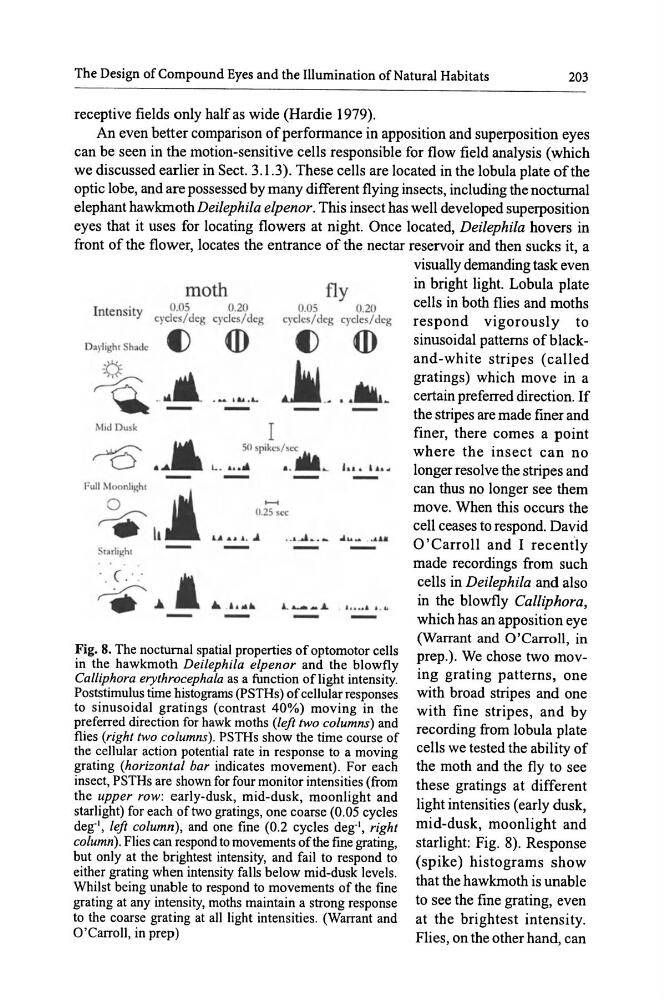
Fig. 8. The nocturnal spatial properties of optomotor cells
in the hawkmoth Deilephila elpenor and the blowfly
Calliphora erythrocephala as a function oflight intensity.
Poststimulus time histograms (PSTHs) of cellular responses
to sinusoidal gratings (contrast 40%) moving in the
preferred direction for hawk moths (left two columns) and
flies (right two columns). PSTHs show the time course of
the cellular action potential rate in response to a moving
grating (horizontal bar indicates movement). For each
insect, PSTHs are shown for four monitor intensities (from
the upper row: early-dusk, mid-dusk, moonlight and
starlight) for each of two gratings, one coarse (0.05 cycles
deg·•, left column), and one fine (0.2 cycles deg·•, right
column). Flies can respond to movements of the fine grating,
but only at the brightest intensity, and fail to respond to
either grating when intensity falls below mid-dusk levels.
Whilst being unable to respond to movements of the fine
grating at any intensity, moths maintain a strong response
to the coarse grating at all light intensities. (Warrant and
O'Carroll, in prep)
visually demanding task even
in bright light. Lobula plate
cells in both flies and moths
respond vigorously to
sinusoidal patterns ofblackand-white stripes (called
gratings) which move in a
certain preferred direction. If
the stripes are made finer and
finer, there comes a point
where the insect can no
longer resolve the stripes and
can thus no longer see them
move. When this occurs the
cell ceases to respond. David
O'Carroll and I recently
made recordings from such
cells in Deilephila and also
in the blowfly Calliphora,
which has an apposition eye
(Warrant and O'Carroll, in
prep.). We chose two moving grating patterns, one
with broad stripes and one
with fine stripes, and by
recording from lobula plate
cells we tested the ability of
the moth and the fly to see
these gratings at different
light intensities (early dusk,
mid-dusk, moonlight and
starlight: Fig. 8). Response
(spike) histograms show
that the hawkmoth is unable
to see the fine grating, even
at the brightest intensity.
Flies, on the other hand, can
203
receptive fields only half as wide (Hardie 1979).
An even better comparison of performance in apposition and superposition eyes
can be seen in the motion-sensitive cells responsible for flow field analysis (which
we discussed earlier in Sect. 3.1.3). These cells are located in the lobula plate ofthe
optic lobe, and are possessed by many different flying insects, including the nocturnal
elephant hawkmoth Deilephila elpenor. This insect has well developed superposition
eyes that it uses for locating flowers at night. Once located, Deilephila hovers in
front of the flower, locates the entrance of the nectar reservoir and then sucks it, a
moth
fly
Inte nsity
0.05
0.20
C)•cles/dcg C)•dcs/dcg
0.05
0.20
cydcs/dcg cycles/deg
Darlighc hade
t) (J)
t) (I)
¢
~ - -~& -~·~·~
~- -···lid Dusk
I
50 spikes/se"..Ma.
Fw~ illl
.I,.
1 •• 111......
. . -
....
........
0.25 sec
u ..... .A
.. .. ....J. .... -
. . . . .....
,, ... ',,.
. . . . . . . . . . . .......
Fig. 8. The nocturnal spatial properties of optomotor cells
in the hawkmoth Deilephila elpenor and the blowfly
Calliphora erythrocephala as a function oflight intensity.
Poststimulus time histograms (PSTHs) of cellular responses
to sinusoidal gratings (contrast 40%) moving in the
preferred direction for hawk moths (left two columns) and
flies (right two columns). PSTHs show the time course of
the cellular action potential rate in response to a moving
grating (horizontal bar indicates movement). For each
insect, PSTHs are shown for four monitor intensities (from
the upper row: early-dusk, mid-dusk, moonlight and
starlight) for each of two gratings, one coarse (0.05 cycles
deg·•, left column), and one fine (0.2 cycles deg·•, right
column). Flies can respond to movements of the fine grating,
but only at the brightest intensity, and fail to respond to
either grating when intensity falls below mid-dusk levels.
Whilst being unable to respond to movements of the fine
grating at any intensity, moths maintain a strong response
to the coarse grating at all light intensities. (Warrant and
O'Carroll, in prep)
visually demanding task even
in bright light. Lobula plate
cells in both flies and moths
respond vigorously to
sinusoidal patterns ofblackand-white stripes (called
gratings) which move in a
certain preferred direction. If
the stripes are made finer and
finer, there comes a point
where the insect can no
longer resolve the stripes and
can thus no longer see them
move. When this occurs the
cell ceases to respond. David
O'Carroll and I recently
made recordings from such
cells in Deilephila and also
in the blowfly Calliphora,
which has an apposition eye
(Warrant and O'Carroll, in
prep.). We chose two moving grating patterns, one
with broad stripes and one
with fine stripes, and by
recording from lobula plate
cells we tested the ability of
the moth and the fly to see
these gratings at different
light intensities (early dusk,
mid-dusk, moonlight and
starlight: Fig. 8). Response
(spike) histograms show
that the hawkmoth is unable
to see the fine grating, even
at the brightest intensity.
Flies, on the other hand, can