

202
Eric J. Warrant
4.1 Terrestrial Habitats
4.1.1 Superposition Eyes
Superposition eyes, by virtue of their large apertures, wide receptive fields and low
F-numbers, are the compound eyes most suited for vision in dim light [Eq. (1); Table
1]. This design is much more flexible than previously thought (Macroglossum's eye
being but one of many newly discovered variations:
see Sect. 3.2), and superposition eyes can be
adapted to a whole range of different habitat
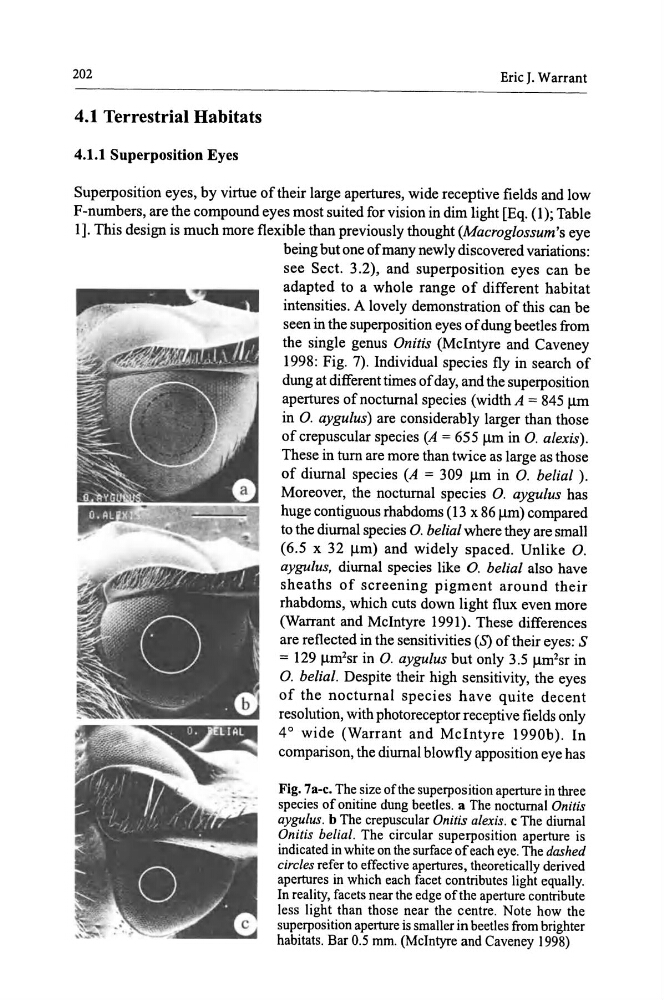
intensities. A lovely demonstration of this can be
seen in the superposition eyes of dung beetles from
the single genus Onitis (Mcintyre and Caveney
1998: Fig. 7). Individual species fly in search of
dung at different times of day, and the superposition
apertures of nocturnal species (width A = 845 J..lm
in 0. aygulus) are considerably larger than those
of crepuscular species (A= 655 J..lm in 0. alexis).
These in tum are more than twice as large as those
of diurnal species (A = 309 f..lm in 0. belial ).
Moreover, the nocturnal species 0. aygulus has
huge contiguous rhabdoms (13 x 86 J..lm) compared
to the diurnal species 0. belial where they are small
(6.5 x 32 f..lm) and widely spaced. Unlike 0.
aygulus, diurnal species like 0. belial also have
sheaths of screening pigment around their
rhabdoms, which cuts down light flux even more
(Warrant and Mcintyre 1991). These differences
are reflected in the sensitivities (S) of their eyes: S
= 129 J..lm 2 sr in 0. aygulus but only 3.5 J..lm 2 sr in
0 . belial. Despite their high sensitivity, the eyes
of the nocturnal species have quite decent
resolution, with photoreceptor receptive fields only
4° wide (Warrant and Mcintyre 1990b). In
comparison, the diurnal blowfly apposition eye has
Fig. 7a-c. The size of the superposition aperture in three
species of onitine dung beetles. a The nocturnal Onitis
aygulus. b The crepuscular Onitis alexis. c The diurnal
Onitis belial. The circular superposition aperture is
indicated in white on the surface of each eye. The dashed
circles refer to effective apertures, theoretically derived
apertures in which each facet contributes light equally.
In reality, facets near the edge of the aperture contribute
less light than those near the centre. Note how the
superposition aperture is smaller in beetles from brighter
habitats. Bar 0.5 mm. (Mcintyre and Caveney 1998)
Eric J. Warrant
4.1 Terrestrial Habitats
4.1.1 Superposition Eyes
Superposition eyes, by virtue of their large apertures, wide receptive fields and low
F-numbers, are the compound eyes most suited for vision in dim light [Eq. (1); Table
1]. This design is much more flexible than previously thought (Macroglossum's eye
being but one of many newly discovered variations:
see Sect. 3.2), and superposition eyes can be
adapted to a whole range of different habitat
intensities. A lovely demonstration of this can be
seen in the superposition eyes of dung beetles from
the single genus Onitis (Mcintyre and Caveney
1998: Fig. 7). Individual species fly in search of
dung at different times of day, and the superposition
apertures of nocturnal species (width A = 845 J..lm
in 0. aygulus) are considerably larger than those
of crepuscular species (A= 655 J..lm in 0. alexis).
These in tum are more than twice as large as those
of diurnal species (A = 309 f..lm in 0. belial ).
Moreover, the nocturnal species 0. aygulus has
huge contiguous rhabdoms (13 x 86 J..lm) compared
to the diurnal species 0. belial where they are small
(6.5 x 32 f..lm) and widely spaced. Unlike 0.
aygulus, diurnal species like 0. belial also have
sheaths of screening pigment around their
rhabdoms, which cuts down light flux even more
(Warrant and Mcintyre 1991). These differences
are reflected in the sensitivities (S) of their eyes: S
= 129 J..lm 2 sr in 0. aygulus but only 3.5 J..lm 2 sr in
0 . belial. Despite their high sensitivity, the eyes
of the nocturnal species have quite decent
resolution, with photoreceptor receptive fields only
4° wide (Warrant and Mcintyre 1990b). In
comparison, the diurnal blowfly apposition eye has
Fig. 7a-c. The size of the superposition aperture in three
species of onitine dung beetles. a The nocturnal Onitis
aygulus. b The crepuscular Onitis alexis. c The diurnal
Onitis belial. The circular superposition aperture is
indicated in white on the surface of each eye. The dashed
circles refer to effective apertures, theoretically derived
apertures in which each facet contributes light equally.
In reality, facets near the edge of the aperture contribute
less light than those near the centre. Note how the
superposition aperture is smaller in beetles from brighter
habitats. Bar 0.5 mm. (Mcintyre and Caveney 1998)