

8
David B. Dusenbery
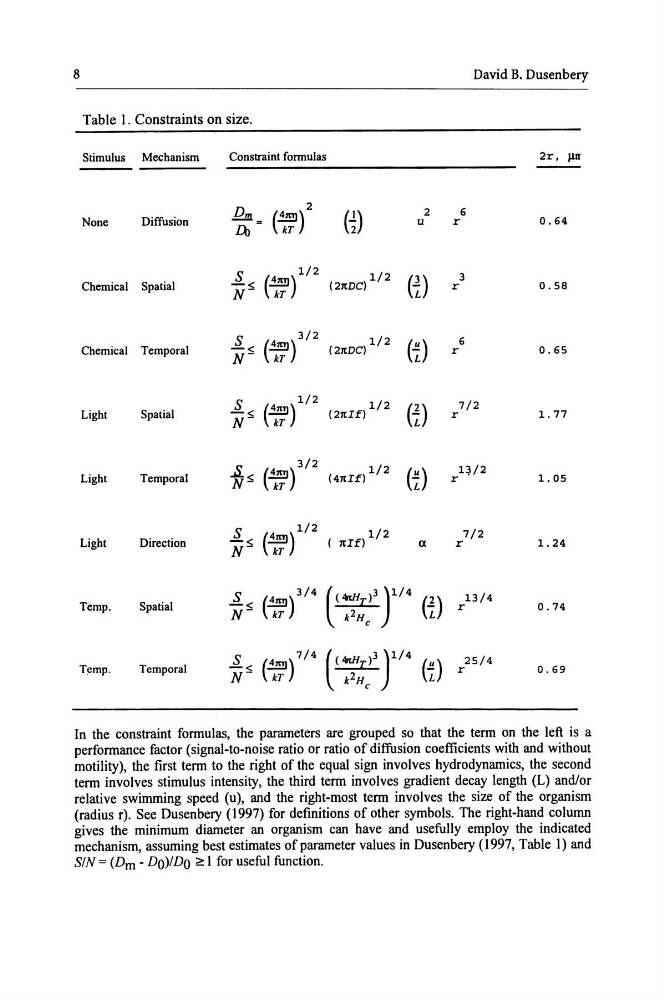
Table 1. Constraints on size.
Stimulus Mechanism
Constraint formulas
2r, 111r
!2m=
2
2
6
None
Diffusion
~
(~)
H)
u
r
0.64
s
1/2
1/2
H)
3
Chemical Spatial
-< (7r) (2ltDC)
r
0.58
Nl:.< (~)3/2
1/2
(~)
6
Chemical Temporal
N(2ltDC)
r
0.65
Light
Spatial
s (7r) 1/2
1/2
H)
7/2
-<
(2ltif)
r
1. 77
N.£..!(.
3/2
(4ltif) 112
(~)
1U2
Light
Temporal
(7r)
1.05
N
r
l:.<
(
1/2
1/2
7/2
Light
Direction
~)
( ltif)
a
r
1. 24
N- kT
Temp.
Spatial
l:.<
N(
3/4
~) kT
(<
H)
13/4
r
0.74
Temp.
Temporal
l:.s, (~) 7/4 (<
kT
k2Hc
L
25/4
r
0.69
In the constraint formulas, the parameters are grouped so that the term on the left is a
performance factor (signal-to-noise ratio or ratio of diffusion coefficients with and without
motility), the first term to the right of the equal sign involves hydrodynamics, the second
term involves stimulus intensity, the third temt involves gradient decay length (L) and/or
relative swimming speed (u), and the right-most term involves the size of the organism
(radius r). See Dusenbery (1997) for definitions of other symbols. The right-hand column
gives the minimum diameter an organism can have and usefully employ the indicated
mechanism, assuming best estimates of parameter values in Dusenbery (1997, Table 1) and
SIN= (Dm - Do)!Do ~ 1 for useful function.
David B. Dusenbery
Table 1. Constraints on size.
Stimulus Mechanism
Constraint formulas
2r, 111r
!2m=
2
2
6
None
Diffusion
~
(~)
H)
u
r
0.64
s
1/2
1/2
H)
3
Chemical Spatial
-< (7r) (2ltDC)
r
0.58
Nl:.< (~)3/2
1/2
(~)
6
Chemical Temporal
N(2ltDC)
r
0.65
Light
Spatial
s (7r) 1/2
1/2
H)
7/2
-<
(2ltif)
r
1. 77
N.£..!(.
3/2
(4ltif) 112
(~)
1U2
Light
Temporal
(7r)
1.05
N
r
l:.<
(
1/2
1/2
7/2
Light
Direction
~)
( ltif)
a
r
1. 24
N- kT
Temp.
Spatial
l:.<
N(
3/4
~) kT
(<
H)
13/4
r
0.74
Temp.
Temporal
l:.s, (~) 7/4 (<
kT
k2Hc
L
25/4
r
0.69
In the constraint formulas, the parameters are grouped so that the term on the left is a
performance factor (signal-to-noise ratio or ratio of diffusion coefficients with and without
motility), the first term to the right of the equal sign involves hydrodynamics, the second
term involves stimulus intensity, the third temt involves gradient decay length (L) and/or
relative swimming speed (u), and the right-most term involves the size of the organism
(radius r). See Dusenbery (1997) for definitions of other symbols. The right-hand column
gives the minimum diameter an organism can have and usefully employ the indicated
mechanism, assuming best estimates of parameter values in Dusenbery (1997, Table 1) and
SIN= (Dm - Do)!Do ~ 1 for useful function.