

Physical Constraints in Sensory Ecology
7
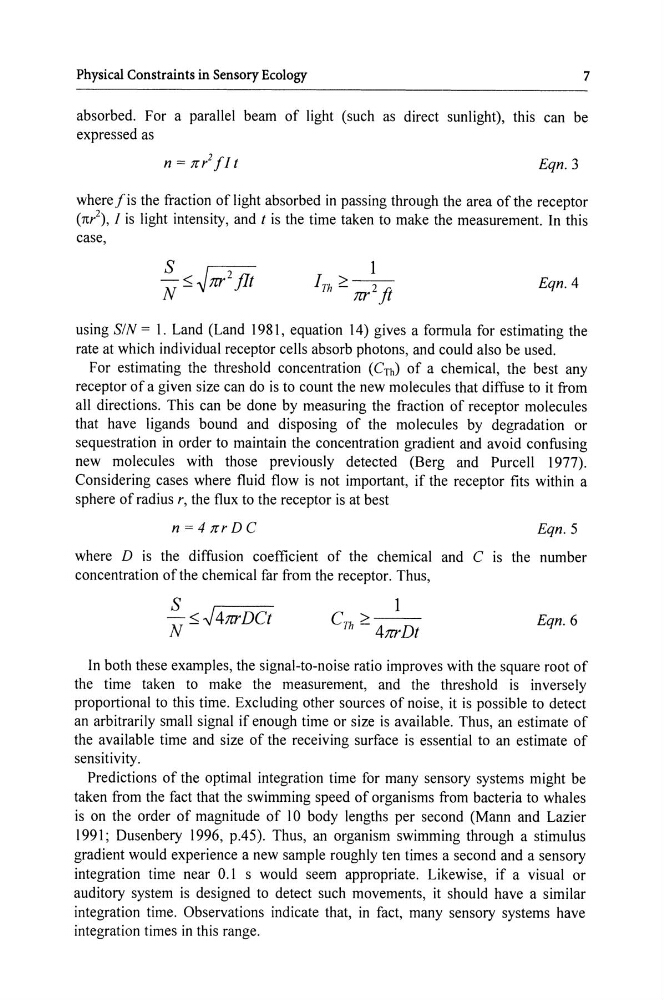
absorbed. For a parallel beam of light (such as direct sunlight), this can be
expressed as
Eqn. 3
where f is the fraction of! ight absorbed in passing through the area of the receptor
(rcr 2 ), I is light intensity, and tis the time taken to make the measurement. In this
case,
1
JTh "2_-2Jrrfl
Eqn.4
using SIN = I. Land (Land 1981, equation 14) gives a formula for estimating the
rate at which individual receptor cells absorb photons, and could also be used.
For estimating the threshold concentration (CTh) of a chemical, the best any
receptor of a given size can do is to count the new molecules that diffuse to it from
all directions. This can be done by measuring the fraction of receptor molecules
that have ligands bound and disposing of the molecules by degradation or
sequestration in order to maintain the concentration gradient and avoid confusing
new molecules with those previously detected (Berg and Purcell 1977).
Considering cases where fluid flow is not important, if the receptor fits within a
sphere of radius r, the flux to the receptor is at best
n=4ffrDC
Eqn. 5
where D is the diffusion coefficient of the chemical and C is the number
concentration of the chemical far from the receptor. Thus,
s
-::; -J4JrrDCt
N
1
CTh "?.--4JrrDt
Eqn.6
In both these examples, the signal-to-noise ratio improves with the square root of
the time taken to make the measurement, and the threshold is inversely
proportional to this time. Excluding other sources of noise, it is possible to detect
an arbitrarily small signal if enough time or size is available. Thus, an estimate of
the available time and size of the receiving surface is essential to an estimate of
sensitivity.
Predictions of the optimal integration time for many sensory systems might be
taken from the fact that the swimming speed of organisms from bacteria to whales
is on the order of magnitude of 10 body lengths per second (Mann and Lazier
1991; Dusenbery 1996, p.45). Thus, an organism swimming through a stimulus
gradient would experience a new sample roughly ten times a second and a sensory
integration time near 0.1 s would seem appropriate. Likewise, if a visual or
auditory system is designed to detect such movements, it should have a similar
integration time. Observations indicate that, in fact, many sensory systems have
integration times in this range.
7
absorbed. For a parallel beam of light (such as direct sunlight), this can be
expressed as
Eqn. 3
where f is the fraction of! ight absorbed in passing through the area of the receptor
(rcr 2 ), I is light intensity, and tis the time taken to make the measurement. In this
case,
1
JTh "2_-2Jrrfl
Eqn.4
using SIN = I. Land (Land 1981, equation 14) gives a formula for estimating the
rate at which individual receptor cells absorb photons, and could also be used.
For estimating the threshold concentration (CTh) of a chemical, the best any
receptor of a given size can do is to count the new molecules that diffuse to it from
all directions. This can be done by measuring the fraction of receptor molecules
that have ligands bound and disposing of the molecules by degradation or
sequestration in order to maintain the concentration gradient and avoid confusing
new molecules with those previously detected (Berg and Purcell 1977).
Considering cases where fluid flow is not important, if the receptor fits within a
sphere of radius r, the flux to the receptor is at best
n=4ffrDC
Eqn. 5
where D is the diffusion coefficient of the chemical and C is the number
concentration of the chemical far from the receptor. Thus,
s
-::; -J4JrrDCt
N
1
CTh "?.--4JrrDt
Eqn.6
In both these examples, the signal-to-noise ratio improves with the square root of
the time taken to make the measurement, and the threshold is inversely
proportional to this time. Excluding other sources of noise, it is possible to detect
an arbitrarily small signal if enough time or size is available. Thus, an estimate of
the available time and size of the receiving surface is essential to an estimate of
sensitivity.
Predictions of the optimal integration time for many sensory systems might be
taken from the fact that the swimming speed of organisms from bacteria to whales
is on the order of magnitude of 10 body lengths per second (Mann and Lazier
1991; Dusenbery 1996, p.45). Thus, an organism swimming through a stimulus
gradient would experience a new sample roughly ten times a second and a sensory
integration time near 0.1 s would seem appropriate. Likewise, if a visual or
auditory system is designed to detect such movements, it should have a similar
integration time. Observations indicate that, in fact, many sensory systems have
integration times in this range.