

198
d
v
A
Rotation
d
~ 75
c:
0
~45
> (I)
.
.
Qj 15"
f o·
-1 5 .
-45
0
-75
0
v
:--~'"""~~~ - .._ .... ' I& ~ ~ ~ ~
. - .. ... \ ~ ~ t ;
- ' " \o ~ ~ + t +
• G.
" "' \ + t + t
. ' ~ ~ + ~ +
• . . • ' '
~ t ;
. I • .. .. ~
•
• • f ~ ¥
•
\
' . • I I •
I
. . . , • I '
I
I
I
~
+
f
•
' ~
I
I
'
Eric]. Warrant
C!)
c:
0
o·~ c
>
QJ
Qj
/II¥~
75" ®
c:
0
I
"
, ~
I •
'
9
I
I
,
'
I
I
, .
' .
' '
" .,.
, '
. .
e .
'
• •
0
•
45" ~
> (I)
15" Qj
o· c
-15"
-45 •
-75°
o·
45•
go•
13s•
180°
azimuth 'I'
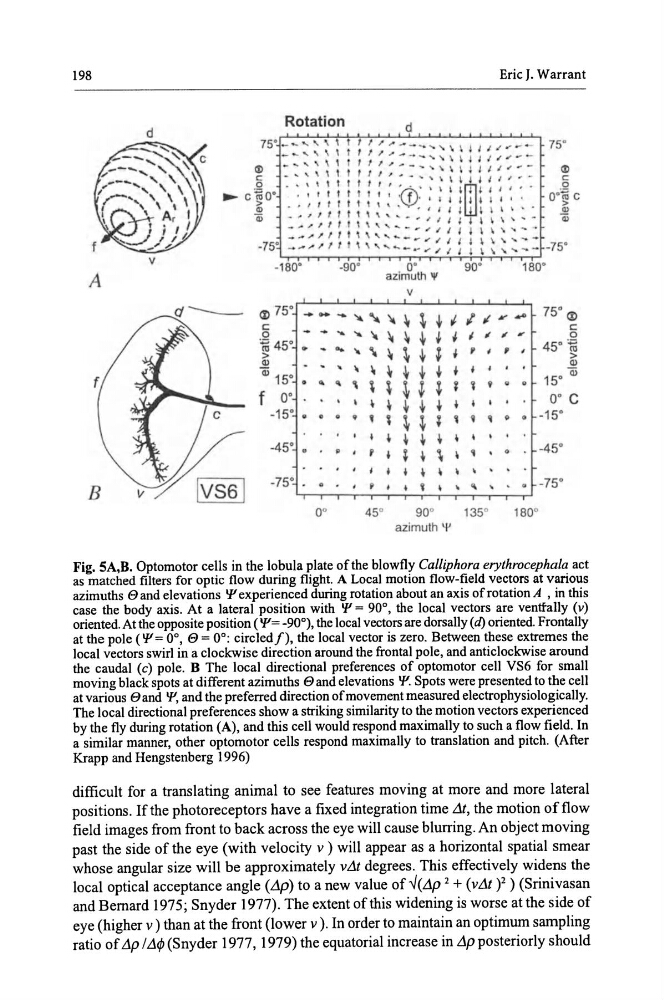
Fig. SA,B. Optomotor cells in the lobula plate of the blowfly Calliphora erythrocephala act
as matched filters for optic flow during flight. A Local motion flow-field vectors at various
azimuths e and elevations 'P experienced during rotation about an axis of rotation A , in this
case the body axis. At a lateral position with 'P = 90°, the local vectors are venttally (v)
oriented. At the opposite position ( 'P= -90°), the local vectors are dorsally (d) oriented. Frontally
at the pole ( 'P = oo, e = o•: circled f), the local vector is zero. Between these extremes the
local vectors swirl in a clockwise direction around the frontal pole, and anticlockwise around
the caudal (c) pole. B The local directional preferences of optomotor cell VS6 for small
moving black spots at different azimuths e and elevations 'P. Spots were presented to the cell
at various e and 'P, and the preferred direction of movement measured electrophysiologically.
The local directional preferences show a striking similarity to the motion vectors experienced
by the fly during rotation (A), and this cell would respond maximally to such a flow field. In
a similar manner, other optomotor cells respond maximally to translation and pitch. (After
Krapp and Hengstenberg 1996)
difficult for a translating animal to see features moving at more and more lateral
positions. If the photoreceptors have a fixed integration time Llt, the motion of flow
field images from front to back across the eye will cause blurring. An object moving
past the side of the eye (with velocity v) will appear as a horizontal spatial smear
whose angular size will be approximately vLlt degrees. This effectively widens the
local optical acceptance angle (.1p) to a new value of..J(Llp 2 + (vLlt )2) (Srinivasan
and Bernard 1975; Snyder 1977). The extent of this widening is worse at the side of
eye (higher v) than at the front (lower v ). In order to maintain an optimum sampling
ratio of Llp I Ll
d
v
A
Rotation
d
~ 75
c:
0
~45
> (I)
.
.
Qj 15"
f o·
-1 5 .
-45
0
-75
0
v
:--~'"""~~~ - .._ .... ' I& ~ ~ ~ ~
. - .. ... \ ~ ~ t ;
- ' " \o ~ ~ + t +
• G.
" "' \ + t + t
. ' ~ ~ + ~ +
• . . • ' '
~ t ;
. I • .. .. ~
•
• • f ~ ¥
•
\
' . • I I •
I
. . . , • I '
I
I
I
~
+
f
•
' ~
I
I
'
Eric]. Warrant
C!)
c:
0
o·~ c
>
QJ
Qj
/II¥~
75" ®
c:
0
I
"
, ~
I •
'
9
I
I
,
'
I
I
, .
' .
' '
" .,.
, '
. .
e .
'
• •
0
•
45" ~
> (I)
15" Qj
o· c
-15"
-45 •
-75°
o·
45•
go•
13s•
180°
azimuth 'I'
Fig. SA,B. Optomotor cells in the lobula plate of the blowfly Calliphora erythrocephala act
as matched filters for optic flow during flight. A Local motion flow-field vectors at various
azimuths e and elevations 'P experienced during rotation about an axis of rotation A , in this
case the body axis. At a lateral position with 'P = 90°, the local vectors are venttally (v)
oriented. At the opposite position ( 'P= -90°), the local vectors are dorsally (d) oriented. Frontally
at the pole ( 'P = oo, e = o•: circled f), the local vector is zero. Between these extremes the
local vectors swirl in a clockwise direction around the frontal pole, and anticlockwise around
the caudal (c) pole. B The local directional preferences of optomotor cell VS6 for small
moving black spots at different azimuths e and elevations 'P. Spots were presented to the cell
at various e and 'P, and the preferred direction of movement measured electrophysiologically.
The local directional preferences show a striking similarity to the motion vectors experienced
by the fly during rotation (A), and this cell would respond maximally to such a flow field. In
a similar manner, other optomotor cells respond maximally to translation and pitch. (After
Krapp and Hengstenberg 1996)
difficult for a translating animal to see features moving at more and more lateral
positions. If the photoreceptors have a fixed integration time Llt, the motion of flow
field images from front to back across the eye will cause blurring. An object moving
past the side of the eye (with velocity v) will appear as a horizontal spatial smear
whose angular size will be approximately vLlt degrees. This effectively widens the
local optical acceptance angle (.1p) to a new value of..J(Llp 2 + (vLlt )2) (Srinivasan
and Bernard 1975; Snyder 1977). The extent of this widening is worse at the side of
eye (higher v) than at the front (lower v ). In order to maintain an optimum sampling
ratio of Llp I Ll