

The Design of Compound Eyes and the Illumination of Natural Habitats
197
v
c
}"JI.WJ~
~- s·~
32"
CB
"'e::.:::u c>zzc:;O<
movement
stimulus
•
•
•
Ill
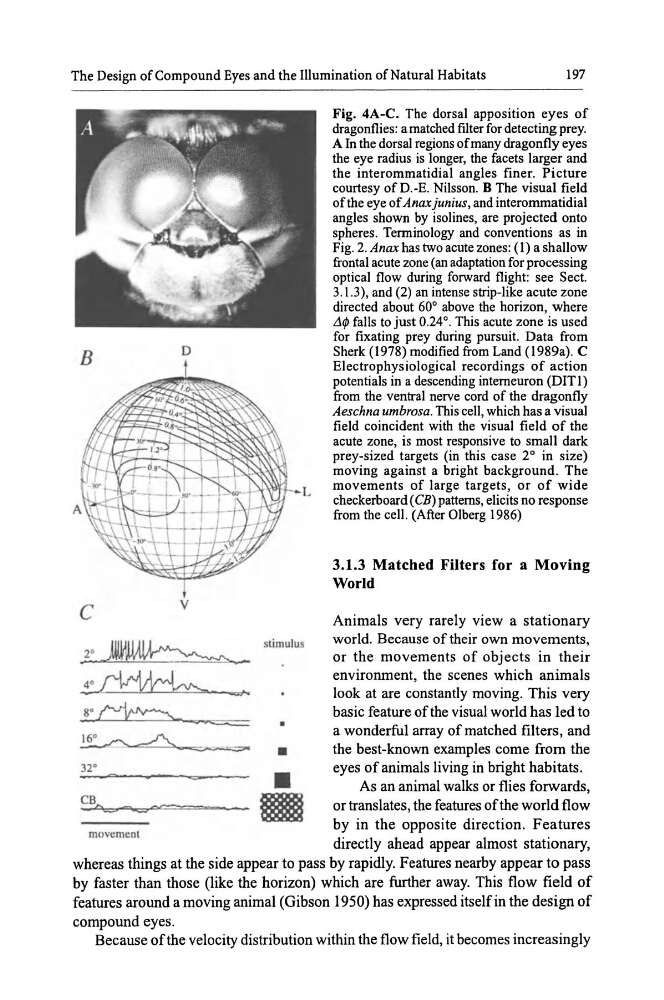
Fig. 4A-C. The dorsal apposition eyes of
dragonflies: a matched filter for detecting prey.
A In the dorsal regions of many dragonfly eyes
the eye radius is longer, the facets larger and
the interommatidial angles finer. Picture
courtesy of D.-E. Nilsson. B The visual field
of the eye ofAnaxjunius, and interomrnatidial
angles shown by isolines, ~re projected onto
spheres. Terminology and conventions as in
Fig. 2. Anax has two acute zones: ( 1) a shallow
frontal acute zone (an adaptation for processing
optical flow during forward flight: see Sect.
3.1.3), and (2) an intense strip-like acute zone
directed about 60° above the horizon, where
.1¢ falls to just 0.24°. This acute zone is used
for fixating prey during pursuit. Data from
Sherk (1978) modified from Land (1989a). C
Electrophysiological recordings of action
potentials in a descending interneuron (DITI)
from the ventral nerve cord of the dragonfly
Aeschna umbrosa. This cell, which has a visual
field coincident with the visual field of the
acute zone, is most responsive to small dark
prey-sized targets (in this case 2° in size)
moving against a bright background. The
movements of large targets, or of wide
checkerboard ( CB) patterns, elicits no response
from the cell. (After Olberg 1986)
3.1.3 Matched Filters for a Moving
World
Animals very rarely view a stationary
world. Because of their own movements,
or the movements of objects in their
environment, the scenes which animals
look at are constantly moving. This very
basic feature of the visual world has led to
a wonderful array of matched filters, and
the best-known examples come from the
eyes of animals living in bright habitats.
As an animal walks or flies forwards,
or translates, the features of the world flow
by in the opposite direction. Features
directly ahead appear almost stationary,
whereas things at the side appear to pass by rapidly. Features nearby appear to pass
by faster than those (like the horizon) which are further away. This flow field of
features around a moving animal (Gibson 1950) has expressed itself in the design of
compound eyes.
Because of the velocity distribution within the flow field, it becomes increasingly
197
v
c
}"JI.WJ~
~- s·~
32"
CB
"'e::.:::u c>zzc:;O<
movement
stimulus
•
•
•
Ill
Fig. 4A-C. The dorsal apposition eyes of
dragonflies: a matched filter for detecting prey.
A In the dorsal regions of many dragonfly eyes
the eye radius is longer, the facets larger and
the interommatidial angles finer. Picture
courtesy of D.-E. Nilsson. B The visual field
of the eye ofAnaxjunius, and interomrnatidial
angles shown by isolines, ~re projected onto
spheres. Terminology and conventions as in
Fig. 2. Anax has two acute zones: ( 1) a shallow
frontal acute zone (an adaptation for processing
optical flow during forward flight: see Sect.
3.1.3), and (2) an intense strip-like acute zone
directed about 60° above the horizon, where
.1¢ falls to just 0.24°. This acute zone is used
for fixating prey during pursuit. Data from
Sherk (1978) modified from Land (1989a). C
Electrophysiological recordings of action
potentials in a descending interneuron (DITI)
from the ventral nerve cord of the dragonfly
Aeschna umbrosa. This cell, which has a visual
field coincident with the visual field of the
acute zone, is most responsive to small dark
prey-sized targets (in this case 2° in size)
moving against a bright background. The
movements of large targets, or of wide
checkerboard ( CB) patterns, elicits no response
from the cell. (After Olberg 1986)
3.1.3 Matched Filters for a Moving
World
Animals very rarely view a stationary
world. Because of their own movements,
or the movements of objects in their
environment, the scenes which animals
look at are constantly moving. This very
basic feature of the visual world has led to
a wonderful array of matched filters, and
the best-known examples come from the
eyes of animals living in bright habitats.
As an animal walks or flies forwards,
or translates, the features of the world flow
by in the opposite direction. Features
directly ahead appear almost stationary,
whereas things at the side appear to pass by rapidly. Features nearby appear to pass
by faster than those (like the horizon) which are further away. This flow field of
features around a moving animal (Gibson 1950) has expressed itself in the design of
compound eyes.
Because of the velocity distribution within the flow field, it becomes increasingly