

188
Eric J. Warrant
bright light, the other class- superposition eyes (Fig. IB) -to dim light. In apposition
eyes, the abundance of light has allowed spatial resolution to be maximized, and
foveal eye regions of higher acuity are very common. The opposite is generally true
in superposition eyes: spatial resolution is usually sacrificed in the drive to capture
as much light as possible.
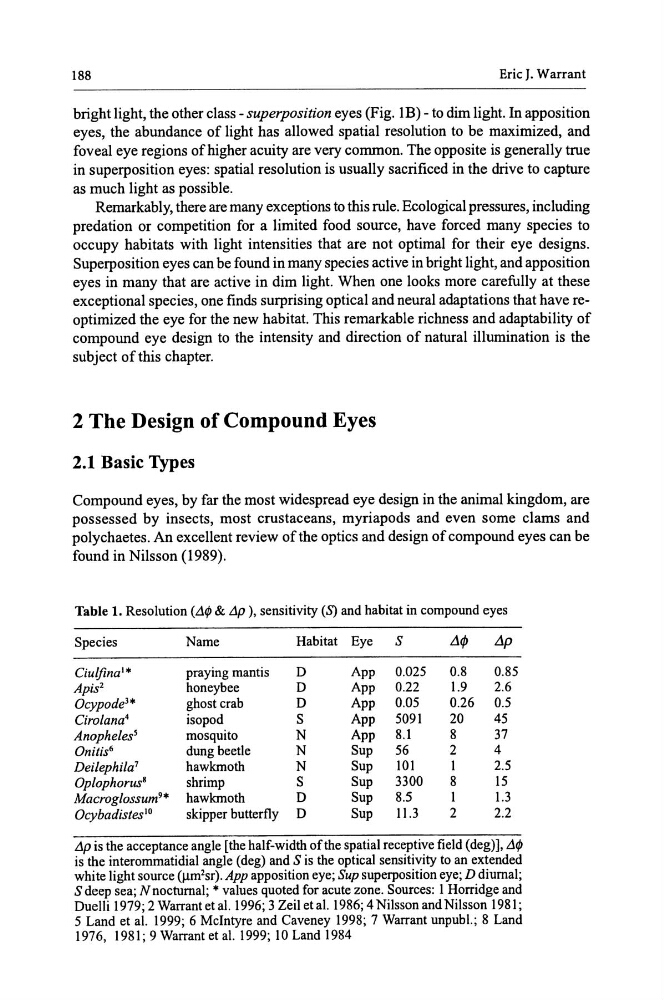
Remarkably, there are many exceptions to this rule. Ecological pressures, including
predation or competition for a limited food source, have forced many species to
occupy habitats with light intensities that are not optimal for their eye designs.
Superposition eyes can be found in many species active in bright light, and apposition
eyes in many that are active in dim light. When one looks more carefully at these
exceptional species, one fmds surprising optical and neural adaptations that have reoptimized the eye for the new habitat. This remarkable richness and adaptability of
compound eye design to the intensity and direction of natural illumination is the
subject of this chapter.
2 The Design of Compound Eyes
2.1 Basic Types
Compound eyes, by far the most widespread eye design in the animal kingdom, are
possessed by insects, most crustaceans, myriapods and even some clams and
polychaetes. An excellent review of the optics and design of compound eyes can be
found in Nilsson (1989).
Table 1. Resolution (Llif> & Llp ), sensitivity (S) and habitat in compound eyes
Species
Name
Habitat Eye
s
tlt;
tlp
Ciulfina 1 *
praying mantis
D
App
0.025
0.8
0.85
Apis 2
honeybee
D
App
0.22
1.9
2.6
Ocypode 3 *
ghost crab
D
App
0.05
0.26
0.5
Cirolana 4
isopod
s
App
5091
20
45
Anopheles 5
mosquito
N
App
8.1
8
37
Onitis 6
dung beetle
N
Sup
56
2
4
Deilephila 1
hawkmoth
N
Sup
101
1
2.5
Oplophorus 8
shrimp
s
Sup
3300
8
15
Macroglossum 9 * hawkmoth
D
Sup
8.5
1
1.3
Ocybadistes 10
skipper butterfly D
Sup
11.3
2
2.2
Llp is the acceptance angle [the half-width of the spatial receptive field (deg)], LlqJ
is the interommatidial angle (deg) and Sis the optical sensitivity to an extended
white light source (~m 2 sr). App apposition eye; Sup superposition eye; D diurnal;
S deep sea; N nocturnal; * values quoted for acute zone. Sources: l Horridge and
Duelli 1979; 2 Warrant et al. 1996; 3 Zeil etal. 1986; 4 Nilsson and Nilsson 1981;
5 Land et al. 1999; 6 Mcintyre and Caveney 1998; 7 Warrant unpubl.; 8 Land
1976, 1981; 9 Warrant et al. 1999; 10 Land 1984
Eric J. Warrant
bright light, the other class- superposition eyes (Fig. IB) -to dim light. In apposition
eyes, the abundance of light has allowed spatial resolution to be maximized, and
foveal eye regions of higher acuity are very common. The opposite is generally true
in superposition eyes: spatial resolution is usually sacrificed in the drive to capture
as much light as possible.
Remarkably, there are many exceptions to this rule. Ecological pressures, including
predation or competition for a limited food source, have forced many species to
occupy habitats with light intensities that are not optimal for their eye designs.
Superposition eyes can be found in many species active in bright light, and apposition
eyes in many that are active in dim light. When one looks more carefully at these
exceptional species, one fmds surprising optical and neural adaptations that have reoptimized the eye for the new habitat. This remarkable richness and adaptability of
compound eye design to the intensity and direction of natural illumination is the
subject of this chapter.
2 The Design of Compound Eyes
2.1 Basic Types
Compound eyes, by far the most widespread eye design in the animal kingdom, are
possessed by insects, most crustaceans, myriapods and even some clams and
polychaetes. An excellent review of the optics and design of compound eyes can be
found in Nilsson (1989).
Table 1. Resolution (Llif> & Llp ), sensitivity (S) and habitat in compound eyes
Species
Name
Habitat Eye
s
tlt;
tlp
Ciulfina 1 *
praying mantis
D
App
0.025
0.8
0.85
Apis 2
honeybee
D
App
0.22
1.9
2.6
Ocypode 3 *
ghost crab
D
App
0.05
0.26
0.5
Cirolana 4
isopod
s
App
5091
20
45
Anopheles 5
mosquito
N
App
8.1
8
37
Onitis 6
dung beetle
N
Sup
56
2
4
Deilephila 1
hawkmoth
N
Sup
101
1
2.5
Oplophorus 8
shrimp
s
Sup
3300
8
15
Macroglossum 9 * hawkmoth
D
Sup
8.5
1
1.3
Ocybadistes 10
skipper butterfly D
Sup
11.3
2
2.2
Llp is the acceptance angle [the half-width of the spatial receptive field (deg)], LlqJ
is the interommatidial angle (deg) and Sis the optical sensitivity to an extended
white light source (~m 2 sr). App apposition eye; Sup superposition eye; D diurnal;
S deep sea; N nocturnal; * values quoted for acute zone. Sources: l Horridge and
Duelli 1979; 2 Warrant et al. 1996; 3 Zeil etal. 1986; 4 Nilsson and Nilsson 1981;
5 Land et al. 1999; 6 Mcintyre and Caveney 1998; 7 Warrant unpubl.; 8 Land
1976, 1981; 9 Warrant et al. 1999; 10 Land 1984