

172
Simon B. Laughlin
obvious. Raptors, with their need for high acuity, and owls, with their need for
high sensitivity, have eyes that are 1.4 (Fig. I) and 2.2 times larger than the
average for birds of the same body weight. Why are many eyes smaller than
average? What factors have promoted reductions in eye size and can these factors
be quantified?
10"
~
·a.
oompound eyes
'10 3
Q)
a.
rn
rn
m
E 10 2
...... -
~
simple eyes
10 1
10o~~~~~~~~~~~wL~~~~
1~
1~
1~
1~
1if
1~
benefit, number of pixels
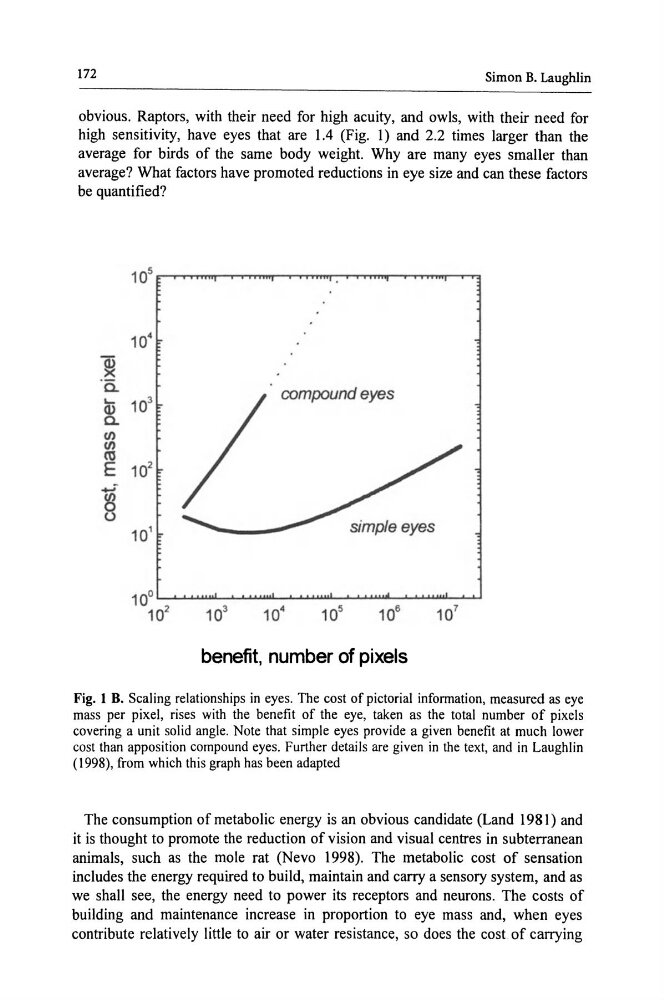
Fig. 1 B. Scaling relationships in eyes. The cost of pictorial information, measured as eye
mass per pixel, rises with the benefit of the eye, taken as the total number of pixels
covering a unit solid angle. Note that simple eyes provide a given benefit at much lower
cost than apposition compound eyes. Further details are given in the text, and in Laughlin
( 1998), from which this graph has been adapted
The consumption of metabolic energy is an obvious candidate (Land 1981) and
it is thought to promote the reduction of vision and visual centres in subterranean
animals, such as the mole rat (Nevo 1998). The metabolic cost of sensation
includes the energy required to build, maintain and carry a sensory system, and as
we shall see, the energy need to power its receptors and neurons. The costs of
building and maintenance increase in proportion to eye mass and, when eyes
contribute relatively little to air or water resistance, so does the cost of carrying
Simon B. Laughlin
obvious. Raptors, with their need for high acuity, and owls, with their need for
high sensitivity, have eyes that are 1.4 (Fig. I) and 2.2 times larger than the
average for birds of the same body weight. Why are many eyes smaller than
average? What factors have promoted reductions in eye size and can these factors
be quantified?
10"
~
·a.
oompound eyes
'10 3
Q)
a.
rn
rn
m
E 10 2
...... -
~
simple eyes
10 1
10o~~~~~~~~~~~wL~~~~
1~
1~
1~
1~
1if
1~
benefit, number of pixels
Fig. 1 B. Scaling relationships in eyes. The cost of pictorial information, measured as eye
mass per pixel, rises with the benefit of the eye, taken as the total number of pixels
covering a unit solid angle. Note that simple eyes provide a given benefit at much lower
cost than apposition compound eyes. Further details are given in the text, and in Laughlin
( 1998), from which this graph has been adapted
The consumption of metabolic energy is an obvious candidate (Land 1981) and
it is thought to promote the reduction of vision and visual centres in subterranean
animals, such as the mole rat (Nevo 1998). The metabolic cost of sensation
includes the energy required to build, maintain and carry a sensory system, and as
we shall see, the energy need to power its receptors and neurons. The costs of
building and maintenance increase in proportion to eye mass and, when eyes
contribute relatively little to air or water resistance, so does the cost of carrying