

The Metabolic Cost of Information- a Fundamental Factor in Visual Ecology
171
objects would be resolved at a constant time to contact. On average, larger
animals move fewer body lengths per second and have eyes that are a smaller
fraction of body length. However, the hypothesis that anatomical resolving
power rises in proportion to speed does not hold in birds (Brooke et al. 1999).
1.5
.........
0>
- (/)
(/)
1.0
m
E
Q)
~ 0.5
~
0.0
2.0
2.5
3.0
3.5
4.0
log body mass (g)
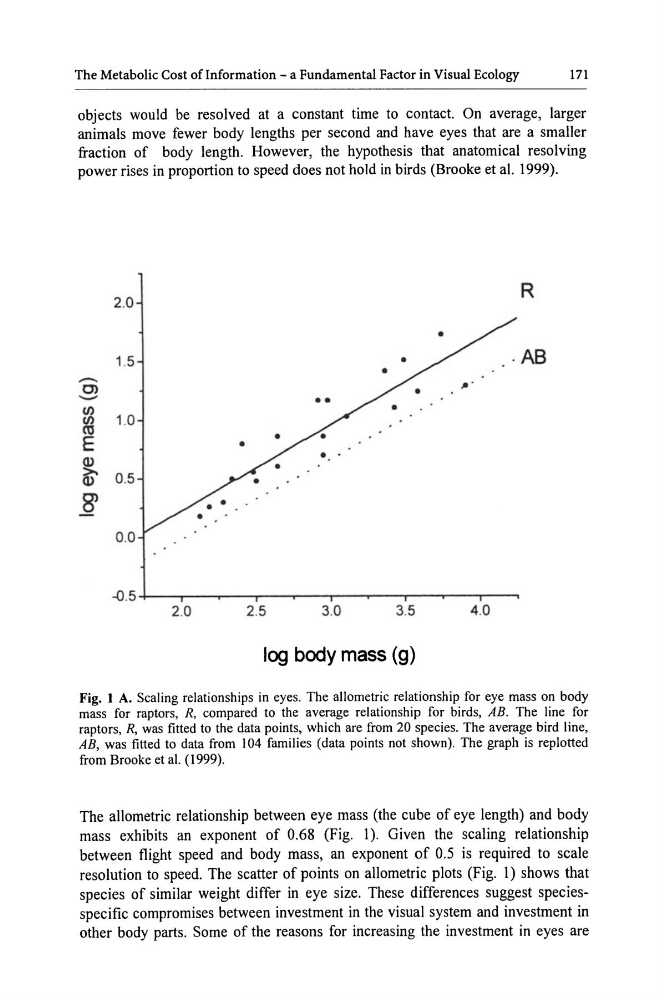
Fig. I A. Scaling relationships in eyes. The allometric relationship for eye mass on body
mass for raptors, R, compared to the average relationship for birds, AB. The line for
raptors, R, was fitted to the data points, which are from 20 species. The average bird line,
AB, was fitted to data from I 04 families (data points not shown). The graph is replotted
from Brooke et al. (1999).
The allometric relationship between eye mass (the cube of eye length) and body
mass exhibits an exponent of 0.68 (Fig. 1). Given the scaling relationship
between flight speed and body mass, an exponent of 0.5 is required to scale
resolution to speed. The scatter of points on allometric plots (Fig. I) shows that
species of similar weight differ in eye size. These differences suggest speciesspecific compromises between investment in the visual system and investment in
other body parts. Some of the reasons for increasing the investment in eyes are
171
objects would be resolved at a constant time to contact. On average, larger
animals move fewer body lengths per second and have eyes that are a smaller
fraction of body length. However, the hypothesis that anatomical resolving
power rises in proportion to speed does not hold in birds (Brooke et al. 1999).
1.5
.........
0>
- (/)
(/)
1.0
m
E
Q)
~ 0.5
~
0.0
2.0
2.5
3.0
3.5
4.0
log body mass (g)
Fig. I A. Scaling relationships in eyes. The allometric relationship for eye mass on body
mass for raptors, R, compared to the average relationship for birds, AB. The line for
raptors, R, was fitted to the data points, which are from 20 species. The average bird line,
AB, was fitted to data from I 04 families (data points not shown). The graph is replotted
from Brooke et al. (1999).
The allometric relationship between eye mass (the cube of eye length) and body
mass exhibits an exponent of 0.68 (Fig. 1). Given the scaling relationship
between flight speed and body mass, an exponent of 0.5 is required to scale
resolution to speed. The scatter of points on allometric plots (Fig. I) shows that
species of similar weight differ in eye size. These differences suggest speciesspecific compromises between investment in the visual system and investment in
other body parts. Some of the reasons for increasing the investment in eyes are