

124
Joseph A. C. Humphrey et al.
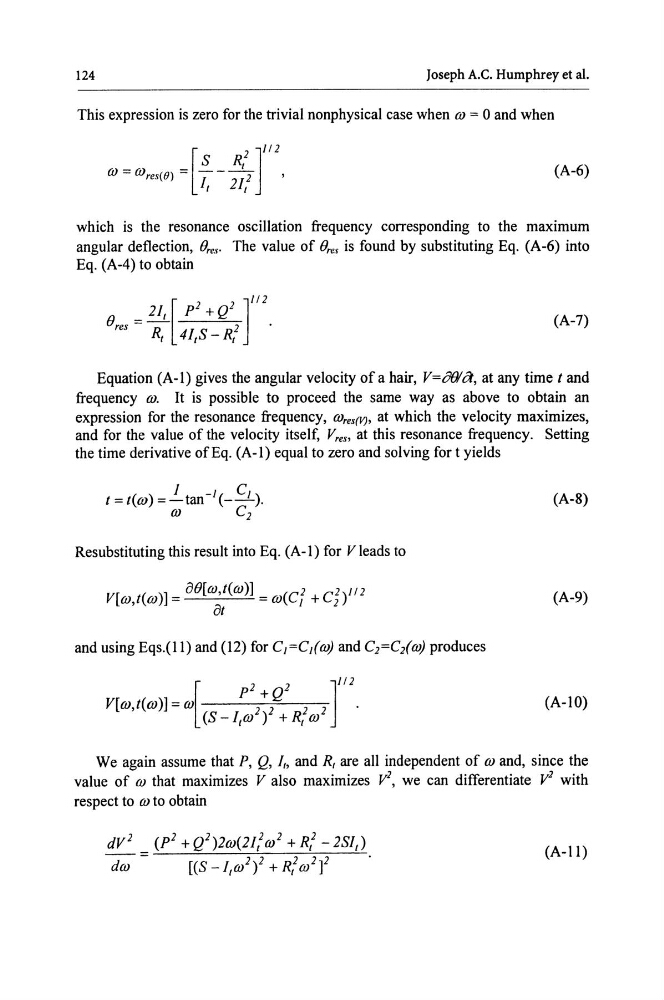
This expression is zero for the trivial nonphysical case when OJ = 0 and when
(A-6)
which is the resonance oscillation frequency corresponding to the maximum
angular deflection, Bre.,·· The value of Bres is found by substituting Eq. (A-6) into
Eq. (A-4) to obtain
(A-7)
Equation (A-1) gives the angular velocity of a hair, V=olt' a, at any time t and
frequency OJ. It is possible to proceed the same way as above to obtain an
expression for the resonance frequency, OJres(VJ• at which the velocity maximizes,
and for the value of the velocity itself, V, • ., at this resonance frequency. Setting
the time derivative ofEq. (A-1) equal to zero and solving fort yields
(A-8)
Resubstituting this result into Eq. (A-1) for V leads to
(A-9)
and using Eqs.(ll) and (12) for C1=CJ{m) and C2=C2(m) produces
[
2
2
]II 2
p +Q
V[m,t(m)] =OJ
2 2
2 2
(S- ! 1 m ) + R 1 m
(A-10)
We again assume that P, Q, I, and R, are all independent of OJ and, since the
value of m that maximizes V also maximizes V 2 , we can differentiate V 2 with
respect to OJ to obtain
(P 2 +Q 2 )2m(2I/m 2 +R/ -2SI 1 )
- - =
[(S _! 1 m2 )2 + R/ OJ2 ]2
dm
(A-ll)
Joseph A. C. Humphrey et al.
This expression is zero for the trivial nonphysical case when OJ = 0 and when
(A-6)
which is the resonance oscillation frequency corresponding to the maximum
angular deflection, Bre.,·· The value of Bres is found by substituting Eq. (A-6) into
Eq. (A-4) to obtain
(A-7)
Equation (A-1) gives the angular velocity of a hair, V=olt' a, at any time t and
frequency OJ. It is possible to proceed the same way as above to obtain an
expression for the resonance frequency, OJres(VJ• at which the velocity maximizes,
and for the value of the velocity itself, V, • ., at this resonance frequency. Setting
the time derivative ofEq. (A-1) equal to zero and solving fort yields
(A-8)
Resubstituting this result into Eq. (A-1) for V leads to
(A-9)
and using Eqs.(ll) and (12) for C1=CJ{m) and C2=C2(m) produces
[
2
2
]II 2
p +Q
V[m,t(m)] =OJ
2 2
2 2
(S- ! 1 m ) + R 1 m
(A-10)
We again assume that P, Q, I, and R, are all independent of OJ and, since the
value of m that maximizes V also maximizes V 2 , we can differentiate V 2 with
respect to OJ to obtain
(P 2 +Q 2 )2m(2I/m 2 +R/ -2SI 1 )
- - =
[(S _! 1 m2 )2 + R/ OJ2 ]2
dm
(A-ll)