

The Motion-Sensing Hairs of Arthropods
123
Shimozawa T, Kanou M (1984) The aerodynamics and sensory physiology of
range fractionation in the cereal filiform sensilla of the cricket Gryllus
bimaculatus. J Comp Physiol A 155:495-505
Shimozawa T, Kumagai T, Baba Y (1998) Structural scaling and functional design
ofthe cereal wind-receptor hairs of a cricket. J Comp Physiol A 183:171186
Stokes GG (1851) On the effect of the internal friction of fluids on the motion of
pendulums. Trans Camb Phil Soc 9:8ff. (Reprinted in Mathematical and
physical papers, vol. III, 1-141. Cambridge University Press, 1901)
Tautz J (1979) Reception of particle oscillation in a medium - an unorthodox
sensory capacity. Narturwissenschaften 66:452-461
Appendix
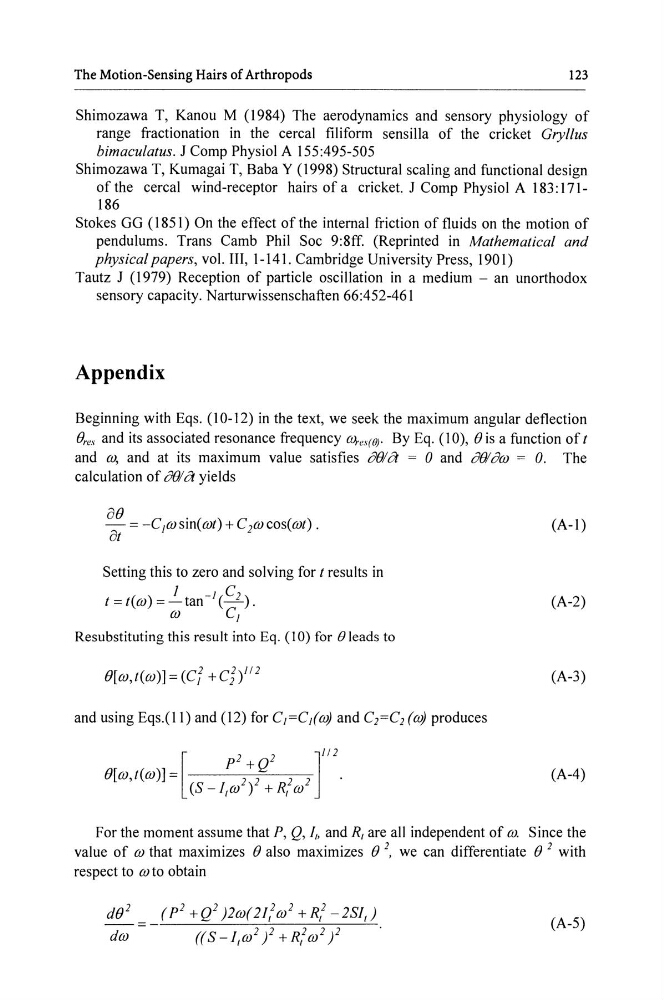
Beginning with Eqs. ( 1 0-12) in the text, we seek the maximum angular deflection
Bres and its associated resonance frequency CV,.es(B)· By Eq. (I 0), ()is a function oft
and OJ, and at its maximum value satisfies iJ()!Ct = 0 and iJ()IiJOJ = 0. The
calculation of iJ()/Ct yields
Setting this to zero and solving for t results in
t = t(OJ) = .itan- 1 (C 2 ).
OJ
cl
Resubstituting this result into Eq. (I 0) for B leads to
B[OJ,t(OJ)]=(Cf +Cff)I1 2
and using Eqs.(l1) and (12) for C1=CJ(w) and C2=C2 (OJ) produces
[
2
2
]II 2
p +Q
B[OJ,t(OJ)] =
2 2
2 2
(S- f 1 0J ) + R 1 OJ
(A-1)
(A-2)
(A-3)
(A-4)
For the moment assume that P, Q, !,, and R, are all independent of OJ. Since the
value of OJ that maximizes () also maximizes () 2 , we can differentiate () 2 with
respect to OJ to obtain
d() 2
(P 2 +Q 2 )20J(21/0J 2 +R/ -2S1 1 )
- - - -
dOJ
((S-1 1 0J 2 /+R/OJ 2 /
(A-5)
123
Shimozawa T, Kanou M (1984) The aerodynamics and sensory physiology of
range fractionation in the cereal filiform sensilla of the cricket Gryllus
bimaculatus. J Comp Physiol A 155:495-505
Shimozawa T, Kumagai T, Baba Y (1998) Structural scaling and functional design
ofthe cereal wind-receptor hairs of a cricket. J Comp Physiol A 183:171186
Stokes GG (1851) On the effect of the internal friction of fluids on the motion of
pendulums. Trans Camb Phil Soc 9:8ff. (Reprinted in Mathematical and
physical papers, vol. III, 1-141. Cambridge University Press, 1901)
Tautz J (1979) Reception of particle oscillation in a medium - an unorthodox
sensory capacity. Narturwissenschaften 66:452-461
Appendix
Beginning with Eqs. ( 1 0-12) in the text, we seek the maximum angular deflection
Bres and its associated resonance frequency CV,.es(B)· By Eq. (I 0), ()is a function oft
and OJ, and at its maximum value satisfies iJ()!Ct = 0 and iJ()IiJOJ = 0. The
calculation of iJ()/Ct yields
Setting this to zero and solving for t results in
t = t(OJ) = .itan- 1 (C 2 ).
OJ
cl
Resubstituting this result into Eq. (I 0) for B leads to
B[OJ,t(OJ)]=(Cf +Cff)I1 2
and using Eqs.(l1) and (12) for C1=CJ(w) and C2=C2 (OJ) produces
[
2
2
]II 2
p +Q
B[OJ,t(OJ)] =
2 2
2 2
(S- f 1 0J ) + R 1 OJ
(A-1)
(A-2)
(A-3)
(A-4)
For the moment assume that P, Q, !,, and R, are all independent of OJ. Since the
value of OJ that maximizes () also maximizes () 2 , we can differentiate () 2 with
respect to OJ to obtain
d() 2
(P 2 +Q 2 )20J(21/0J 2 +R/ -2S1 1 )
- - - -
dOJ
((S-1 1 0J 2 /+R/OJ 2 /
(A-5)