

Marine-Derived Fungal Metabolites 32.2 Drug Screening from Marine Organisms 761
Part F | 32.2
NH 2
OH
H-Cys-Lys-Gly-Lys-Gly-Ala-Lys-Cys-Ser-Arg-Leu-Met-Tyr-Asp-CysCys-Thr-Gly-Ser-Cys-Arg-Ser-Gly-Lys-Cys-NH 2
Cytarabine
(Cytosar
®
)
Vidarabine
(Vira-A
® )
Eribulin mesylate
(Halaven
®
)
Ziconotide, ω-conotoxin MVIIA
(Prialt
®
)
Zidovudine
(Retrovir
®
)
Lamivudine
(Epivir
®
)
Stavudine
(Zerit
®
)
Trabectedin
(Yondelis
®
)
HO
HO
N
N
O
O
NH 2
CH 3
N 3
OH
HO
HO
OH
NH
H
H
H
OH
O
–
S
Me
+ H 3 N
HO
HO
N
HN
N
N
N
N
O
O
O
O
HO
N
N
NH 2
O
O
O
O
O
1
O
H
O
O
O
O
O
O
O
O
O
O
O
O
O
O
N
N
S
S
O
HO
HN
N
O
CH 3
O
O
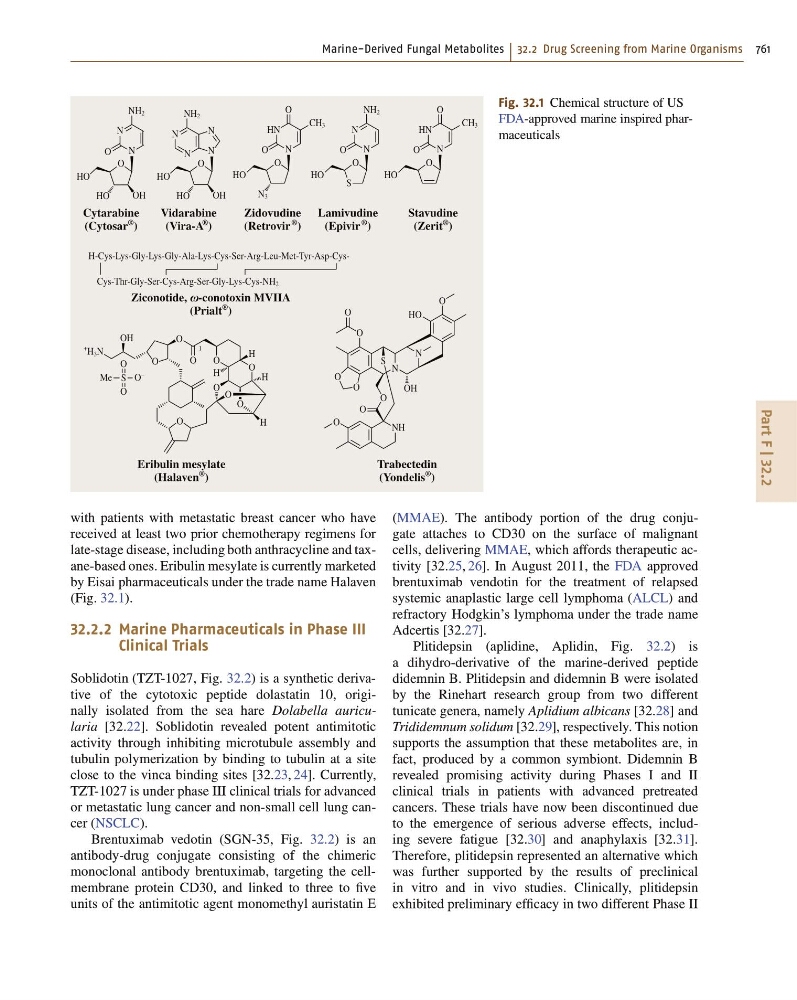
Fig. 32.1 Chemical structure of US
FDA-approved marine inspired pharmaceuticals
with patients with metastatic breast cancer who have
received at least two prior chemotherapy regimens for
late-stage disease, including both anthracycline and taxane-based ones. Eribulin mesylate is currently marketed
by Eisai pharmaceuticals under the trade name Halaven
(Fig. 32.1).
32.2.2 Marine Pharmaceuticals in Phase III
Clinical Trials
Soblidotin (TZT-1027, Fig. 32.2) is a synthetic derivative of the cytotoxic peptide dolastatin 10, originally isolated from the sea hare Dolabella auricularia [32.22]. Soblidotin revealed potent antimitotic
activity through inhibiting microtubule assembly and
tubulin polymerization by binding to tubulin at a site
close to the vinca binding sites [32.23, 24]. Currently,
TZT-1027 is under phase III clinical trials for advanced
or metastatic lung cancer and non-small cell lung cancer (NSCLC).
Brentuximab vedotin (SGN-35, Fig. 32.2) is an
antibody-drug conjugate consisting of the chimeric
monoclonal antibody brentuximab, targeting the cellmembrane protein CD30, and linked to three to five
units of the antimitotic agent monomethyl auristatin E
(MMAE). The antibody portion of the drug conjugate attaches to CD30 on the surface of malignant
cells, delivering MMAE, which affords therapeutic activity [32.25, 26]. In August 2011, the FDA approved
brentuximab vendotin for the treatment of relapsed
systemic anaplastic large cell lymphoma (ALCL) and
refractory Hodgkin’s lymphoma under the trade name
Adcertis [32.27].
Plitidepsin (aplidine, Aplidin, Fig. 32.2) is
a dihydro-derivative of the marine-derived peptide
didemnin B. Plitidepsin and didemnin B were isolated
by the Rinehart research group from two different
tunicate genera, namely Aplidium albicans [32.28] and
Trididemnum solidum [32.29], respectively. This notion
supports the assumption that these metabolites are, in
fact, produced by a common symbiont. Didemnin B
revealed promising activity during Phases I and II
clinical trials in patients with advanced pretreated
cancers. These trials have now been discontinued due
to the emergence of serious adverse effects, including severe fatigue [32.30] and anaphylaxis [32.31].
Therefore, plitidepsin represented an alternative which
was further supported by the results of preclinical
in vitro and in vivo studies. Clinically, plitidepsin
exhibited preliminary efficacy in two different Phase II