

Part F | 31.4
754 Part F Marine Derived Metabolites
a)
b)
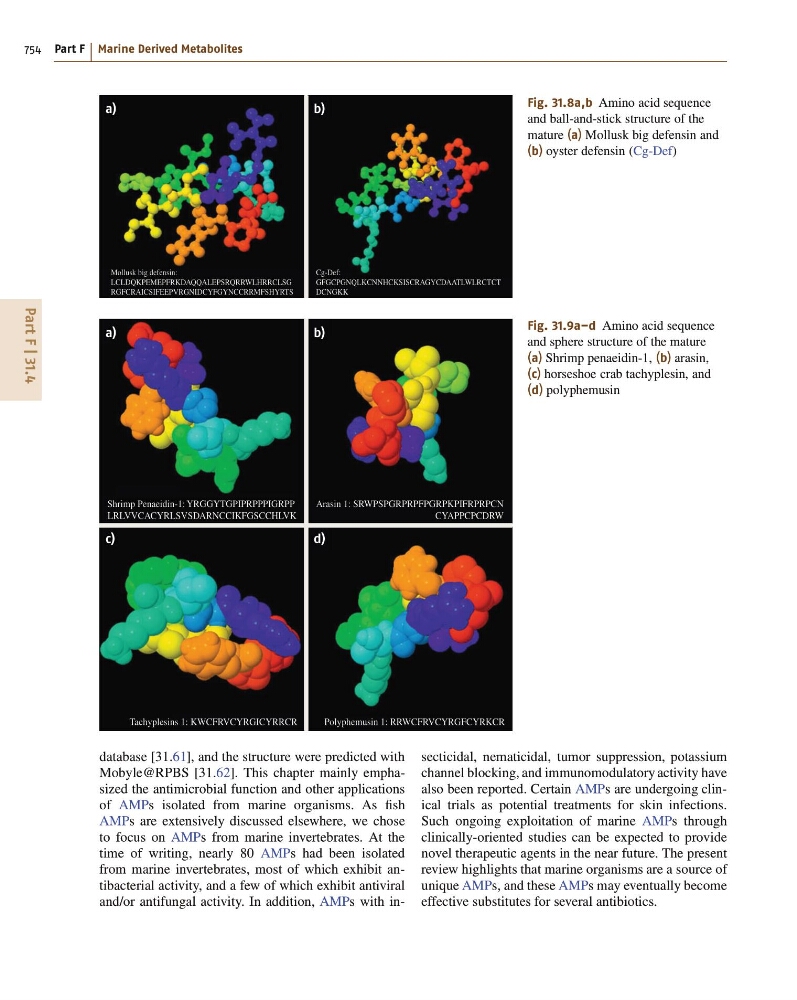
Mollusk big defensin:
LCLDQKPEMEPFRKDAQQALEPSRQRRWLHRRCLSG
RGFCRAICSIFEEPVRGNIDCYFGYNCCRRMFSHYRTS
Cg-Def:
GFGCPGNQLKCNNHCKSISCRAGYCDAATLWLRCTCT
DCNGKK
Fig. 31.8a,b Amino acid sequence
and ball-and-stick structure of the
mature (a) Mollusk big defensin and
(b) oyster defensin (Cg-Def)
a)
b)
c)
d)
Shrimp Penaeidin-1: YRGGYTGPIPRPPPIGRPP
LRLVVCACYRLSVSDARNCCIKFGSCCHLVK
Arasin 1: SRWPSPGRPRPFPGRPKPIFRPRPCN
CYAPPCPCDRW
Tachyplesins 1: KWCFRVCYRGICYRRCR
Polyphemusin 1: RRWCFRVCYRGFCYRKCR
Fig. 31.9a–d Amino acid sequence
and sphere structure of the mature
(a) Shrimp penaeidin-1, (b) arasin,
(c) horseshoe crab tachyplesin, and
(d) polyphemusin
database [31.61], and the structure were predicted with
Mobyle@RPBS [31.62]. This chapter mainly emphasized the antimicrobial function and other applications
of AMPs isolated from marine organisms. As fish
AMPs are extensively discussed elsewhere, we chose
to focus on AMPs from marine invertebrates. At the
time of writing, nearly 80 AMPs had been isolated
from marine invertebrates, most of which exhibit antibacterial activity, and a few of which exhibit antiviral
and/or antifungal activity. In addition, AMPs with insecticidal, nematicidal, tumor suppression, potassium
channel blocking, and immunomodulatory activity have
also been reported. Certain AMPs are undergoing clinical trials as potential treatments for skin infections.
Such ongoing exploitation of marine AMPs through
clinically-oriented studies can be expected to provide
novel therapeutic agents in the near future. The present
review highlights that marine organisms are a source of
unique AMPs, and these AMPs may eventually become
effective substitutes for several antibiotics.