

Drugs and Leads from the Ocean Through Biotechnology 29.5 Marine Natural Products: New and Recurrent Challenges 721
Part F | 29.5
microorganisms that invertebrates take up from the food
chain, such as in the case of bryostatin 1, which is actually produced by a symbiotic microorganism living
in the host bryozoans B. neritina [29.98, 99]. Hence,
new methods for the development of marine natural
products could diversify and facilitate production. It is
hoped that synthesis and fermentation simultaneously
with biotechnology may be the major methods for the
development of marine natural products to reach industrial production.
29.5.2 Marine Natural Products:
Paradigms, Genomics, and
Biosynthesis Exemplified
The sustainable biotechnological production of pharmacologically important metabolites from marine organisms may be improved by genomics and with
cloning and expression of the respective key biosynthetic gene clusters. A combination of the available
biotechnological strategies must definitely be considered due the complexity of the structure and the novelty
of marine natural products. Particular and more orientated approaches will open up new avenues for biotechnological production of drugs or drug candidates from
the sea. In some ways, many compounds from marine
organisms do not receive the required consideration that
they deserve from pharmaceutical companies because
of concerns about a sustainable, economic supply of
the compounds [29.9]. The traditional process of drug
discovery and delivery has been undertaken largely
through the effects of a natural product or a derived
synthetic agent on a living system (physiological process or pathological state) and a process of testing in
vivo, as well as chemical synthesis. Thus, discoveries
were achieved by a one molecule at a time process.
The new paradigms in drug discovery are dominated
by genomic-based approaches which are expected to
lead to multiple new targets [29.84], which could represent a significant increase of approximately thousands
of targets in the pharmacognosia of natural products
(Fig. 29.7).
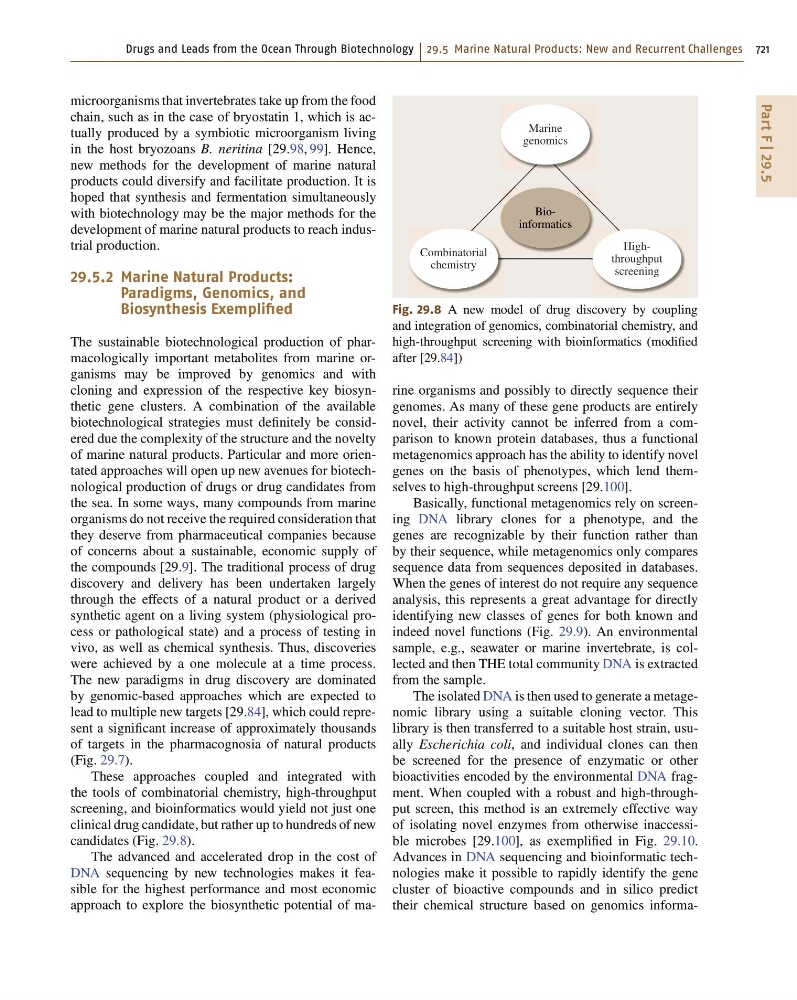
These approaches coupled and integrated with
the tools of combinatorial chemistry, high-throughput
screening, and bioinformatics would yield not just one
clinical drug candidate, but rather up to hundreds of new
candidates (Fig. 29.8).
The advanced and accelerated drop in the cost of
DNA sequencing by new technologies makes it feasible for the highest performance and most economic
approach to explore the biosynthetic potential of maMarine
genomics
Bioinformatics
Combinatorial
chemistry
Highthroughput
screening
Fig. 29.8 A new model of drug discovery by coupling
and integration of genomics, combinatorial chemistry, and
high-throughput screening with bioinformatics (modified
after [29.84])
rine organisms and possibly to directly sequence their
genomes. As many of these gene products are entirely
novel, their activity cannot be inferred from a comparison to known protein databases, thus a functional
metagenomics approach has the ability to identify novel
genes on the basis of phenotypes, which lend themselves to high-throughput screens [29.100].
Basically, functional metagenomics rely on screening DNA library clones for a phenotype, and the
genes are recognizable by their function rather than
by their sequence, while metagenomics only compares
sequence data from sequences deposited in databases.
When the genes of interest do not require any sequence
analysis, this represents a great advantage for directly
identifying new classes of genes for both known and
indeed novel functions (Fig. 29.9). An environmental
sample, e.g., seawater or marine invertebrate, is collected and then THE total community DNA is extracted
from the sample.
The isolated DNA is then used to generate a metagenomic library using a suitable cloning vector. This
library is then transferred to a suitable host strain, usually Escherichia coli, and individual clones can then
be screened for the presence of enzymatic or other
bioactivities encoded by the environmental DNA fragment. When coupled with a robust and high-throughput screen, this method is an extremely effective way
of isolating novel enzymes from otherwise inaccessible microbes [29.100], as exemplified in Fig. 29.10.
Advances in DNA sequencing and bioinformatic technologies make it possible to rapidly identify the gene
cluster of bioactive compounds and in silico predict
their chemical structure based on genomics informa-