

Part E | 28.3
702 Part E Marine Microbiology and Biotechnology
0
1
2
3
4
5
6
7
8
9
1 0
1 1
1 2
1 4
13
Time
Inten.
Time 11.976 Inten.
–5430
Time 12.182 Inten.
51 875
Time 10.344 Inten.
19 414
24 754
Time 15.350 Inten.
15 min
µV (×100 000)
µV (×10 000)
Chromatogram
7.5
5
2.5
0
5
2.5
0
µV (×10 000)
10
7.5
5
2.5
0
µV (×10 000)
2
1
0
µV (×10 000)
a)
b)
c)
d)
e)
2
1
0
CN
CN
OH
OH
O
OH
OH
O
OH
OH
O
OH
O
OH
O
OH
O
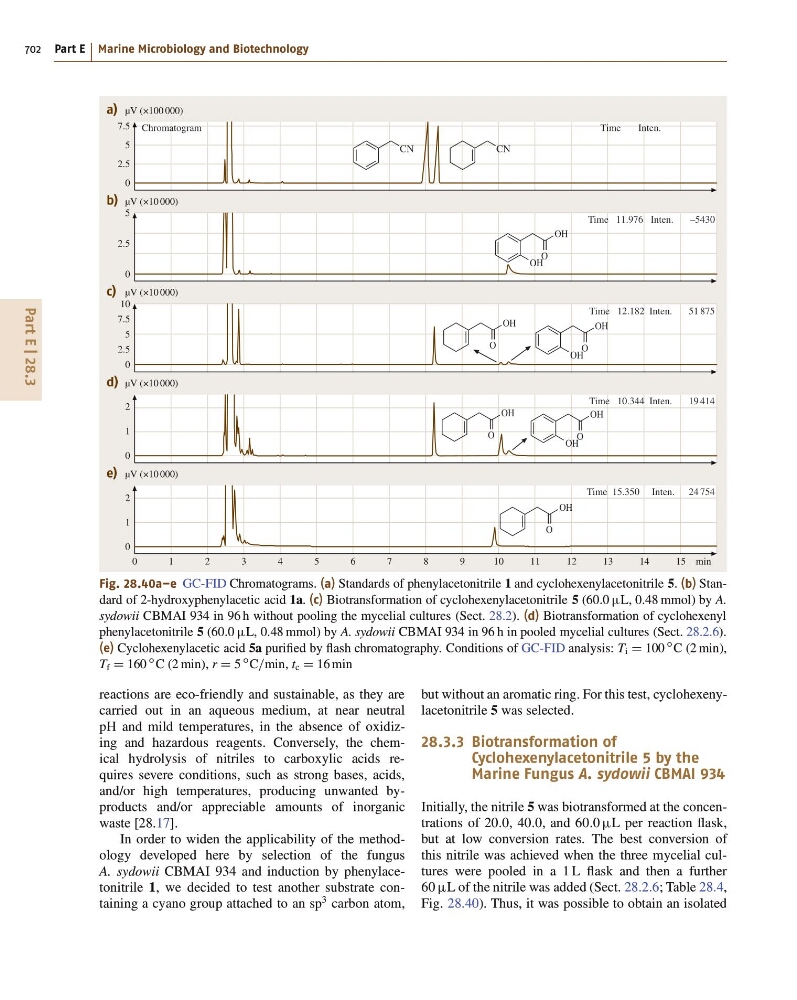
Fig. 28.40a–e GC-FID Chromatograms. (a) Standards of phenylacetonitrile 1 and cyclohexenylacetonitrile 5. (b) Standard of 2-hydroxyphenylacetic acid 1a. (c) Biotransformation of cyclohexenylacetonitrile 5 (60:0 L, 0:48 mmol) by A.
sydowii CBMAI 934 in 96 h without pooling the mycelial cultures (Sect. 28.2). (d) Biotransformation of cyclohexenyl
phenylacetonitrile 5 (60:0 L, 0:48 mmol) by A. sydowii CBMAI 934 in 96 h in pooled mycelial cultures (Sect. 28.2.6).
(e) Cyclohexenylacetic acid 5a purified by flash chromatography. Conditions of GC-FID analysis: T i D 100
ı C (2 min),
T f D 160
ı C (2 min), r D 5
ı C=min, t c D 16 min
reactions are eco-friendly and sustainable, as they are
carried out in an aqueous medium, at near neutral
pH and mild temperatures, in the absence of oxidizing and hazardous reagents. Conversely, the chemical hydrolysis of nitriles to carboxylic acids requires severe conditions, such as strong bases, acids,
and/or high temperatures, producing unwanted byproducts and/or appreciable amounts of inorganic
waste [28.17].
In order to widen the applicability of the methodology developed here by selection of the fungus
A. sydowii CBMAI 934 and induction by phenylacetonitrile 1, we decided to test another substrate containing a cyano group attached to an sp
3 carbon atom,
but without an aromatic ring. For this test, cyclohexenylacetonitrile 5 was selected.
28.3.3 Biotransformation of
Cyclohexenylacetonitrile 5 by the
Marine Fungus A. sydowii CBMAI 934
Initially, the nitrile 5 was biotransformed at the concentrations of 20:0, 40:0, and 60:0 L per reaction flask,
but at low conversion rates. The best conversion of
this nitrile was achieved when the three mycelial cultures were pooled in a 1 L flask and then a further
60 L of the nitrile was added (Sect. 28.2.6; Table 28.4,
Fig. 28.40). Thus, it was possible to obtain an isolated