

Biotransformation of Nitriles by Marine Fungi 28.3 Results and Discussion 701
Part E | 28.3
0
1
2
3
4
5
6
7
8
9
1 0
1 1
1 2
1 4
13
Time 14.302
Inten.
Time 12.357 Inten.
36 376
485 138
Time 14.406 Inten.
4495
Time 15.000 Inten.
11 239
200 000
Time 6.877
Inten.
min
µV (×100 000)
µV (×10 000)
7.5
5
2.5
0
5
2.5
0
µV (×10 000)
5
2.5
0
µV (×10 000)
1
0.5
0
µV (×100 000)
a)
b)
c)
d)
e)
f)
2
1
0
CN
MeO
CN
MeO
CN
OH
OH
O
OH
OH
O
OH
OH
O
MeO
OH
O
MeO
OH
O
MeO
OH
O
Time
Inten.
µV (×100 000)
Chromatogram
2
1
0
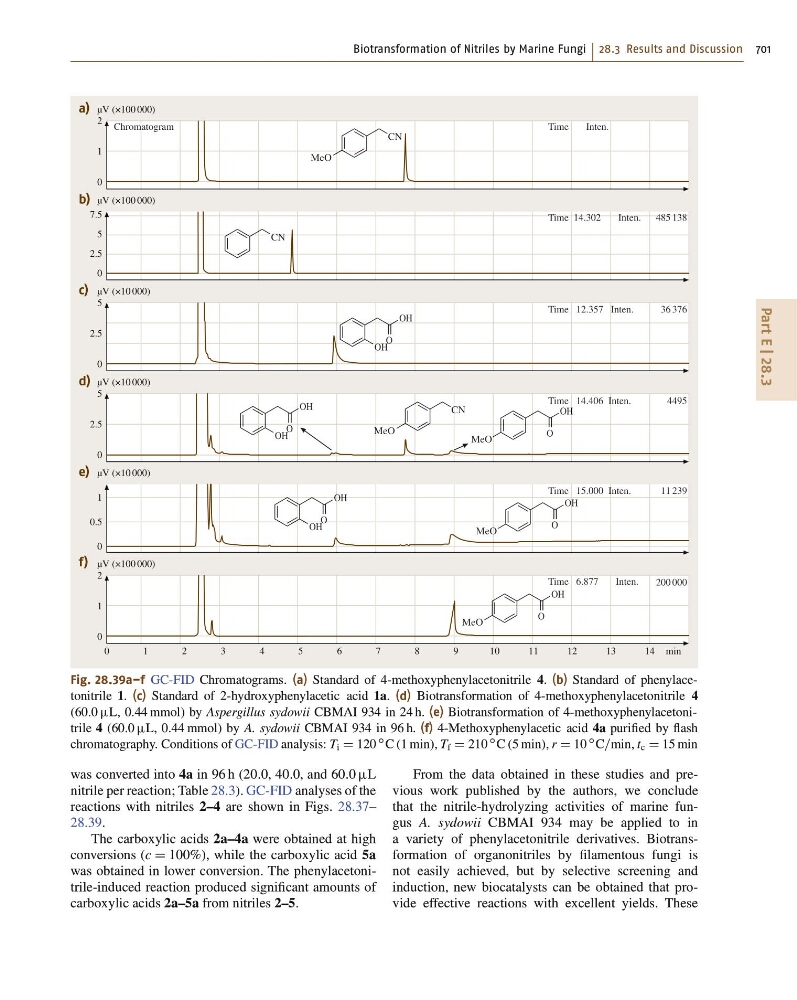
Fig. 28.39a–f GC-FID Chromatograms. (a) Standard of 4-methoxyphenylacetonitrile 4. (b) Standard of phenylacetonitrile 1. (c) Standard of 2-hydroxyphenylacetic acid 1a. (d) Biotransformation of 4-methoxyphenylacetonitrile 4
(60:0 L, 0:44 mmol) by Aspergillus sydowii CBMAI 934 in 24 h. (e) Biotransformation of 4-methoxyphenylacetonitrile 4 (60:0 L, 0:44 mmol) by A. sydowii CBMAI 934 in 96 h. (f) 4-Methoxyphenylacetic acid 4a purified by flash
chromatography. Conditions of GC-FID analysis: T i D 120
ı C (1 min), T f D 210
ı C (5 min), r D 10
ı C=min, t c D 15 min
was converted into 4a in 96 h (20:0, 40:0, and 60:0 L
nitrile per reaction; Table 28.3). GC-FID analyses of the
reactions with nitriles 2–4 are shown in Figs. 28.37–
28.39.
The carboxylic acids 2a–4a were obtained at high
conversions (c D 100%), while the carboxylic acid 5a
was obtained in lower conversion. The phenylacetonitrile-induced reaction produced significant amounts of
carboxylic acids 2a–5a from nitriles 2–5.
From the data obtained in these studies and previous work published by the authors, we conclude
that the nitrile-hydrolyzing activities of marine fungus A. sydowii CBMAI 934 may be applied to in
a variety of phenylacetonitrile derivatives. Biotransformation of organonitriles by filamentous fungi is
not easily achieved, but by selective screening and
induction, new biocatalysts can be obtained that provide effective reactions with excellent yields. These