

Marine Algae Biomass for Removal of Heavy Metal Ions 25.7 Mechanism of Biosorption 641
Part D | 25.8
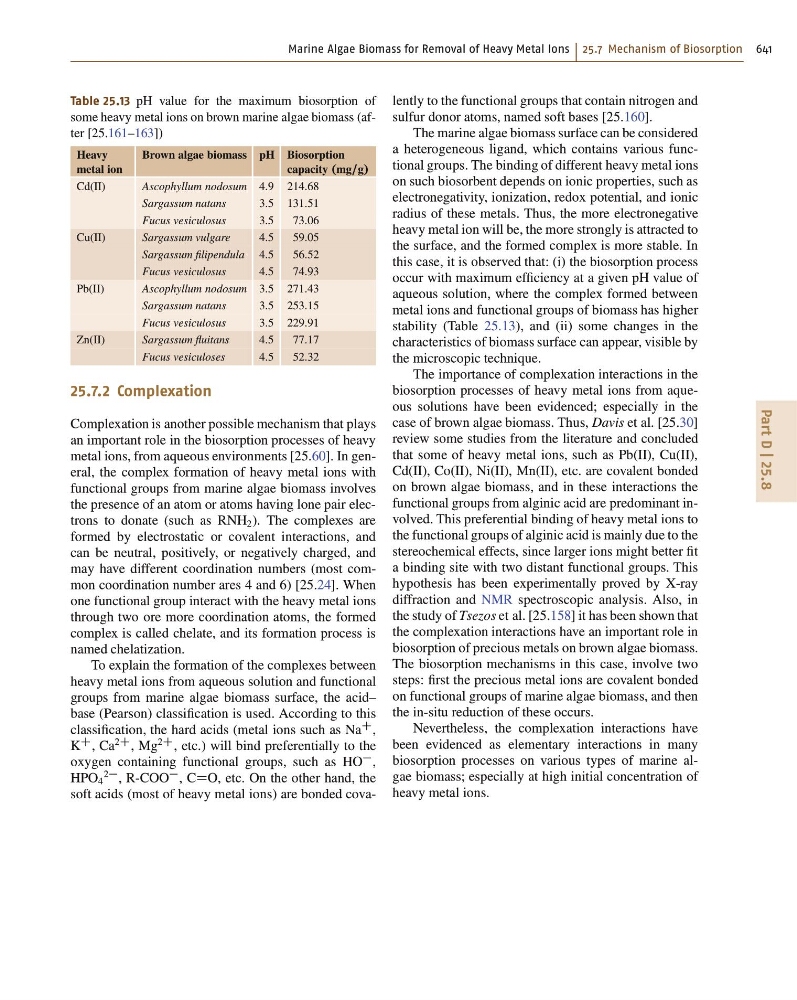
Table 25.13 pH value for the maximum biosorption of
some heavy metal ions on brown marine algae biomass (after [25.161–163])
Heavy
metal ion
Brown algae biomass pH Biosorption
capacity .mg=g/
Cd(II)
Ascophyllum nodosum 4.9 214.68
Sargassum natans
3.5 131.51
Fucus vesiculosus
3.5
73.06
Cu(II)
Sargassum vulgare
4.5
59.05
Sargassum filipendula 4.5
56.52
Fucus vesiculosus
4.5
74.93
Pb(II)
Ascophyllum nodosum 3.5 271.43
Sargassum natans
3.5 253.15
Fucus vesiculosus
3.5 229.91
Zn(II)
Sargassum fluitans
4.5
77.17
Fucus vesiculoses
4.5
52.32
25.7.2 Complexation
Complexation is another possible mechanism that plays
an important role in the biosorption processes of heavy
metal ions, from aqueous environments [25.60]. In general, the complex formation of heavy metal ions with
functional groups from marine algae biomass involves
the presence of an atom or atoms having lone pair electrons to donate (such as RNH 2 ). The complexes are
formed by electrostatic or covalent interactions, and
can be neutral, positively, or negatively charged, and
may have different coordination numbers (most common coordination number ares 4 and 6) [25.24]. When
one functional group interact with the heavy metal ions
through two ore more coordination atoms, the formed
complex is called chelate, and its formation process is
named chelatization.
To explain the formation of the complexes between
heavy metal ions from aqueous solution and functional
groups from marine algae biomass surface, the acid–
base (Pearson) classification is used. According to this
classification, the hard acids (metal ions such as Na
C ,
K
C , Ca
2C , Mg
2C , etc.) will bind preferentially to the
oxygen containing functional groups, such as HO
,
HPO 4
2 , R-COO
, CDO, etc. On the other hand, the
soft acids (most of heavy metal ions) are bonded covalently to the functional groups that contain nitrogen and
sulfur donor atoms, named soft bases [25.160].
The marine algae biomass surface can be considered
a heterogeneous ligand, which contains various functional groups. The binding of different heavy metal ions
on such biosorbent depends on ionic properties, such as
electronegativity, ionization, redox potential, and ionic
radius of these metals. Thus, the more electronegative
heavy metal ion will be, the more strongly is attracted to
the surface, and the formed complex is more stable. In
this case, it is observed that: (i) the biosorption process
occur with maximum efficiency at a given pH value of
aqueous solution, where the complex formed between
metal ions and functional groups of biomass has higher
stability (Table 25.13), and (ii) some changes in the
characteristics of biomass surface can appear, visible by
the microscopic technique.
The importance of complexation interactions in the
biosorption processes of heavy metal ions from aqueous solutions have been evidenced; especially in the
case of brown algae biomass. Thus, Davis et al. [25.30]
review some studies from the literature and concluded
that some of heavy metal ions, such as Pb(II), Cu(II),
Cd(II), Co(II), Ni(II), Mn(II), etc. are covalent bonded
on brown algae biomass, and in these interactions the
functional groups from alginic acid are predominant involved. This preferential binding of heavy metal ions to
the functional groups of alginic acid is mainly due to the
stereochemical effects, since larger ions might better fit
a binding site with two distant functional groups. This
hypothesis has been experimentally proved by X-ray
diffraction and NMR spectroscopic analysis. Also, in
the study of Tsezos et al. [25.158] it has been shown that
the complexation interactions have an important role in
biosorption of precious metals on brown algae biomass.
The biosorption mechanisms in this case, involve two
steps: first the precious metal ions are covalent bonded
on functional groups of marine algae biomass, and then
the in-situ reduction of these occurs.
Nevertheless, the complexation interactions have
been evidenced as elementary interactions in many
biosorption processes on various types of marine algae biomass; especially at high initial concentration of
heavy metal ions.