

Part D | 25.7
640 Part D Marine Algal Biotechnology
4000
3000
2922.15
3429.43
3311.61
2939.37
1635.63
1543.05
1421.53
1417.61
1238.24
1055.01
844.78
702.05
1533.33
1652.91
1255.66
1114.85
1055.06
1031.86
790.81
671.23
2000
1000
(1)
(2)
Wavenumber (cm
–1
)
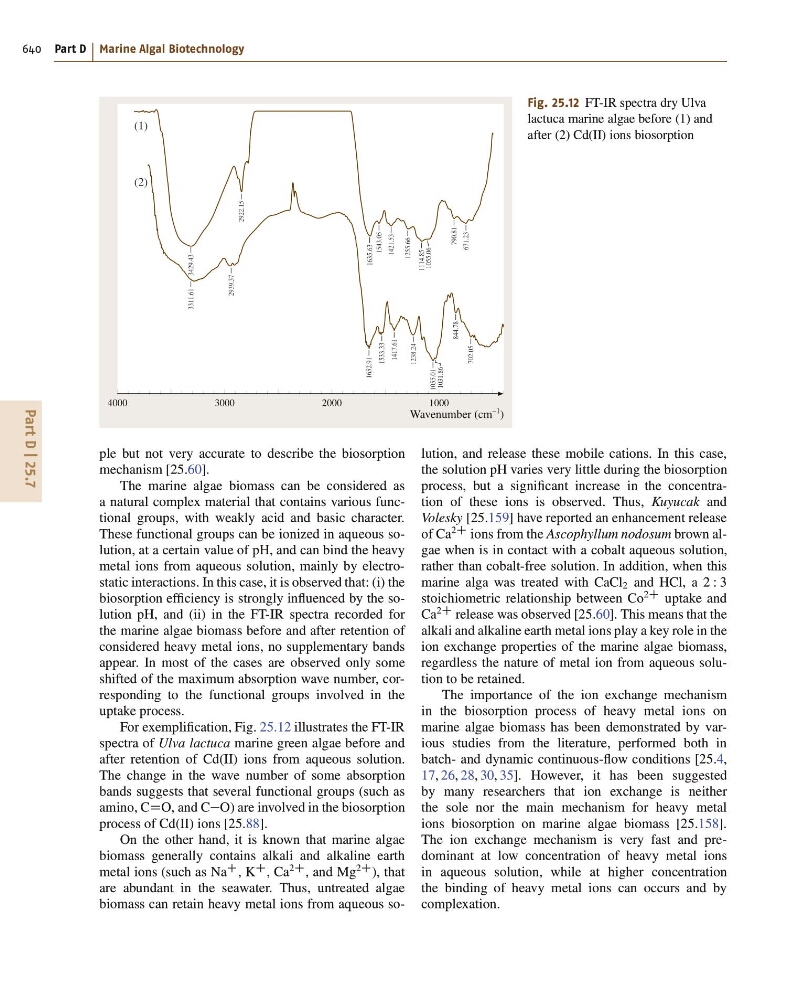
Fig. 25.12 FT-IR spectra dry Ulva
lactuca marine algae before (1) and
after (2) Cd(II) ions biosorption
ple but not very accurate to describe the biosorption
mechanism [25.60].
The marine algae biomass can be considered as
a natural complex material that contains various functional groups, with weakly acid and basic character.
These functional groups can be ionized in aqueous solution, at a certain value of pH, and can bind the heavy
metal ions from aqueous solution, mainly by electrostatic interactions. In this case, it is observed that: (i) the
biosorption efficiency is strongly influenced by the solution pH, and (ii) in the FT-IR spectra recorded for
the marine algae biomass before and after retention of
considered heavy metal ions, no supplementary bands
appear. In most of the cases are observed only some
shifted of the maximum absorption wave number, corresponding to the functional groups involved in the
uptake process.
For exemplification, Fig. 25.12 illustrates the FT-IR
spectra of Ulva lactuca marine green algae before and
after retention of Cd(II) ions from aqueous solution.
The change in the wave number of some absorption
bands suggests that several functional groups (such as
amino, CDO, and CO) are involved in the biosorption
process of Cd(II) ions [25.88].
On the other hand, it is known that marine algae
biomass generally contains alkali and alkaline earth
metal ions (such as Na
C , K
C , Ca
2C , and Mg
2C ), that
are abundant in the seawater. Thus, untreated algae
biomass can retain heavy metal ions from aqueous solution, and release these mobile cations. In this case,
the solution pH varies very little during the biosorption
process, but a significant increase in the concentration of these ions is observed. Thus, Kuyucak and
Volesky [25.159] have reported an enhancement release
of Ca
2C ions from the Ascophyllum nodosum brown algae when is in contact with a cobalt aqueous solution,
rather than cobalt-free solution. In addition, when this
marine alga was treated with CaCl 2 and HCl, a 2 W 3
stoichiometric relationship between Co
2C uptake and
Ca
2C release was observed [25.60]. This means that the
alkali and alkaline earth metal ions play a key role in the
ion exchange properties of the marine algae biomass,
regardless the nature of metal ion from aqueous solution to be retained.
The importance of the ion exchange mechanism
in the biosorption process of heavy metal ions on
marine algae biomass has been demonstrated by various studies from the literature, performed both in
batch- and dynamic continuous-flow conditions [25.4,
17, 26, 28, 30, 35]. However, it has been suggested
by many researchers that ion exchange is neither
the sole nor the main mechanism for heavy metal
ions biosorption on marine algae biomass [25.158].
The ion exchange mechanism is very fast and predominant at low concentration of heavy metal ions
in aqueous solution, while at higher concentration
the binding of heavy metal ions can occurs and by
complexation.