

Part D | 25.5
630 Part D Marine Algal Biotechnology
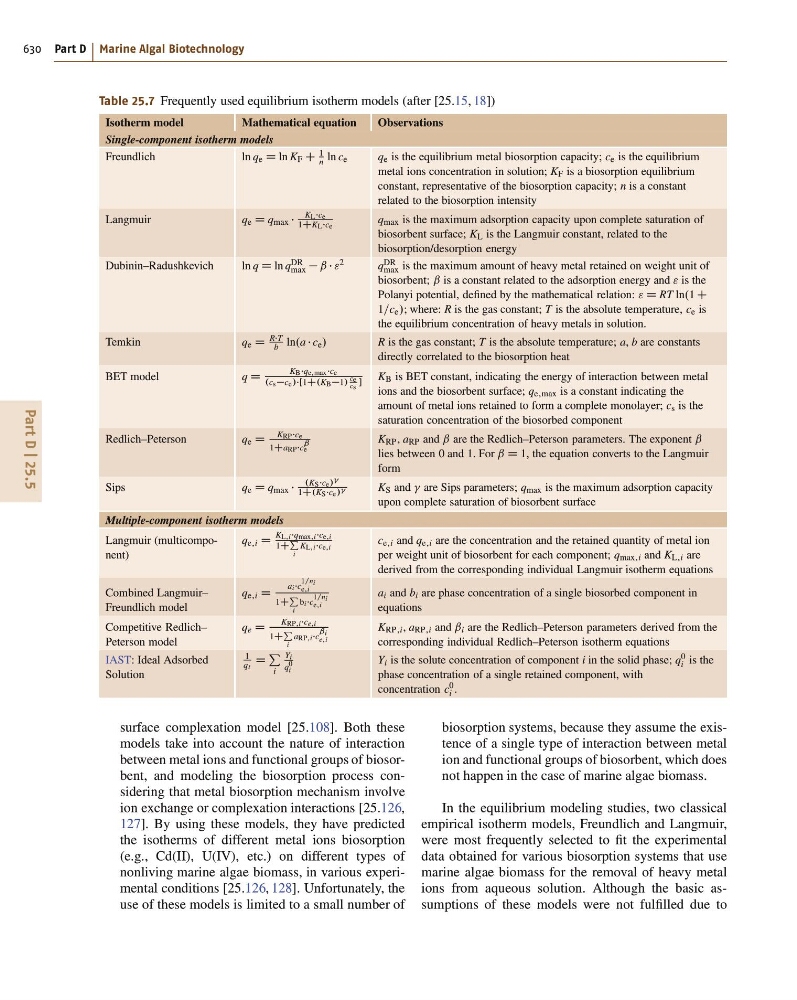
Table 25.7 Frequently used equilibrium isotherm models (after [25.15, 18])
Isotherm model
Mathematical equation
Observations
Single-component isotherm models
Freundlich
ln q e D ln K F C
1
n ln c e
q e is the equilibrium metal biosorption capacity; c e is the equilibrium
metal ions concentration in solution; K F is a biosorption equilibrium
constant, representative of the biosorption capacity; n is a constant
related to the biosorption intensity
Langmuir
q e D q max
KLce
1CKLce
q max is the maximum adsorption capacity upon complete saturation of
biosorbent surface; K L is the Langmuir constant, related to the
biosorption/desorption energy
Dubinin–Radushkevich
ln q D ln q DR
max ˇ " 2
q DR
max is the maximum amount of heavy metal retained on weight unit of
biosorbent; ˇ is a constant related to the adsorption energy and " is the
Polanyi potential, defined by the mathematical relation: " D RT ln.1 C
1=c e /; where: R is the gas constant; T is the absolute temperature, c e is
the equilibrium concentration of heavy metals in solution.
Temkin
q e D
RT
b ln.a c e /
R is the gas constant; T is the absolute temperature; a, b are constants
directly correlated to the biosorption heat
BET model
q D
KBqe;maxce
.csce/Œ1C.KB1/
ce
cs
K B is BET constant, indicating the energy of interaction between metal
ions and the biosorbent surface; q e;max is a constant indicating the
amount of metal ions retained to form a complete monolayer; c s is the
saturation concentration of the biosorbed component
Redlich–Peterson
q e D
KRPce
1CaRPc
ˇ
e
K RP , a RP and ˇ are the Redlich–Peterson parameters. The exponent ˇ
lies between 0 and 1. For ˇ D 1, the equation converts to the Langmuir
form
Sips
q e D q max
.KSce/
1C.KSce/
K S and are Sips parameters; q max is the maximum adsorption capacity
upon complete saturation of biosorbent surface
Multiple-component isotherm models
Langmuir (multicomponent)
q e;i D
KL;iqmax;ice;i
1C
P
i
KL;ice;i
c e;i and q e;i are the concentration and the retained quantity of metal ion
per weight unit of biosorbent for each component; q max;i and K L;i are
derived from the corresponding individual Langmuir isotherm equations
Combined Langmuir–
Freundlich model
q e;i D
aic
1=n i
e;i
1C
P
i
bic
1=n i
e;i
a i and b i are phase concentration of a single biosorbed component in
equations
Competitive Redlich–
Peterson model
q e D
KRP;ice;i
1C
P
i
aRP;ic
ˇ i
e;i
K RP;i , a RP;i and ˇ i are the Redlich–Peterson parameters derived from the
corresponding individual Redlich–Peterson isotherm equations
IAST: Ideal Adsorbed
Solution
1
qt D
P
i
Yi
q
0
i
Y i is the solute concentration of component i in the solid phase; q
0
i is the
phase concentration of a single retained component, with
concentration c
0
i .
surface complexation model [25.108]. Both these
models take into account the nature of interaction
between metal ions and functional groups of biosorbent, and modeling the biosorption process considering that metal biosorption mechanism involve
ion exchange or complexation interactions [25.126,
127]. By using these models, they have predicted
the isotherms of different metal ions biosorption
(e.g., Cd(II), U(IV), etc.) on different types of
nonliving marine algae biomass, in various experimental conditions [25.126, 128]. Unfortunately, the
use of these models is limited to a small number of
biosorption systems, because they assume the existence of a single type of interaction between metal
ion and functional groups of biosorbent, which does
not happen in the case of marine algae biomass.
In the equilibrium modeling studies, two classical
empirical isotherm models, Freundlich and Langmuir,
were most frequently selected to fit the experimental
data obtained for various biosorption systems that use
marine algae biomass for the removal of heavy metal
ions from aqueous solution. Although the basic assumptions of these models were not fulfilled due to