

Marine Algae Biomass for Removal of Heavy Metal Ions 25.5 Modeling of Biosorption in Batch Conditions 629
Part D | 25.5
t = 10 °C
t = 20 °C
t = 40 °C
t = 10 °C
t = 20 °C
t = 40 °C
0
0.3
0.6
0.9
1.2
1.5
1.8
a) q (mmol/g)
c (mmol/l)
0.3
0.25
0.2
0.15
0.1
0.05
0
0
0.5
1
1.5
2
2.5
3
3.5
b) q (mmol/g)
c (mmol/l)
0.3
0.25
0.2
0.15
0.1
0.05
0
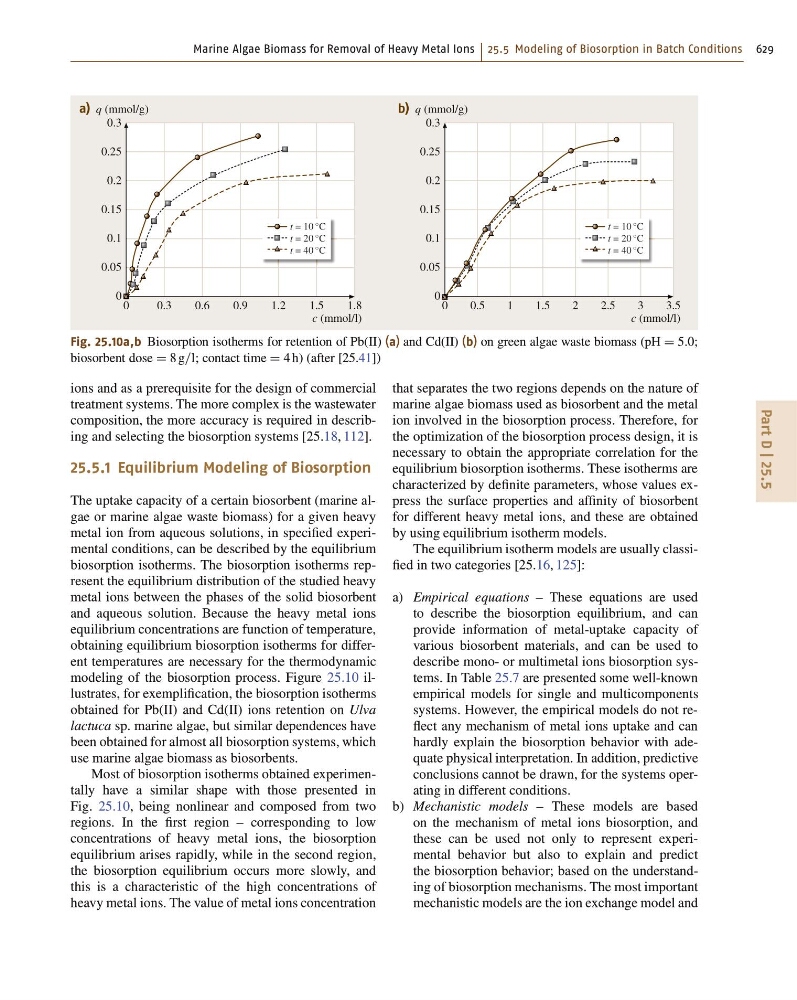
Fig. 25.10a,b Biosorption isotherms for retention of Pb(II) (a) and Cd(II) (b) on green algae waste biomass (pH D 5:0;
biosorbent dose D 8 g=l; contact time D 4 h) (after [25.41])
ions and as a prerequisite for the design of commercial
treatment systems. The more complex is the wastewater
composition, the more accuracy is required in describing and selecting the biosorption systems [25.18, 112].
25.5.1 Equilibrium Modeling of Biosorption
The uptake capacity of a certain biosorbent (marine algae or marine algae waste biomass) for a given heavy
metal ion from aqueous solutions, in specified experimental conditions, can be described by the equilibrium
biosorption isotherms. The biosorption isotherms represent the equilibrium distribution of the studied heavy
metal ions between the phases of the solid biosorbent
and aqueous solution. Because the heavy metal ions
equilibrium concentrations are function of temperature,
obtaining equilibrium biosorption isotherms for different temperatures are necessary for the thermodynamic
modeling of the biosorption process. Figure 25.10 illustrates, for exemplification, the biosorption isotherms
obtained for Pb(II) and Cd(II) ions retention on Ulva
lactuca sp. marine algae, but similar dependences have
been obtained for almost all biosorption systems, which
use marine algae biomass as biosorbents.
Most of biosorption isotherms obtained experimentally have a similar shape with those presented in
Fig. 25.10, being nonlinear and composed from two
regions. In the first region – corresponding to low
concentrations of heavy metal ions, the biosorption
equilibrium arises rapidly, while in the second region,
the biosorption equilibrium occurs more slowly, and
this is a characteristic of the high concentrations of
heavy metal ions. The value of metal ions concentration
that separates the two regions depends on the nature of
marine algae biomass used as biosorbent and the metal
ion involved in the biosorption process. Therefore, for
the optimization of the biosorption process design, it is
necessary to obtain the appropriate correlation for the
equilibrium biosorption isotherms. These isotherms are
characterized by definite parameters, whose values express the surface properties and affinity of biosorbent
for different heavy metal ions, and these are obtained
by using equilibrium isotherm models.
The equilibrium isotherm models are usually classified in two categories [25.16, 125]:
a) Empirical equations – These equations are used
to describe the biosorption equilibrium, and can
provide information of metal-uptake capacity of
various biosorbent materials, and can be used to
describe mono- or multimetal ions biosorption systems. In Table 25.7 are presented some well-known
empirical models for single and multicomponents
systems. However, the empirical models do not reflect any mechanism of metal ions uptake and can
hardly explain the biosorption behavior with adequate physical interpretation. In addition, predictive
conclusions cannot be drawn, for the systems operating in different conditions.
b) Mechanistic models – These models are based
on the mechanism of metal ions biosorption, and
these can be used not only to represent experimental behavior but also to explain and predict
the biosorption behavior; based on the understanding of biosorption mechanisms. The most important
mechanistic models are the ion exchange model and