

Marine Algae Biomass for Removal of Heavy Metal Ions 25.4 Influence of Experimental Parameters 627
Part D | 25.4
Table 25.6 Experimental conditions for biosorption of some heavy metal ions onto marine algae biomass, in dynamic
continuous-flow conditions
Heavy
metal ion
Marine algae biomass
Bed height
.cm/
Flow rate
.ml=s/
Initial concentration
.mg=l/
Reference
Cd(II)
Sargassum muticum
6.9
10.0
50
[25.66]
Sargassum glaucescens
40
–
25
[25.69]
Gelidium
15
4.0
50
[25.119]
Ulva lactuca
–
3.5
65
[25.80]
Ulva lactuca – fixed in agar –
3.5
65
[25.80]
Co(II)
Ulva reticulata
25.0
10.0
100
[25.75]
Ulva reticulata
25.0
10.0
100
[25.75]
Gelidium
15
4.0
50
[25.119]
Cu(II)
Sargassum fluitans
20
7.5
100
[25.120, 121]
Sargassum – Ca form
50
4.0
200
[25.122]
Ni(II)
Ulva reticulata
25.0
10.0
100
[25.75]
Sargassum filipendula
30.5
6.0
125
[25.68]
Gelidium
15
4.0
50
[25.73, 119]
Sargassum glaucescens
40
–
245
[25.69]
Pb(II)
Ulva lactuca
–
3.5
65
[25.80]
Ulva lactuca – fixed in agar –
3.5
65
[25.80]
Ulva lactuca: A-100
2.5
3.5
135
[25.42]
Re(VII)
Laminaria japonica
100 mg biosorbent
6.0
20
[25.79]
Zn(II)
Sargassum – Ca form
50
3.0
200
[25.122]
Ulva reticulata
25
5.0
100
[25.76]
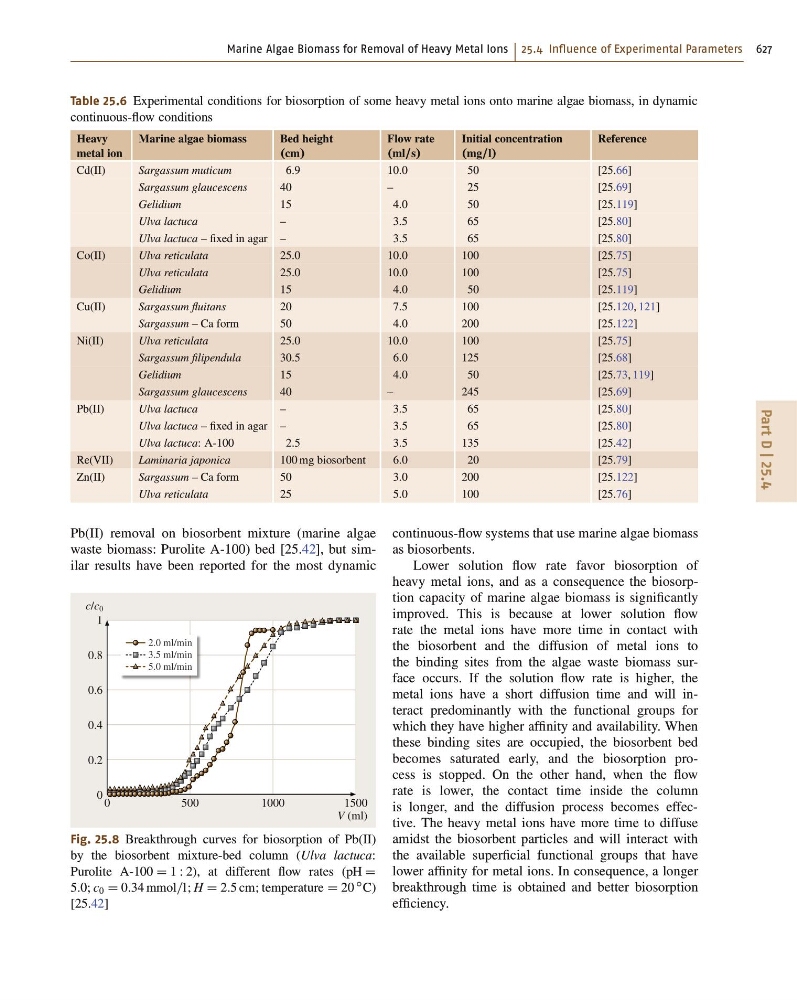
Pb(II) removal on biosorbent mixture (marine algae
waste biomass: Purolite A-100) bed [25.42], but similar results have been reported for the most dynamic
2.0 ml/min
3.5 ml/min
5.0 ml/min
0
500
1000
1500
c/c 0
V (ml)
1
0.8
0.6
0.4
0.2
0
Fig. 25.8 Breakthrough curves for biosorption of Pb(II)
by the biosorbent mixture-bed column (Ulva lactuca:
Purolite A-100 D 1 W 2), at different flow rates (pH D
5:0; c 0 D 0:34 mmol=l; H D 2:5 cm; temperature D 20
ı C)
[25.42]
continuous-flow systems that use marine algae biomass
as biosorbents.
Lower solution flow rate favor biosorption of
heavy metal ions, and as a consequence the biosorption capacity of marine algae biomass is significantly
improved. This is because at lower solution flow
rate the metal ions have more time in contact with
the biosorbent and the diffusion of metal ions to
the binding sites from the algae waste biomass surface occurs. If the solution flow rate is higher, the
metal ions have a short diffusion time and will interact predominantly with the functional groups for
which they have higher affinity and availability. When
these binding sites are occupied, the biosorbent bed
becomes saturated early, and the biosorption process is stopped. On the other hand, when the flow
rate is lower, the contact time inside the column
is longer, and the diffusion process becomes effective. The heavy metal ions have more time to diffuse
amidst the biosorbent particles and will interact with
the available superficial functional groups that have
lower affinity for metal ions. In consequence, a longer
breakthrough time is obtained and better biosorption
efficiency.