

Part D | 25.4
626 Part D Marine Algal Biotechnology
Table 25.5 The values of thermodynamic parameters obtained for some biosorption processes of heavy metal ions onto
marine algae biomass
Heavy metal ion Marine algae biosorbent T .
ı C/ G .kJ=mol/ H .kJ=mol/ S .J=molK/ Reference
As(III)
Maugeotia genuflexa
20
18.39
29.69
38.43
[25.56]
Ulva lactuca sp.
20
16.40
32.80
55.0
[25.38]
Cd(II)
Ceramium virgatum
20
19.50
31.80
42.40
[25.62]
Gymnogongrus torulosus 22
15.65
23.00
25.00
[25.92]
Cu(II)
Gymnogongrus torulosus 22
15.64
33.00
59.00
[25.92]
Ulva lactuca sp.
20
16.70
30.20
45.8
[25.38]
Pb(II)
Spirogyra sp.
25
20.45
4.00
83.50
[25.73]
Gymnogongrus torulosus 22
15.25
24.00
32.00
[25.92]
Waste algae biomass
20
16.60
26.69
34.43
[25.93]
Se(IV)
Cladophora hutchinsiae
20
18.39
45.96
70.92
[25.78]
Zn(II)
Gymnogongrus torulosus 22
10.44
28.00
129.0
[25.92]
Ulva reticulate sp.
25
14.70
4.45
64.00
[25.89]
15 cm
20 cm
25 cm
0
4
8
12
16
Copper concentration (mg/l)
Time (h)
100
80
60
40
20
0
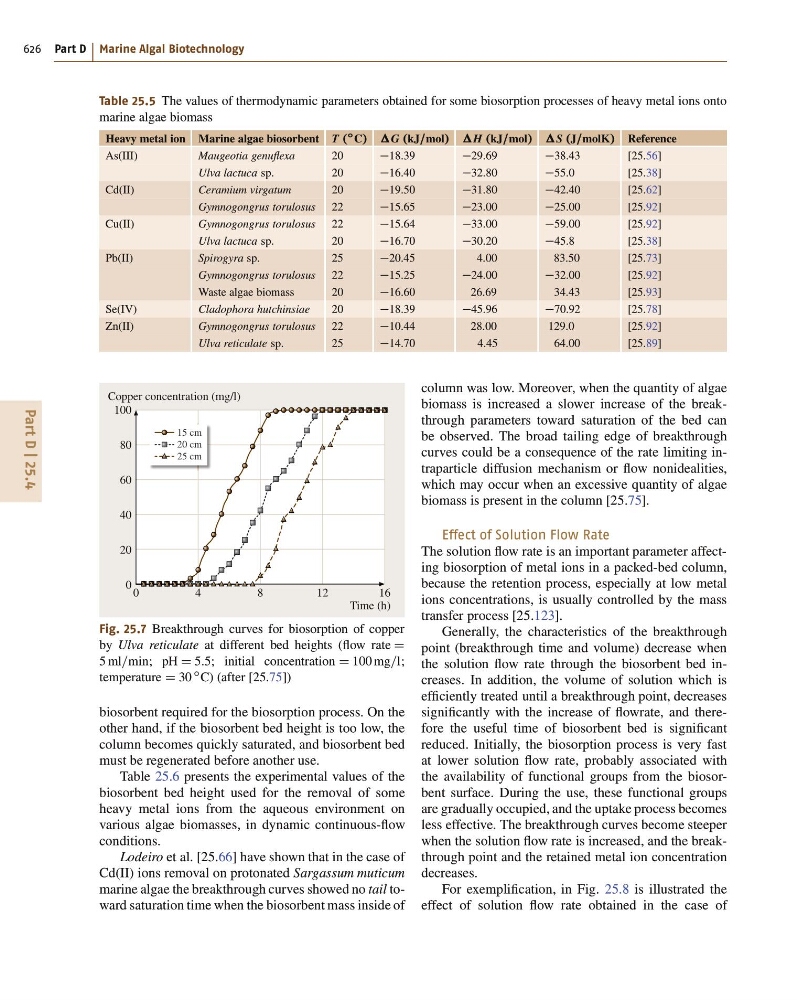
Fig. 25.7 Breakthrough curves for biosorption of copper
by Ulva reticulate at different bed heights (flow rate D
5 ml=min; pH D 5:5; initial concentration D 100 mg=l;
temperature D 30
ı C) (after [25.75])
biosorbent required for the biosorption process. On the
other hand, if the biosorbent bed height is too low, the
column becomes quickly saturated, and biosorbent bed
must be regenerated before another use.
Table 25.6 presents the experimental values of the
biosorbent bed height used for the removal of some
heavy metal ions from the aqueous environment on
various algae biomasses, in dynamic continuous-flow
conditions.
Lodeiro et al. [25.66] have shown that in the case of
Cd(II) ions removal on protonated Sargassum muticum
marine algae the breakthrough curves showed no tail toward saturation time when the biosorbent mass inside of
column was low. Moreover, when the quantity of algae
biomass is increased a slower increase of the breakthrough parameters toward saturation of the bed can
be observed. The broad tailing edge of breakthrough
curves could be a consequence of the rate limiting intraparticle diffusion mechanism or flow nonidealities,
which may occur when an excessive quantity of algae
biomass is present in the column [25.75].
Effect of Solution Flow Rate
The solution flow rate is an important parameter affecting biosorption of metal ions in a packed-bed column,
because the retention process, especially at low metal
ions concentrations, is usually controlled by the mass
transfer process [25.123].
Generally, the characteristics of the breakthrough
point (breakthrough time and volume) decrease when
the solution flow rate through the biosorbent bed increases. In addition, the volume of solution which is
efficiently treated until a breakthrough point, decreases
significantly with the increase of flowrate, and therefore the useful time of biosorbent bed is significant
reduced. Initially, the biosorption process is very fast
at lower solution flow rate, probably associated with
the availability of functional groups from the biosorbent surface. During the use, these functional groups
are gradually occupied, and the uptake process becomes
less effective. The breakthrough curves become steeper
when the solution flow rate is increased, and the breakthrough point and the retained metal ion concentration
decreases.
For exemplification, in Fig. 25.8 is illustrated the
effect of solution flow rate obtained in the case of