

Part D | 24.1
600 Part D Marine Algal Biotechnology
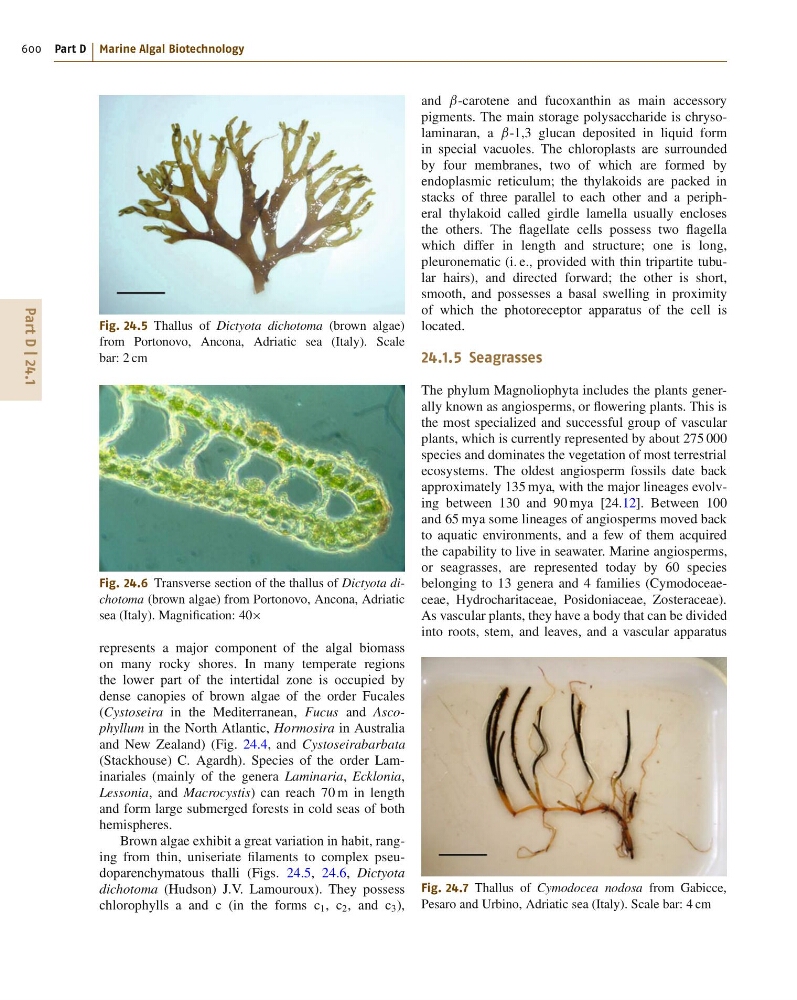
Fig. 24.5 Thallus of Dictyota dichotoma (brown algae)
from Portonovo, Ancona, Adriatic sea (Italy). Scale
bar: 2 cm
Fig. 24.6 Transverse section of the thallus of Dictyota dichotoma (brown algae) from Portonovo, Ancona, Adriatic
sea (Italy). Magnification: 40
represents a major component of the algal biomass
on many rocky shores. In many temperate regions
the lower part of the intertidal zone is occupied by
dense canopies of brown algae of the order Fucales
(Cystoseira in the Mediterranean, Fucus and Ascophyllum in the North Atlantic, Hormosira in Australia
and New Zealand) (Fig. 24.4, and Cystoseirabarbata
(Stackhouse) C. Agardh). Species of the order Laminariales (mainly of the genera Laminaria, Ecklonia,
Lessonia, and Macrocystis) can reach 70 m in length
and form large submerged forests in cold seas of both
hemispheres.
Brown algae exhibit a great variation in habit, ranging from thin, uniseriate filaments to complex pseudoparenchymatous thalli (Figs. 24.5, 24.6, Dictyota
dichotoma (Hudson) J.V. Lamouroux). They possess
chlorophylls a and c (in the forms c 1 , c 2 , and c 3 ),
and ˇ-carotene and fucoxanthin as main accessory
pigments. The main storage polysaccharide is chrysolaminaran, a ˇ-1,3 glucan deposited in liquid form
in special vacuoles. The chloroplasts are surrounded
by four membranes, two of which are formed by
endoplasmic reticulum; the thylakoids are packed in
stacks of three parallel to each other and a peripheral thylakoid called girdle lamella usually encloses
the others. The flagellate cells possess two flagella
which differ in length and structure; one is long,
pleuronematic (i. e., provided with thin tripartite tubular hairs), and directed forward; the other is short,
smooth, and possesses a basal swelling in proximity
of which the photoreceptor apparatus of the cell is
located.
24.1.5 Seagrasses
The phylum Magnoliophyta includes the plants generally known as angiosperms, or flowering plants. This is
the most specialized and successful group of vascular
plants, which is currently represented by about 275 000
species and dominates the vegetation of most terrestrial
ecosystems. The oldest angiosperm fossils date back
approximately 135 mya, with the major lineages evolving between 130 and 90 mya [24.12]. Between 100
and 65 mya some lineages of angiosperms moved back
to aquatic environments, and a few of them acquired
the capability to live in seawater. Marine angiosperms,
or seagrasses, are represented today by 60 species
belonging to 13 genera and 4 families (Cymodoceaeceae, Hydrocharitaceae, Posidoniaceae, Zosteraceae).
As vascular plants, they have a body that can be divided
into roots, stem, and leaves, and a vascular apparatus
Fig. 24.7 Thallus of Cymodocea nodosa from Gabicce,
Pesaro and Urbino, Adriatic sea (Italy). Scale bar: 4 cm