

Part D | 22.3
556 Part D Marine Algal Biotechnology
22.3.1 Extraction Procedures
The subsequent extraction steps vary depending on
whether the polysaccharides contain sulfate and/or carboxylic groups. Routine procedures of common extraction of polysaccharides from various algae are outlined
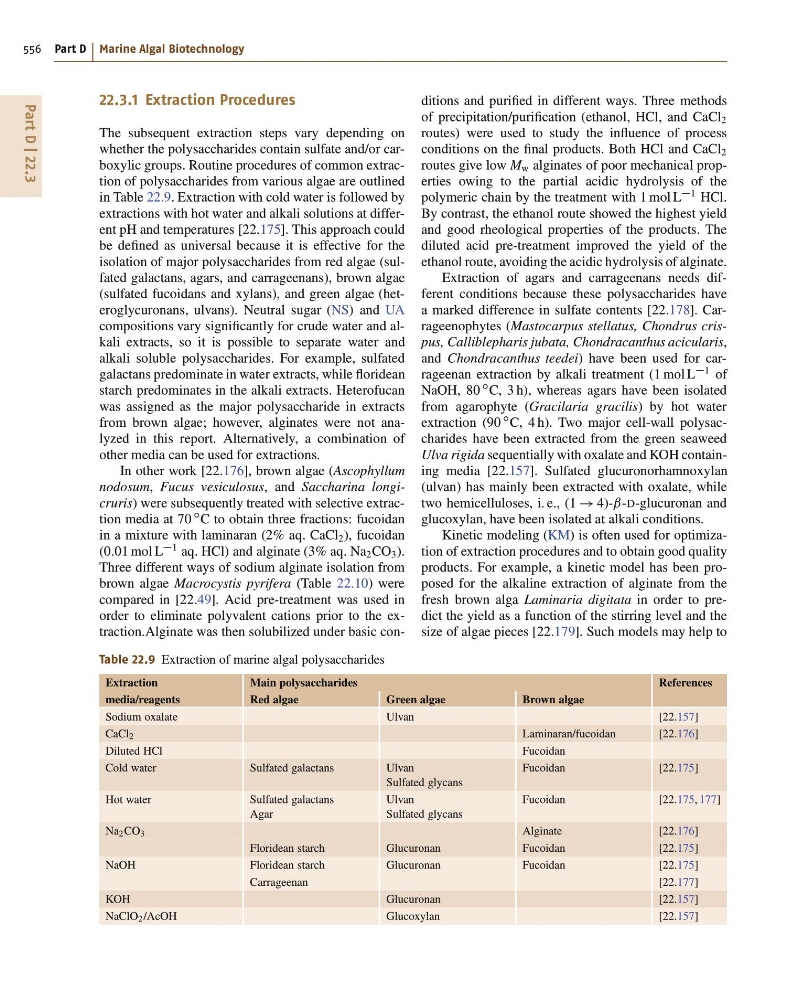
in Table 22.9. Extraction with cold water is followed by
extractions with hot water and alkali solutions at different pH and temperatures [22.175]. This approach could
be defined as universal because it is effective for the
isolation of major polysaccharides from red algae (sulfated galactans, agars, and carrageenans), brown algae
(sulfated fucoidans and xylans), and green algae (heteroglycuronans, ulvans). Neutral sugar (NS) and UA
compositions vary significantly for crude water and alkali extracts, so it is possible to separate water and
alkali soluble polysaccharides. For example, sulfated
galactans predominate in water extracts, while floridean
starch predominates in the alkali extracts. Heterofucan
was assigned as the major polysaccharide in extracts
from brown algae; however, alginates were not analyzed in this report. Alternatively, a combination of
other media can be used for extractions.
In other work [22.176], brown algae (Ascophyllum
nodosum, Fucus vesiculosus, and Saccharina longicruris) were subsequently treated with selective extraction media at 70
ı C to obtain three fractions: fucoidan
in a mixture with laminaran (2% aq. CaCl 2 ), fucoidan
(0:01 mol L
1 aq. HCl) and alginate (3% aq. Na 2 CO 3 ).
Three different ways of sodium alginate isolation from
brown algae Macrocystis pyrifera (Table 22.10) were
compared in [22.49]. Acid pre-treatment was used in
order to eliminate polyvalent cations prior to the extraction.Alginate was then solubilized under basic conTable 22.9 Extraction of marine algal polysaccharides
Extraction
Main polysaccharides
References
media/reagents
Red algae
Green algae
Brown algae
Sodium oxalate
Ulvan
[22.157]
CaCl 2
Laminaran/fucoidan
[22.176]
Diluted HCl
Fucoidan
Cold water
Sulfated galactans
Ulvan
Sulfated glycans
Fucoidan
[22.175]
Hot water
Sulfated galactans
Agar
Ulvan
Sulfated glycans
Fucoidan
[22.175, 177]
Na 2 CO 3
Alginate
[22.176]
Floridean starch
Glucuronan
Fucoidan
[22.175]
NaOH
Floridean starch
Glucuronan
Fucoidan
[22.175]
Carrageenan
[22.177]
KOH
Glucuronan
[22.157]
NaClO 2 /AcOH
Glucoxylan
[22.157]
ditions and purified in different ways. Three methods
of precipitation/purification (ethanol, HCl, and CaCl 2
routes) were used to study the influence of process
conditions on the final products. Both HCl and CaCl 2
routes give low M w alginates of poor mechanical properties owing to the partial acidic hydrolysis of the
polymeric chain by the treatment with 1 mol L
1 HCl.
By contrast, the ethanol route showed the highest yield
and good rheological properties of the products. The
diluted acid pre-treatment improved the yield of the
ethanol route, avoiding the acidic hydrolysis of alginate.
Extraction of agars and carrageenans needs different conditions because these polysaccharides have
a marked difference in sulfate contents [22.178]. Carrageenophytes (Mastocarpus stellatus, Chondrus crispus, Calliblepharis jubata, Chondracanthus acicularis,
and Chondracanthus teedei) have been used for carrageenan extraction by alkali treatment (1 mol L
1 of
NaOH, 80
ı C, 3 h), whereas agars have been isolated
from agarophyte (Gracilaria gracilis) by hot water
extraction (90
ı C, 4 h). Two major cell-wall polysaccharides have been extracted from the green seaweed
Ulva rigida sequentially with oxalate and KOH containing media [22.157]. Sulfated glucuronorhamnoxylan
(ulvan) has mainly been extracted with oxalate, while
two hemicelluloses, i. e., (1 ! 4)-ˇ-D-glucuronan and
glucoxylan, have been isolated at alkali conditions.
Kinetic modeling (KM) is often used for optimization of extraction procedures and to obtain good quality
products. For example, a kinetic model has been proposed for the alkaline extraction of alginate from the
fresh brown alga Laminaria digitata in order to predict the yield as a function of the stirring level and the
size of algae pieces [22.179]. Such models may help to
556 Part D Marine Algal Biotechnology
22.3.1 Extraction Procedures
The subsequent extraction steps vary depending on
whether the polysaccharides contain sulfate and/or carboxylic groups. Routine procedures of common extraction of polysaccharides from various algae are outlined
in Table 22.9. Extraction with cold water is followed by
extractions with hot water and alkali solutions at different pH and temperatures [22.175]. This approach could
be defined as universal because it is effective for the
isolation of major polysaccharides from red algae (sulfated galactans, agars, and carrageenans), brown algae
(sulfated fucoidans and xylans), and green algae (heteroglycuronans, ulvans). Neutral sugar (NS) and UA
compositions vary significantly for crude water and alkali extracts, so it is possible to separate water and
alkali soluble polysaccharides. For example, sulfated
galactans predominate in water extracts, while floridean
starch predominates in the alkali extracts. Heterofucan
was assigned as the major polysaccharide in extracts
from brown algae; however, alginates were not analyzed in this report. Alternatively, a combination of
other media can be used for extractions.
In other work [22.176], brown algae (Ascophyllum
nodosum, Fucus vesiculosus, and Saccharina longicruris) were subsequently treated with selective extraction media at 70
ı C to obtain three fractions: fucoidan
in a mixture with laminaran (2% aq. CaCl 2 ), fucoidan
(0:01 mol L
1 aq. HCl) and alginate (3% aq. Na 2 CO 3 ).
Three different ways of sodium alginate isolation from
brown algae Macrocystis pyrifera (Table 22.10) were
compared in [22.49]. Acid pre-treatment was used in
order to eliminate polyvalent cations prior to the extraction.Alginate was then solubilized under basic conTable 22.9 Extraction of marine algal polysaccharides
Extraction
Main polysaccharides
References
media/reagents
Red algae
Green algae
Brown algae
Sodium oxalate
Ulvan
[22.157]
CaCl 2
Laminaran/fucoidan
[22.176]
Diluted HCl
Fucoidan
Cold water
Sulfated galactans
Ulvan
Sulfated glycans
Fucoidan
[22.175]
Hot water
Sulfated galactans
Agar
Ulvan
Sulfated glycans
Fucoidan
[22.175, 177]
Na 2 CO 3
Alginate
[22.176]
Floridean starch
Glucuronan
Fucoidan
[22.175]
NaOH
Floridean starch
Glucuronan
Fucoidan
[22.175]
Carrageenan
[22.177]
KOH
Glucuronan
[22.157]
NaClO 2 /AcOH
Glucoxylan
[22.157]
ditions and purified in different ways. Three methods
of precipitation/purification (ethanol, HCl, and CaCl 2
routes) were used to study the influence of process
conditions on the final products. Both HCl and CaCl 2
routes give low M w alginates of poor mechanical properties owing to the partial acidic hydrolysis of the
polymeric chain by the treatment with 1 mol L
1 HCl.
By contrast, the ethanol route showed the highest yield
and good rheological properties of the products. The
diluted acid pre-treatment improved the yield of the
ethanol route, avoiding the acidic hydrolysis of alginate.
Extraction of agars and carrageenans needs different conditions because these polysaccharides have
a marked difference in sulfate contents [22.178]. Carrageenophytes (Mastocarpus stellatus, Chondrus crispus, Calliblepharis jubata, Chondracanthus acicularis,
and Chondracanthus teedei) have been used for carrageenan extraction by alkali treatment (1 mol L
1 of
NaOH, 80
ı C, 3 h), whereas agars have been isolated
from agarophyte (Gracilaria gracilis) by hot water
extraction (90
ı C, 4 h). Two major cell-wall polysaccharides have been extracted from the green seaweed
Ulva rigida sequentially with oxalate and KOH containing media [22.157]. Sulfated glucuronorhamnoxylan
(ulvan) has mainly been extracted with oxalate, while
two hemicelluloses, i. e., (1 ! 4)-ˇ-D-glucuronan and
glucoxylan, have been isolated at alkali conditions.
Kinetic modeling (KM) is often used for optimization of extraction procedures and to obtain good quality
products. For example, a kinetic model has been proposed for the alkaline extraction of alginate from the
fresh brown alga Laminaria digitata in order to predict the yield as a function of the stirring level and the
size of algae pieces [22.179]. Such models may help to