

Part D | 22.1
544 Part D Marine Algal Biotechnology
22.1 Overview
Marine algae are a plentiful source of many bioactive compounds. Among these chemical components,
polysaccharides are of interest because of their physical
and chemical properties, which are useful for food and
medicinal applications. Algae synthesize various types
of polysaccharides as cell wall structural components
or energy reserves. Algal polysaccharides demonstrate
a high specificity to raw algae, which has been used
by phycologists to clarify the phylogenetic relationship between main algal taxa and higher (vascular)
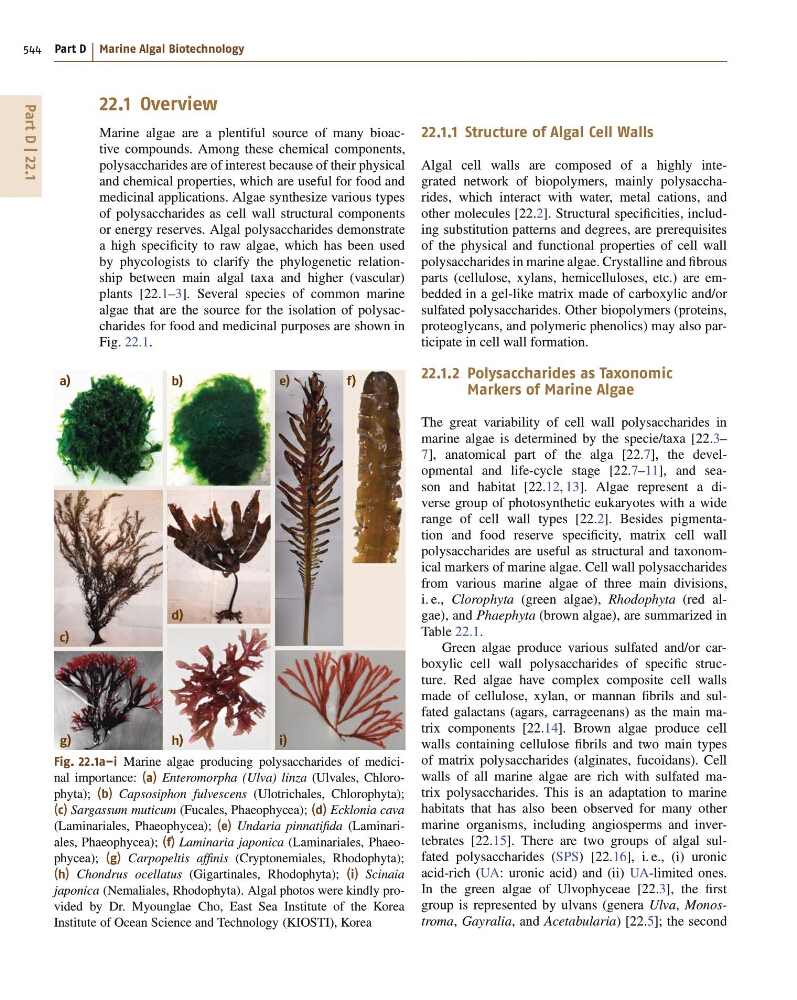
plants [22.1–3]. Several species of common marine
algae that are the source for the isolation of polysaccharides for food and medicinal purposes are shown in
Fig. 22.1.
a)
b)
c)
d)
g)
h)
i)
e)
f)
Fig. 22.1a–i Marine algae producing polysaccharides of medicinal importance: (a) Enteromorpha (Ulva) linza (Ulvales, Chlorophyta); (b) Capsosiphon fulvescens (Ulotrichales, Chlorophyta);
(c) Sargassum muticum (Fucales, Phaeophycea); (d) Ecklonia cava
(Laminariales, Phaeophycea); (e) Undaria pinnatifida (Laminariales, Phaeophycea); (f) Laminaria japonica (Laminariales, Phaeophycea); (g) Carpopeltis affinis (Cryptonemiales, Rhodophyta);
(h) Chondrus ocellatus (Gigartinales, Rhodophyta); (i) Scinaia
japonica (Nemaliales, Rhodophyta). Algal photos were kindly provided by Dr. Myounglae Cho, East Sea Institute of the Korea
Institute of Ocean Science and Technology (KIOSTI), Korea
22.1.1 Structure of Algal Cell Walls
Algal cell walls are composed of a highly integrated network of biopolymers, mainly polysaccharides, which interact with water, metal cations, and
other molecules [22.2]. Structural specificities, including substitution patterns and degrees, are prerequisites
of the physical and functional properties of cell wall
polysaccharides in marine algae. Crystalline and fibrous
parts (cellulose, xylans, hemicelluloses, etc.) are embedded in a gel-like matrix made of carboxylic and/or
sulfated polysaccharides. Other biopolymers (proteins,
proteoglycans, and polymeric phenolics) may also participate in cell wall formation.
22.1.2 Polysaccharides as Taxonomic
Markers of Marine Algae
The great variability of cell wall polysaccharides in
marine algae is determined by the specie/taxa [22.3–
7], anatomical part of the alga [22.7], the developmental and life-cycle stage [22.7–11], and season and habitat [22.12, 13]. Algae represent a diverse group of photosynthetic eukaryotes with a wide
range of cell wall types [22.2]. Besides pigmentation and food reserve specificity, matrix cell wall
polysaccharides are useful as structural and taxonomical markers of marine algae. Cell wall polysaccharides
from various marine algae of three main divisions,
i. e., Clorophyta (green algae), Rhodophyta (red algae), and Phaephyta (brown algae), are summarized in
Table 22.1.
Green algae produce various sulfated and/or carboxylic cell wall polysaccharides of specific structure. Red algae have complex composite cell walls
made of cellulose, xylan, or mannan fibrils and sulfated galactans (agars, carrageenans) as the main matrix components [22.14]. Brown algae produce cell
walls containing cellulose fibrils and two main types
of matrix polysaccharides (alginates, fucoidans). Cell
walls of all marine algae are rich with sulfated matrix polysaccharides. This is an adaptation to marine
habitats that has also been observed for many other
marine organisms, including angiosperms and invertebrates [22.15]. There are two groups of algal sulfated polysaccharides (SPS) [22.16], i. e., (i) uronic
acid-rich (UA: uronic acid) and (ii) UA-limited ones.
In the green algae of Ulvophyceae [22.3], the first
group is represented by ulvans (genera Ulva, Monostroma, Gayralia, and Acetabularia) [22.5]; the second
544 Part D Marine Algal Biotechnology
22.1 Overview
Marine algae are a plentiful source of many bioactive compounds. Among these chemical components,
polysaccharides are of interest because of their physical
and chemical properties, which are useful for food and
medicinal applications. Algae synthesize various types
of polysaccharides as cell wall structural components
or energy reserves. Algal polysaccharides demonstrate
a high specificity to raw algae, which has been used
by phycologists to clarify the phylogenetic relationship between main algal taxa and higher (vascular)
plants [22.1–3]. Several species of common marine
algae that are the source for the isolation of polysaccharides for food and medicinal purposes are shown in
Fig. 22.1.
a)
b)
c)
d)
g)
h)
i)
e)
f)
Fig. 22.1a–i Marine algae producing polysaccharides of medicinal importance: (a) Enteromorpha (Ulva) linza (Ulvales, Chlorophyta); (b) Capsosiphon fulvescens (Ulotrichales, Chlorophyta);
(c) Sargassum muticum (Fucales, Phaeophycea); (d) Ecklonia cava
(Laminariales, Phaeophycea); (e) Undaria pinnatifida (Laminariales, Phaeophycea); (f) Laminaria japonica (Laminariales, Phaeophycea); (g) Carpopeltis affinis (Cryptonemiales, Rhodophyta);
(h) Chondrus ocellatus (Gigartinales, Rhodophyta); (i) Scinaia
japonica (Nemaliales, Rhodophyta). Algal photos were kindly provided by Dr. Myounglae Cho, East Sea Institute of the Korea
Institute of Ocean Science and Technology (KIOSTI), Korea
22.1.1 Structure of Algal Cell Walls
Algal cell walls are composed of a highly integrated network of biopolymers, mainly polysaccharides, which interact with water, metal cations, and
other molecules [22.2]. Structural specificities, including substitution patterns and degrees, are prerequisites
of the physical and functional properties of cell wall
polysaccharides in marine algae. Crystalline and fibrous
parts (cellulose, xylans, hemicelluloses, etc.) are embedded in a gel-like matrix made of carboxylic and/or
sulfated polysaccharides. Other biopolymers (proteins,
proteoglycans, and polymeric phenolics) may also participate in cell wall formation.
22.1.2 Polysaccharides as Taxonomic
Markers of Marine Algae
The great variability of cell wall polysaccharides in
marine algae is determined by the specie/taxa [22.3–
7], anatomical part of the alga [22.7], the developmental and life-cycle stage [22.7–11], and season and habitat [22.12, 13]. Algae represent a diverse group of photosynthetic eukaryotes with a wide
range of cell wall types [22.2]. Besides pigmentation and food reserve specificity, matrix cell wall
polysaccharides are useful as structural and taxonomical markers of marine algae. Cell wall polysaccharides
from various marine algae of three main divisions,
i. e., Clorophyta (green algae), Rhodophyta (red algae), and Phaephyta (brown algae), are summarized in
Table 22.1.
Green algae produce various sulfated and/or carboxylic cell wall polysaccharides of specific structure. Red algae have complex composite cell walls
made of cellulose, xylan, or mannan fibrils and sulfated galactans (agars, carrageenans) as the main matrix components [22.14]. Brown algae produce cell
walls containing cellulose fibrils and two main types
of matrix polysaccharides (alginates, fucoidans). Cell
walls of all marine algae are rich with sulfated matrix polysaccharides. This is an adaptation to marine
habitats that has also been observed for many other
marine organisms, including angiosperms and invertebrates [22.15]. There are two groups of algal sulfated polysaccharides (SPS) [22.16], i. e., (i) uronic
acid-rich (UA: uronic acid) and (ii) UA-limited ones.
In the green algae of Ulvophyceae [22.3], the first
group is represented by ulvans (genera Ulva, Monostroma, Gayralia, and Acetabularia) [22.5]; the second