

Part C | 20.2
516 Part C Marine Genomics
a)
b)
c)
Inlets
Upper layer
Waste bag container
Reagent cartridges
Underwater cable
HSA-ATP
Sample inlet
Hot spring
Control module
Analysis module
Lower layer
Actuation
layer
Deformable
membrane
Fluidic
layer
Glass substrate
Waste
10 mm
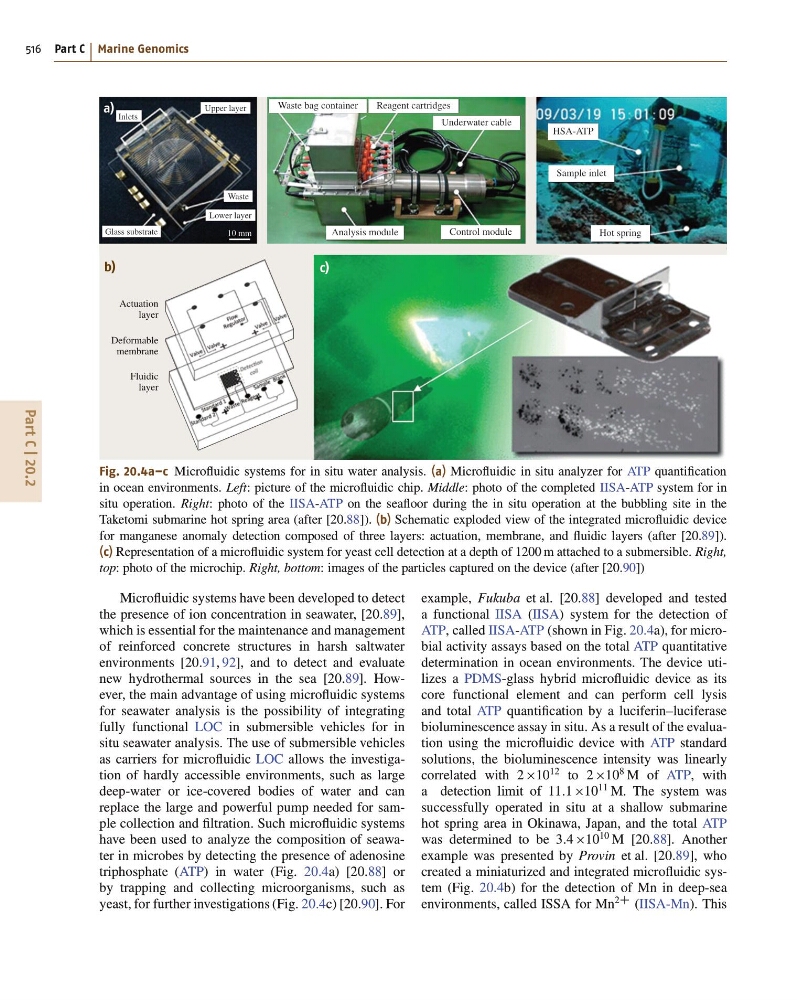
Fig. 20.4a–c Microfluidic systems for in situ water analysis. (a) Microfluidic in situ analyzer for ATP quantification
in ocean environments. Left: picture of the microfluidic chip. Middle: photo of the completed IISA-ATP system for in
situ operation. Right: photo of the IISA-ATP on the seafloor during the in situ operation at the bubbling site in the
Taketomi submarine hot spring area (after [20.88]). (b) Schematic exploded view of the integrated microfluidic device
for manganese anomaly detection composed of three layers: actuation, membrane, and fluidic layers (after [20.89]).
(c) Representation of a microfluidic system for yeast cell detection at a depth of 1200 m attached to a submersible. Right,
top: photo of the microchip. Right, bottom: images of the particles captured on the device (after [20.90])
Microfluidic systems have been developed to detect
the presence of ion concentration in seawater, [20.89],
which is essential for the maintenance and management
of reinforced concrete structures in harsh saltwater
environments [20.91, 92], and to detect and evaluate
new hydrothermal sources in the sea [20.89]. However, the main advantage of using microfluidic systems
for seawater analysis is the possibility of integrating
fully functional LOC in submersible vehicles for in
situ seawater analysis. The use of submersible vehicles
as carriers for microfluidic LOC allows the investigation of hardly accessible environments, such as large
deep-water or ice-covered bodies of water and can
replace the large and powerful pump needed for sample collection and filtration. Such microfluidic systems
have been used to analyze the composition of seawater in microbes by detecting the presence of adenosine
triphosphate (ATP) in water (Fig. 20.4a) [20.88] or
by trapping and collecting microorganisms, such as
yeast, for further investigations (Fig. 20.4c) [20.90]. For
example, Fukuba et al. [20.88] developed and tested
a functional IISA (IISA) system for the detection of
ATP, called IISA-ATP (shown in Fig. 20.4a), for microbial activity assays based on the total ATP quantitative
determination in ocean environments. The device utilizes a PDMS-glass hybrid microfluidic device as its
core functional element and can perform cell lysis
and total ATP quantification by a luciferin–luciferase
bioluminescence assay in situ. As a result of the evaluation using the microfluidic device with ATP standard
solutions, the bioluminescence intensity was linearly
correlated with 2 10
12 to 2 10
8 M of ATP, with
a detection limit of 11:1 10
11 M. The system was
successfully operated in situ at a shallow submarine
hot spring area in Okinawa, Japan, and the total ATP
was determined to be 3:4 10
10 M [20.88]. Another
example was presented by Provin et al. [20.89], who
created a miniaturized and integrated microfluidic system (Fig. 20.4b) for the detection of Mn in deep-sea
environments, called ISSA for Mn
2C (IISA-Mn). This
516 Part C Marine Genomics
a)
b)
c)
Inlets
Upper layer
Waste bag container
Reagent cartridges
Underwater cable
HSA-ATP
Sample inlet
Hot spring
Control module
Analysis module
Lower layer
Actuation
layer
Deformable
membrane
Fluidic
layer
Glass substrate
Waste
10 mm
Fig. 20.4a–c Microfluidic systems for in situ water analysis. (a) Microfluidic in situ analyzer for ATP quantification
in ocean environments. Left: picture of the microfluidic chip. Middle: photo of the completed IISA-ATP system for in
situ operation. Right: photo of the IISA-ATP on the seafloor during the in situ operation at the bubbling site in the
Taketomi submarine hot spring area (after [20.88]). (b) Schematic exploded view of the integrated microfluidic device
for manganese anomaly detection composed of three layers: actuation, membrane, and fluidic layers (after [20.89]).
(c) Representation of a microfluidic system for yeast cell detection at a depth of 1200 m attached to a submersible. Right,
top: photo of the microchip. Right, bottom: images of the particles captured on the device (after [20.90])
Microfluidic systems have been developed to detect
the presence of ion concentration in seawater, [20.89],
which is essential for the maintenance and management
of reinforced concrete structures in harsh saltwater
environments [20.91, 92], and to detect and evaluate
new hydrothermal sources in the sea [20.89]. However, the main advantage of using microfluidic systems
for seawater analysis is the possibility of integrating
fully functional LOC in submersible vehicles for in
situ seawater analysis. The use of submersible vehicles
as carriers for microfluidic LOC allows the investigation of hardly accessible environments, such as large
deep-water or ice-covered bodies of water and can
replace the large and powerful pump needed for sample collection and filtration. Such microfluidic systems
have been used to analyze the composition of seawater in microbes by detecting the presence of adenosine
triphosphate (ATP) in water (Fig. 20.4a) [20.88] or
by trapping and collecting microorganisms, such as
yeast, for further investigations (Fig. 20.4c) [20.90]. For
example, Fukuba et al. [20.88] developed and tested
a functional IISA (IISA) system for the detection of
ATP, called IISA-ATP (shown in Fig. 20.4a), for microbial activity assays based on the total ATP quantitative
determination in ocean environments. The device utilizes a PDMS-glass hybrid microfluidic device as its
core functional element and can perform cell lysis
and total ATP quantification by a luciferin–luciferase
bioluminescence assay in situ. As a result of the evaluation using the microfluidic device with ATP standard
solutions, the bioluminescence intensity was linearly
correlated with 2 10
12 to 2 10
8 M of ATP, with
a detection limit of 11:1 10
11 M. The system was
successfully operated in situ at a shallow submarine
hot spring area in Okinawa, Japan, and the total ATP
was determined to be 3:4 10
10 M [20.88]. Another
example was presented by Provin et al. [20.89], who
created a miniaturized and integrated microfluidic system (Fig. 20.4b) for the detection of Mn in deep-sea
environments, called ISSA for Mn
2C (IISA-Mn). This