

Microfluidic Systems for Marine Biotechnology 20.2 Microfluidic Devices for Marine Biology and Ecosystem Studies 515
Part C | 20.2
Nutrients
Tubing
Seal
Substrate
Channel
Lid
Nutrients
2 W
2 R
x
x
y
3 mm
Flow
In
A
B
C
In
a)
b)
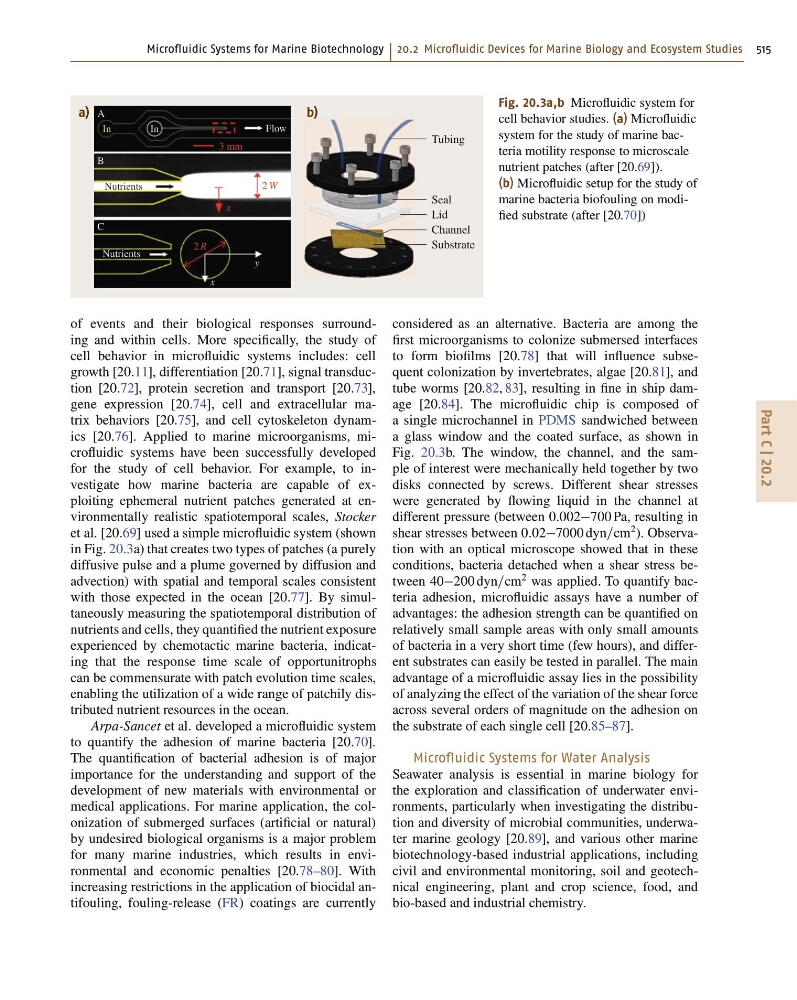
Fig. 20.3a,b Microfluidic system for
cell behavior studies. (a) Microfluidic
system for the study of marine bacteria motility response to microscale
nutrient patches (after [20.69]).
(b) Microfluidic setup for the study of
marine bacteria biofouling on modified substrate (after [20.70])
of events and their biological responses surrounding and within cells. More specifically, the study of
cell behavior in microfluidic systems includes: cell
growth [20.11], differentiation [20.71], signal transduction [20.72], protein secretion and transport [20.73],
gene expression [20.74], cell and extracellular matrix behaviors [20.75], and cell cytoskeleton dynamics [20.76]. Applied to marine microorganisms, microfluidic systems have been successfully developed
for the study of cell behavior. For example, to investigate how marine bacteria are capable of exploiting ephemeral nutrient patches generated at environmentally realistic spatiotemporal scales, Stocker
et al. [20.69] used a simple microfluidic system (shown
in Fig. 20.3a) that creates two types of patches (a purely
diffusive pulse and a plume governed by diffusion and
advection) with spatial and temporal scales consistent
with those expected in the ocean [20.77]. By simultaneously measuring the spatiotemporal distribution of
nutrients and cells, they quantified the nutrient exposure
experienced by chemotactic marine bacteria, indicating that the response time scale of opportunitrophs
can be commensurate with patch evolution time scales,
enabling the utilization of a wide range of patchily distributed nutrient resources in the ocean.
Arpa-Sancet et al. developed a microfluidic system
to quantify the adhesion of marine bacteria [20.70].
The quantification of bacterial adhesion is of major
importance for the understanding and support of the
development of new materials with environmental or
medical applications. For marine application, the colonization of submerged surfaces (artificial or natural)
by undesired biological organisms is a major problem
for many marine industries, which results in environmental and economic penalties [20.78–80]. With
increasing restrictions in the application of biocidal antifouling, fouling-release (FR) coatings are currently
considered as an alternative. Bacteria are among the
first microorganisms to colonize submersed interfaces
to form biofilms [20.78] that will influence subsequent colonization by invertebrates, algae [20.81], and
tube worms [20.82, 83], resulting in fine in ship damage [20.84]. The microfluidic chip is composed of
a single microchannel in PDMS sandwiched between
a glass window and the coated surface, as shown in
Fig. 20.3b. The window, the channel, and the sample of interest were mechanically held together by two
disks connected by screws. Different shear stresses
were generated by flowing liquid in the channel at
different pressure (between 0:002700 Pa, resulting in
shear stresses between 0:027000 dyn=cm
2 ). Observation with an optical microscope showed that in these
conditions, bacteria detached when a shear stress between 40200 dyn=cm
2 was applied. To quantify bacteria adhesion, microfluidic assays have a number of
advantages: the adhesion strength can be quantified on
relatively small sample areas with only small amounts
of bacteria in a very short time (few hours), and different substrates can easily be tested in parallel. The main
advantage of a microfluidic assay lies in the possibility
of analyzing the effect of the variation of the shear force
across several orders of magnitude on the adhesion on
the substrate of each single cell [20.85–87].
Microfluidic Systems for Water Analysis
Seawater analysis is essential in marine biology for
the exploration and classification of underwater environments, particularly when investigating the distribution and diversity of microbial communities, underwater marine geology [20.89], and various other marine
biotechnology-based industrial applications, including
civil and environmental monitoring, soil and geotechnical engineering, plant and crop science, food, and
bio-based and industrial chemistry.
Part C | 20.2
Nutrients
Tubing
Seal
Substrate
Channel
Lid
Nutrients
2 W
2 R
x
x
y
3 mm
Flow
In
A
B
C
In
a)
b)
Fig. 20.3a,b Microfluidic system for
cell behavior studies. (a) Microfluidic
system for the study of marine bacteria motility response to microscale
nutrient patches (after [20.69]).
(b) Microfluidic setup for the study of
marine bacteria biofouling on modified substrate (after [20.70])
of events and their biological responses surrounding and within cells. More specifically, the study of
cell behavior in microfluidic systems includes: cell
growth [20.11], differentiation [20.71], signal transduction [20.72], protein secretion and transport [20.73],
gene expression [20.74], cell and extracellular matrix behaviors [20.75], and cell cytoskeleton dynamics [20.76]. Applied to marine microorganisms, microfluidic systems have been successfully developed
for the study of cell behavior. For example, to investigate how marine bacteria are capable of exploiting ephemeral nutrient patches generated at environmentally realistic spatiotemporal scales, Stocker
et al. [20.69] used a simple microfluidic system (shown
in Fig. 20.3a) that creates two types of patches (a purely
diffusive pulse and a plume governed by diffusion and
advection) with spatial and temporal scales consistent
with those expected in the ocean [20.77]. By simultaneously measuring the spatiotemporal distribution of
nutrients and cells, they quantified the nutrient exposure
experienced by chemotactic marine bacteria, indicating that the response time scale of opportunitrophs
can be commensurate with patch evolution time scales,
enabling the utilization of a wide range of patchily distributed nutrient resources in the ocean.
Arpa-Sancet et al. developed a microfluidic system
to quantify the adhesion of marine bacteria [20.70].
The quantification of bacterial adhesion is of major
importance for the understanding and support of the
development of new materials with environmental or
medical applications. For marine application, the colonization of submerged surfaces (artificial or natural)
by undesired biological organisms is a major problem
for many marine industries, which results in environmental and economic penalties [20.78–80]. With
increasing restrictions in the application of biocidal antifouling, fouling-release (FR) coatings are currently
considered as an alternative. Bacteria are among the
first microorganisms to colonize submersed interfaces
to form biofilms [20.78] that will influence subsequent colonization by invertebrates, algae [20.81], and
tube worms [20.82, 83], resulting in fine in ship damage [20.84]. The microfluidic chip is composed of
a single microchannel in PDMS sandwiched between
a glass window and the coated surface, as shown in
Fig. 20.3b. The window, the channel, and the sample of interest were mechanically held together by two
disks connected by screws. Different shear stresses
were generated by flowing liquid in the channel at
different pressure (between 0:002700 Pa, resulting in
shear stresses between 0:027000 dyn=cm
2 ). Observation with an optical microscope showed that in these
conditions, bacteria detached when a shear stress between 40200 dyn=cm
2 was applied. To quantify bacteria adhesion, microfluidic assays have a number of
advantages: the adhesion strength can be quantified on
relatively small sample areas with only small amounts
of bacteria in a very short time (few hours), and different substrates can easily be tested in parallel. The main
advantage of a microfluidic assay lies in the possibility
of analyzing the effect of the variation of the shear force
across several orders of magnitude on the adhesion on
the substrate of each single cell [20.85–87].
Microfluidic Systems for Water Analysis
Seawater analysis is essential in marine biology for
the exploration and classification of underwater environments, particularly when investigating the distribution and diversity of microbial communities, underwater marine geology [20.89], and various other marine
biotechnology-based industrial applications, including
civil and environmental monitoring, soil and geotechnical engineering, plant and crop science, food, and
bio-based and industrial chemistry.