

Part C | 19.1
498 Part C Marine Genomics
Metagenome library
construction
Marine invertebrates
(sponge, corals)
Bacterial symbionts
Extraction of marine
metagenome
DNA fragmentation
and cloning
Screening for
novel, highly
active/useful
genes
Cloning
vector
Metagenome
fragments
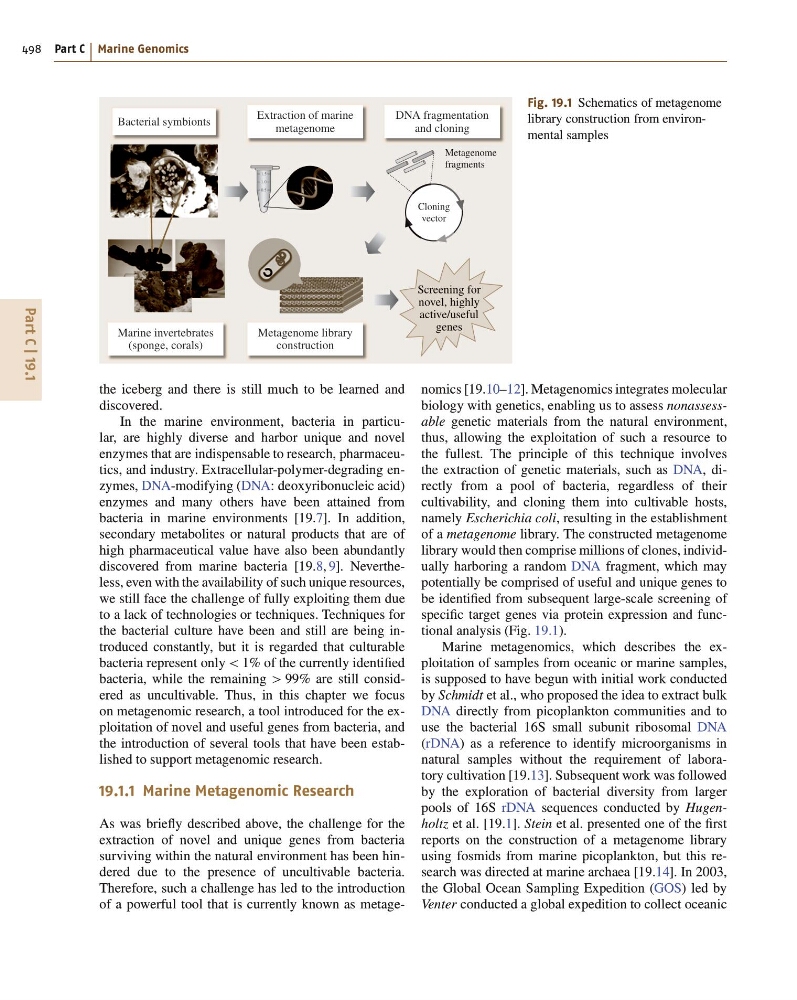
Fig. 19.1 Schematics of metagenome
library construction from environmental samples
the iceberg and there is still much to be learned and
discovered.
In the marine environment, bacteria in particular, are highly diverse and harbor unique and novel
enzymes that are indispensable to research, pharmaceutics, and industry. Extracellular-polymer-degrading enzymes, DNA-modifying (DNA: deoxyribonucleic acid)
enzymes and many others have been attained from
bacteria in marine environments [19.7]. In addition,
secondary metabolites or natural products that are of
high pharmaceutical value have also been abundantly
discovered from marine bacteria [19.8, 9]. Nevertheless, even with the availability of such unique resources,
we still face the challenge of fully exploiting them due
to a lack of technologies or techniques. Techniques for
the bacterial culture have been and still are being introduced constantly, but it is regarded that culturable
bacteria represent only < 1% of the currently identified
bacteria, while the remaining > 99% are still considered as uncultivable. Thus, in this chapter we focus
on metagenomic research, a tool introduced for the exploitation of novel and useful genes from bacteria, and
the introduction of several tools that have been established to support metagenomic research.
19.1.1 Marine Metagenomic Research
As was briefly described above, the challenge for the
extraction of novel and unique genes from bacteria
surviving within the natural environment has been hindered due to the presence of uncultivable bacteria.
Therefore, such a challenge has led to the introduction
of a powerful tool that is currently known as metagenomics [19.10–12]. Metagenomics integrates molecular
biology with genetics, enabling us to assess nonassessable genetic materials from the natural environment,
thus, allowing the exploitation of such a resource to
the fullest. The principle of this technique involves
the extraction of genetic materials, such as DNA, directly from a pool of bacteria, regardless of their
cultivability, and cloning them into cultivable hosts,
namely Escherichia coli, resulting in the establishment
of a metagenome library. The constructed metagenome
library would then comprise millions of clones, individually harboring a random DNA fragment, which may
potentially be comprised of useful and unique genes to
be identified from subsequent large-scale screening of
specific target genes via protein expression and functional analysis (Fig. 19.1).
Marine metagenomics, which describes the exploitation of samples from oceanic or marine samples,
is supposed to have begun with initial work conducted
by Schmidt et al., who proposed the idea to extract bulk
DNA directly from picoplankton communities and to
use the bacterial 16S small subunit ribosomal DNA
(rDNA) as a reference to identify microorganisms in
natural samples without the requirement of laboratory cultivation [19.13]. Subsequent work was followed
by the exploration of bacterial diversity from larger
pools of 16S rDNA sequences conducted by Hugenholtz et al. [19.1]. Stein et al. presented one of the first
reports on the construction of a metagenome library
using fosmids from marine picoplankton, but this research was directed at marine archaea [19.14]. In 2003,
the Global Ocean Sampling Expedition (GOS) led by
Venter conducted a global expedition to collect oceanic
498 Part C Marine Genomics
Metagenome library
construction
Marine invertebrates
(sponge, corals)
Bacterial symbionts
Extraction of marine
metagenome
DNA fragmentation
and cloning
Screening for
novel, highly
active/useful
genes
Cloning
vector
Metagenome
fragments
Fig. 19.1 Schematics of metagenome
library construction from environmental samples
the iceberg and there is still much to be learned and
discovered.
In the marine environment, bacteria in particular, are highly diverse and harbor unique and novel
enzymes that are indispensable to research, pharmaceutics, and industry. Extracellular-polymer-degrading enzymes, DNA-modifying (DNA: deoxyribonucleic acid)
enzymes and many others have been attained from
bacteria in marine environments [19.7]. In addition,
secondary metabolites or natural products that are of
high pharmaceutical value have also been abundantly
discovered from marine bacteria [19.8, 9]. Nevertheless, even with the availability of such unique resources,
we still face the challenge of fully exploiting them due
to a lack of technologies or techniques. Techniques for
the bacterial culture have been and still are being introduced constantly, but it is regarded that culturable
bacteria represent only < 1% of the currently identified
bacteria, while the remaining > 99% are still considered as uncultivable. Thus, in this chapter we focus
on metagenomic research, a tool introduced for the exploitation of novel and useful genes from bacteria, and
the introduction of several tools that have been established to support metagenomic research.
19.1.1 Marine Metagenomic Research
As was briefly described above, the challenge for the
extraction of novel and unique genes from bacteria
surviving within the natural environment has been hindered due to the presence of uncultivable bacteria.
Therefore, such a challenge has led to the introduction
of a powerful tool that is currently known as metagenomics [19.10–12]. Metagenomics integrates molecular
biology with genetics, enabling us to assess nonassessable genetic materials from the natural environment,
thus, allowing the exploitation of such a resource to
the fullest. The principle of this technique involves
the extraction of genetic materials, such as DNA, directly from a pool of bacteria, regardless of their
cultivability, and cloning them into cultivable hosts,
namely Escherichia coli, resulting in the establishment
of a metagenome library. The constructed metagenome
library would then comprise millions of clones, individually harboring a random DNA fragment, which may
potentially be comprised of useful and unique genes to
be identified from subsequent large-scale screening of
specific target genes via protein expression and functional analysis (Fig. 19.1).
Marine metagenomics, which describes the exploitation of samples from oceanic or marine samples,
is supposed to have begun with initial work conducted
by Schmidt et al., who proposed the idea to extract bulk
DNA directly from picoplankton communities and to
use the bacterial 16S small subunit ribosomal DNA
(rDNA) as a reference to identify microorganisms in
natural samples without the requirement of laboratory cultivation [19.13]. Subsequent work was followed
by the exploration of bacterial diversity from larger
pools of 16S rDNA sequences conducted by Hugenholtz et al. [19.1]. Stein et al. presented one of the first
reports on the construction of a metagenome library
using fosmids from marine picoplankton, but this research was directed at marine archaea [19.14]. In 2003,
the Global Ocean Sampling Expedition (GOS) led by
Venter conducted a global expedition to collect oceanic