

Part B | 13.4
404 Part B Tools and Methods in Marine Biotechnology
B
3
4
A
1
MW
2
5
8
660 bp (Actin)
450 bp (BSD)
7
6
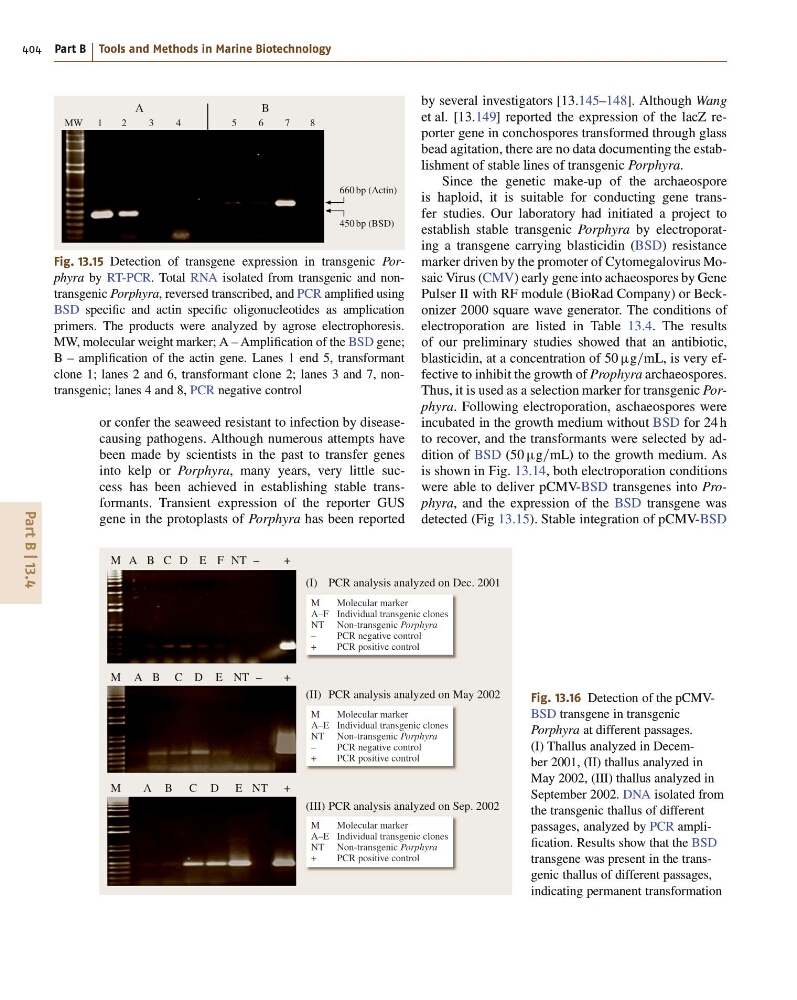
Fig. 13.15 Detection of transgene expression in transgenic Porphyra by RT-PCR. Total RNA isolated from transgenic and nontransgenic Porphyra, reversed transcribed, and PCR amplified using
BSD specific and actin specific oligonucleotides as amplication
primers. The products were analyzed by agrose electrophoresis.
MW, molecular weight marker; A – Amplification of the BSD gene;
B – amplification of the actin gene. Lanes 1 end 5, transformant
clone 1; lanes 2 and 6, transformant clone 2; lanes 3 and 7, nontransgenic; lanes 4 and 8, PCR negative control
or confer the seaweed resistant to infection by diseasecausing pathogens. Although numerous attempts have
been made by scientists in the past to transfer genes
into kelp or Porphyra, many years, very little success has been achieved in establishing stable transformants. Transient expression of the reporter GUS
gene in the protoplasts of Porphyra has been reported
E
NT
F
–
A
M
B C D
+
E NT –
A
M
B C D
+
E NT
A
M
B C D
+
(I) PCR analysis analyzed on Dec. 2001
(II) PCR analysis analyzed on May 2002
(III) PCR analysis analyzed on Sep. 2002
M
Molecular marker
A–F Individual transgenic clones
NT Non-transgenic Porphyra
–
PCR negative control
+
PCR positive control
M
Molecular marker
A–E Individual transgenic clones
NT Non-transgenic Porphyra
–
PCR negative control
+
PCR positive control
M
Molecular marker
A–E Individual transgenic clones
NT Non-transgenic Porphyra
+
PCR positive control
Fig. 13.16 Detection of the pCMVBSD transgene in transgenic
Porphyra at different passages.
(I) Thallus analyzed in December 2001, (II) thallus analyzed in
May 2002, (III) thallus analyzed in
September 2002. DNA isolated from
the transgenic thallus of different
passages, analyzed by PCR amplification. Results show that the BSD
transgene was present in the transgenic thallus of different passages,
indicating permanent transformation
by several investigators [13.145–148]. Although Wang
et al. [13.149] reported the expression of the lacZ reporter gene in conchospores transformed through glass
bead agitation, there are no data documenting the establishment of stable lines of transgenic Porphyra.
Since the genetic make-up of the archaeospore
is haploid, it is suitable for conducting gene transfer studies. Our laboratory had initiated a project to
establish stable transgenic Porphyra by electroporating a transgene carrying blasticidin (BSD) resistance
marker driven by the promoter of Cytomegalovirus Mosaic Virus (CMV) early gene into achaeospores by Gene
Pulser II with RF module (BioRad Company) or Beckonizer 2000 square wave generator. The conditions of
electroporation are listed in Table 13.4. The results
of our preliminary studies showed that an antibiotic,
blasticidin, at a concentration of 50 g=mL, is very effective to inhibit the growth of Prophyra archaeospores.
Thus, it is used as a selection marker for transgenic Porphyra. Following electroporation, aschaeospores were
incubated in the growth medium without BSD for 24 h
to recover, and the transformants were selected by addition of BSD (50 g=mL) to the growth medium. As
is shown in Fig. 13.14, both electroporation conditions
were able to deliver pCMV-BSD transgenes into Prophyra, and the expression of the BSD transgene was
detected (Fig 13.15). Stable integration of pCMV-BSD
404 Part B Tools and Methods in Marine Biotechnology
B
3
4
A
1
MW
2
5
8
660 bp (Actin)
450 bp (BSD)
7
6
Fig. 13.15 Detection of transgene expression in transgenic Porphyra by RT-PCR. Total RNA isolated from transgenic and nontransgenic Porphyra, reversed transcribed, and PCR amplified using
BSD specific and actin specific oligonucleotides as amplication
primers. The products were analyzed by agrose electrophoresis.
MW, molecular weight marker; A – Amplification of the BSD gene;
B – amplification of the actin gene. Lanes 1 end 5, transformant
clone 1; lanes 2 and 6, transformant clone 2; lanes 3 and 7, nontransgenic; lanes 4 and 8, PCR negative control
or confer the seaweed resistant to infection by diseasecausing pathogens. Although numerous attempts have
been made by scientists in the past to transfer genes
into kelp or Porphyra, many years, very little success has been achieved in establishing stable transformants. Transient expression of the reporter GUS
gene in the protoplasts of Porphyra has been reported
E
NT
F
–
A
M
B C D
+
E NT –
A
M
B C D
+
E NT
A
M
B C D
+
(I) PCR analysis analyzed on Dec. 2001
(II) PCR analysis analyzed on May 2002
(III) PCR analysis analyzed on Sep. 2002
M
Molecular marker
A–F Individual transgenic clones
NT Non-transgenic Porphyra
–
PCR negative control
+
PCR positive control
M
Molecular marker
A–E Individual transgenic clones
NT Non-transgenic Porphyra
–
PCR negative control
+
PCR positive control
M
Molecular marker
A–E Individual transgenic clones
NT Non-transgenic Porphyra
+
PCR positive control
Fig. 13.16 Detection of the pCMVBSD transgene in transgenic
Porphyra at different passages.
(I) Thallus analyzed in December 2001, (II) thallus analyzed in
May 2002, (III) thallus analyzed in
September 2002. DNA isolated from
the transgenic thallus of different
passages, analyzed by PCR amplification. Results show that the BSD
transgene was present in the transgenic thallus of different passages,
indicating permanent transformation
by several investigators [13.145–148]. Although Wang
et al. [13.149] reported the expression of the lacZ reporter gene in conchospores transformed through glass
bead agitation, there are no data documenting the establishment of stable lines of transgenic Porphyra.
Since the genetic make-up of the archaeospore
is haploid, it is suitable for conducting gene transfer studies. Our laboratory had initiated a project to
establish stable transgenic Porphyra by electroporating a transgene carrying blasticidin (BSD) resistance
marker driven by the promoter of Cytomegalovirus Mosaic Virus (CMV) early gene into achaeospores by Gene
Pulser II with RF module (BioRad Company) or Beckonizer 2000 square wave generator. The conditions of
electroporation are listed in Table 13.4. The results
of our preliminary studies showed that an antibiotic,
blasticidin, at a concentration of 50 g=mL, is very effective to inhibit the growth of Prophyra archaeospores.
Thus, it is used as a selection marker for transgenic Porphyra. Following electroporation, aschaeospores were
incubated in the growth medium without BSD for 24 h
to recover, and the transformants were selected by addition of BSD (50 g=mL) to the growth medium. As
is shown in Fig. 13.14, both electroporation conditions
were able to deliver pCMV-BSD transgenes into Prophyra, and the expression of the BSD transgene was
detected (Fig 13.15). Stable integration of pCMV-BSD