

Transgenic Technology in Marine Organisms 13.4 Biotechnological Application 403
Part B | 13.4
respectively, for in vivo screening of environmental estrogenic chemicals. Furthermore, by introducing
a transgene carrying the chgH-rfp reporter system,
Cho et al. [13.137] developed stable lines of estrogenresponsive transgenic marine medaka for assessing water born estrogenic compounds under a wide range of
salinity conditions. Using a similar approach, transgenic zebrafish lines carrying the gfp transgene driven
by the TH/bZIP promoter (promoter of thyroid hormone responsive genes) were developed by Terrien
et al. [13.138] for detecting environmental toxicants
that may disrupt thyroid function.
13.4.6 Other Biotechnological Applications
Transgenic marine organisms can potentially serve as
bioreactors for producing proteins for therapeutic and
other applications [13.114]. The advantages of fish as
bioreactors include:
i) Relatively low cost as compared to mammals such
as cows.
ii) Easy maintenance.
iii) Production of a large quantity of progenies.
iv) Most importantly, no known viruses or prions have
been reported to infect both humans and fish.
Successful expression of bioactive human proteins
such as coagulation factor VII, IGF-I, and IGF-II in
fish embryos [13.139, 140] demonstrate this application of transgenic fish to produce therapeutic chemicals for humans in the future. Another application of
transgenic organisms is the production of transgenic
microalgae e.g., Nannochloropsis oculata) [13.7] and
zooplankton (e.g., Artemina) [13.6] expressing biologically active fish growth hormones to serve as feed in
aquaculture.
Hydrogen metabolism has been extensively studied in green alga, C. reinhardtii, resulting in significant advances in both the fundamental understanding of H 2 metabolism in this organism, as well as
the improvements of overall H 2 yields. Thus, transgenic manipulation of genes involved in hydrogen
production in Chlamydomonas reinhardtii would provide a great potential for biofuel production in the
future [13.141].
Significant amounts of marine macroalgae (e.g.,
kelp and Porphyra) have been used as food for human consumption, feed for aquaculture of finfish and
shellfish, and fine chemicals for industrial and pharmaceutical applications worldwide [13.142]. According
Table 13.4 Parameters for electroporating Porphyra archespores
Electroporator
Conditions
Gene pulser II
kV=cm
2.0; 1.75; 1.50
% Modulation
100
RF (kHz)
50
Burst #
10
Duration (s)
6.4
Interval (s)
0.4
Baekonizer 2000
kV=cm
3.0
# Pulses
2 6
Burst (s)
0.4
Cycle #
10
Pulse time (ms)
100
to a report from the Food and Agriculture Organization of the United Nations (FAO) in 2005 [13.143],
the annual harvests of kelp and Prophyra grown on
shore and in coastal regions have declined drastically
as a consequence of toxicant contamination in the
aquatic ecosystem and disease manifestation caused by
pathogenic microorganisms [13.144]. These problems
may be alleviated by introducing genetic traits that
will enable seaweed to remove water-borne toxicants
B
1
2
A
1
2
C
1
2
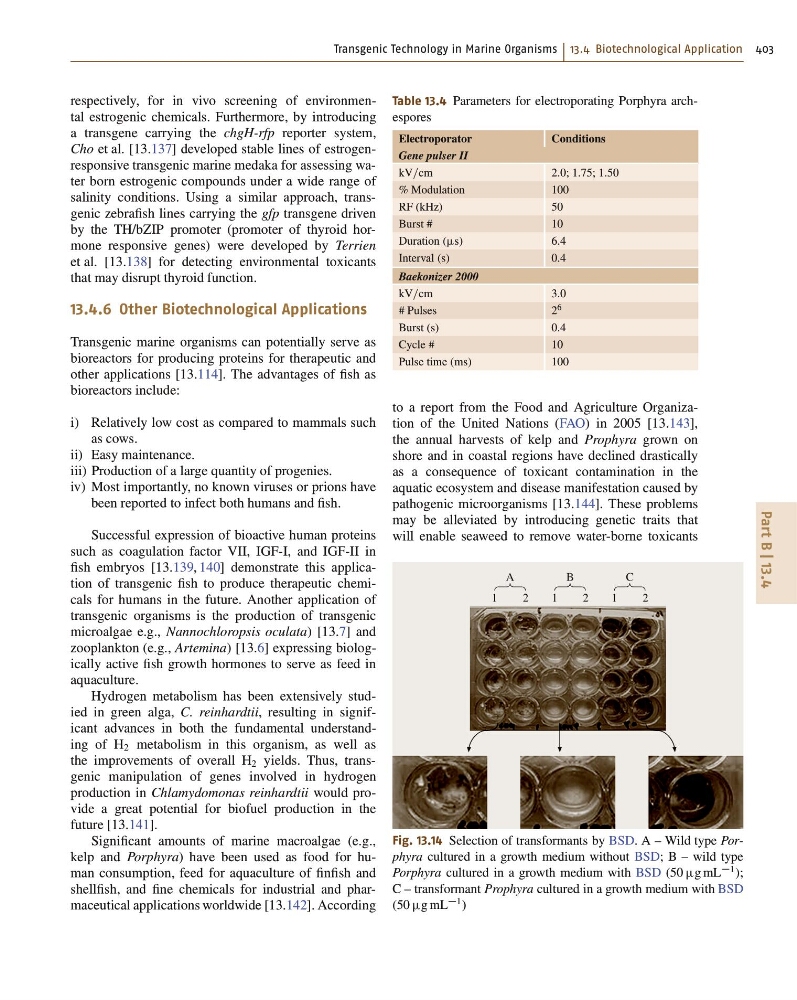
Fig. 13.14 Selection of transformants by BSD. A – Wild type Porphyra cultured in a growth medium without BSD; B – wild type
Porphyra cultured in a growth medium with BSD (50 g mL
1 );
C – transformant Prophyra cultured in a growth medium with BSD
(50 g mL
1 )
Part B | 13.4
respectively, for in vivo screening of environmental estrogenic chemicals. Furthermore, by introducing
a transgene carrying the chgH-rfp reporter system,
Cho et al. [13.137] developed stable lines of estrogenresponsive transgenic marine medaka for assessing water born estrogenic compounds under a wide range of
salinity conditions. Using a similar approach, transgenic zebrafish lines carrying the gfp transgene driven
by the TH/bZIP promoter (promoter of thyroid hormone responsive genes) were developed by Terrien
et al. [13.138] for detecting environmental toxicants
that may disrupt thyroid function.
13.4.6 Other Biotechnological Applications
Transgenic marine organisms can potentially serve as
bioreactors for producing proteins for therapeutic and
other applications [13.114]. The advantages of fish as
bioreactors include:
i) Relatively low cost as compared to mammals such
as cows.
ii) Easy maintenance.
iii) Production of a large quantity of progenies.
iv) Most importantly, no known viruses or prions have
been reported to infect both humans and fish.
Successful expression of bioactive human proteins
such as coagulation factor VII, IGF-I, and IGF-II in
fish embryos [13.139, 140] demonstrate this application of transgenic fish to produce therapeutic chemicals for humans in the future. Another application of
transgenic organisms is the production of transgenic
microalgae e.g., Nannochloropsis oculata) [13.7] and
zooplankton (e.g., Artemina) [13.6] expressing biologically active fish growth hormones to serve as feed in
aquaculture.
Hydrogen metabolism has been extensively studied in green alga, C. reinhardtii, resulting in significant advances in both the fundamental understanding of H 2 metabolism in this organism, as well as
the improvements of overall H 2 yields. Thus, transgenic manipulation of genes involved in hydrogen
production in Chlamydomonas reinhardtii would provide a great potential for biofuel production in the
future [13.141].
Significant amounts of marine macroalgae (e.g.,
kelp and Porphyra) have been used as food for human consumption, feed for aquaculture of finfish and
shellfish, and fine chemicals for industrial and pharmaceutical applications worldwide [13.142]. According
Table 13.4 Parameters for electroporating Porphyra archespores
Electroporator
Conditions
Gene pulser II
kV=cm
2.0; 1.75; 1.50
% Modulation
100
RF (kHz)
50
Burst #
10
Duration (s)
6.4
Interval (s)
0.4
Baekonizer 2000
kV=cm
3.0
# Pulses
2 6
Burst (s)
0.4
Cycle #
10
Pulse time (ms)
100
to a report from the Food and Agriculture Organization of the United Nations (FAO) in 2005 [13.143],
the annual harvests of kelp and Prophyra grown on
shore and in coastal regions have declined drastically
as a consequence of toxicant contamination in the
aquatic ecosystem and disease manifestation caused by
pathogenic microorganisms [13.144]. These problems
may be alleviated by introducing genetic traits that
will enable seaweed to remove water-borne toxicants
B
1
2
A
1
2
C
1
2
Fig. 13.14 Selection of transformants by BSD. A – Wild type Porphyra cultured in a growth medium without BSD; B – wild type
Porphyra cultured in a growth medium with BSD (50 g mL
1 );
C – transformant Prophyra cultured in a growth medium with BSD
(50 g mL
1 )