

Novel Bioreactors for Culturing Marine Organisms 12.8 High-Temperature and/or High-Pressure Bioreactors (HP-/HTBR) 373
Part B | 12.8
Oven
He
H 2
C
PT
FO
PV
RP
CV
BPR
LS
PMT
AT
ATM
GB
VAC
VAC
IV2
IV1
ATM
PG
PG
PNV
INJ
H 2
PP
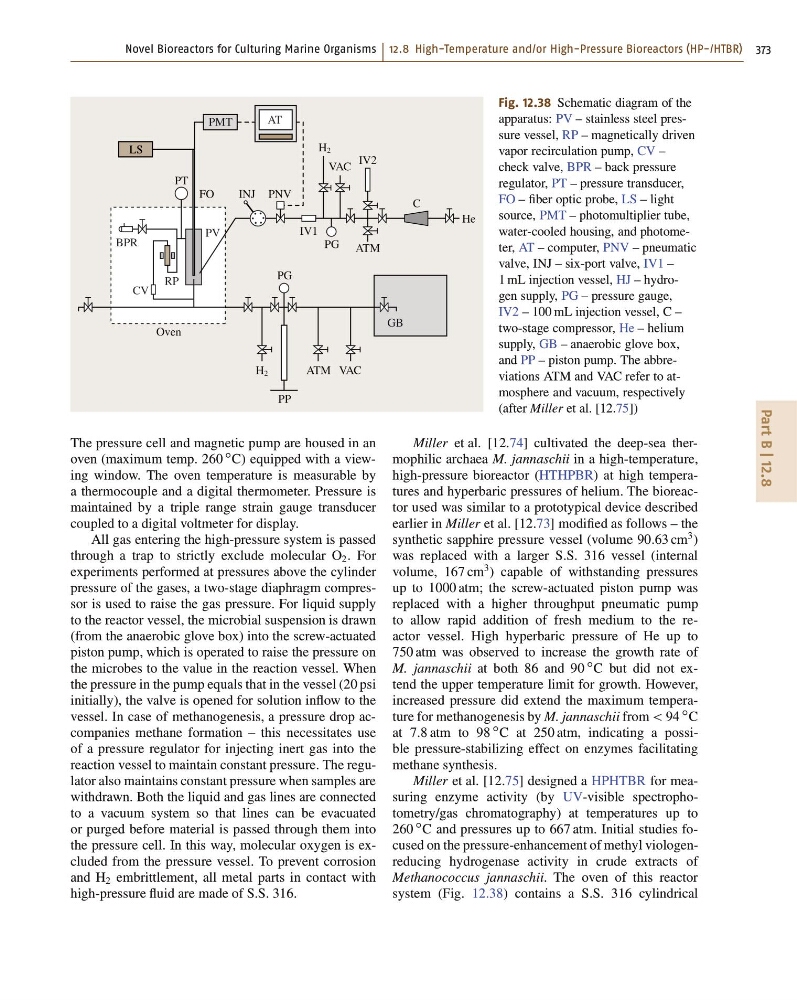
Fig. 12.38 Schematic diagram of the
apparatus: PV – stainless steel pressure vessel, RP – magnetically driven
vapor recirculation pump, CV –
check valve, BPR – back pressure
regulator, PT – pressure transducer,
FO – fiber optic probe, LS – light
source, PMT – photomultiplier tube,
water-cooled housing, and photometer, AT – computer, PNV – pneumatic
valve, INJ – six-port valve, IV1 –
1 mL injection vessel, HJ – hydrogen supply, PG – pressure gauge,
IV2 – 100 mL injection vessel, C –
two-stage compressor, He – helium
supply, GB – anaerobic glove box,
and PP – piston pump. The abbreviations ATM and VAC refer to atmosphere and vacuum, respectively
(after Miller et al. [12.75])
The pressure cell and magnetic pump are housed in an
oven (maximum temp. 260
ı C) equipped with a viewing window. The oven temperature is measurable by
a thermocouple and a digital thermometer. Pressure is
maintained by a triple range strain gauge transducer
coupled to a digital voltmeter for display.
All gas entering the high-pressure system is passed
through a trap to strictly exclude molecular O 2 . For
experiments performed at pressures above the cylinder
pressure of the gases, a two-stage diaphragm compressor is used to raise the gas pressure. For liquid supply
to the reactor vessel, the microbial suspension is drawn
(from the anaerobic glove box) into the screw-actuated
piston pump, which is operated to raise the pressure on
the microbes to the value in the reaction vessel. When
the pressure in the pump equals that in the vessel (20 psi
initially), the valve is opened for solution inflow to the
vessel. In case of methanogenesis, a pressure drop accompanies methane formation – this necessitates use
of a pressure regulator for injecting inert gas into the
reaction vessel to maintain constant pressure. The regulator also maintains constant pressure when samples are
withdrawn. Both the liquid and gas lines are connected
to a vacuum system so that lines can be evacuated
or purged before material is passed through them into
the pressure cell. In this way, molecular oxygen is excluded from the pressure vessel. To prevent corrosion
and H 2 embrittlement, all metal parts in contact with
high-pressure fluid are made of S.S. 316.
Miller et al. [12.74] cultivated the deep-sea thermophilic archaea M. jannaschii in a high-temperature,
high-pressure bioreactor (HTHPBR) at high temperatures and hyperbaric pressures of helium. The bioreactor used was similar to a prototypical device described
earlier in Miller et al. [12.73] modified as follows – the
synthetic sapphire pressure vessel (volume 90:63 cm
3 )
was replaced with a larger S.S. 316 vessel (internal
volume, 167 cm
3 ) capable of withstanding pressures
up to 1000 atm; the screw-actuated piston pump was
replaced with a higher throughput pneumatic pump
to allow rapid addition of fresh medium to the reactor vessel. High hyperbaric pressure of He up to
750 atm was observed to increase the growth rate of
M. jannaschii at both 86 and 90
ı C but did not extend the upper temperature limit for growth. However,
increased pressure did extend the maximum temperature for methanogenesis by M. jannaschii from < 94
ı C
at 7:8 atm to 98
ı C at 250 atm, indicating a possible pressure-stabilizing effect on enzymes facilitating
methane synthesis.
Miller et al. [12.75] designed a HPHTBR for measuring enzyme activity (by UV-visible spectrophotometry/gas chromatography) at temperatures up to
260
ı C and pressures up to 667 atm. Initial studies focused on the pressure-enhancement of methyl viologenreducing hydrogenase activity in crude extracts of
Methanococcus jannaschii. The oven of this reactor
system (Fig. 12.38) contains a S.S. 316 cylindrical
Part B | 12.8
Oven
He
H 2
C
PT
FO
PV
RP
CV
BPR
LS
PMT
AT
ATM
GB
VAC
VAC
IV2
IV1
ATM
PG
PG
PNV
INJ
H 2
PP
Fig. 12.38 Schematic diagram of the
apparatus: PV – stainless steel pressure vessel, RP – magnetically driven
vapor recirculation pump, CV –
check valve, BPR – back pressure
regulator, PT – pressure transducer,
FO – fiber optic probe, LS – light
source, PMT – photomultiplier tube,
water-cooled housing, and photometer, AT – computer, PNV – pneumatic
valve, INJ – six-port valve, IV1 –
1 mL injection vessel, HJ – hydrogen supply, PG – pressure gauge,
IV2 – 100 mL injection vessel, C –
two-stage compressor, He – helium
supply, GB – anaerobic glove box,
and PP – piston pump. The abbreviations ATM and VAC refer to atmosphere and vacuum, respectively
(after Miller et al. [12.75])
The pressure cell and magnetic pump are housed in an
oven (maximum temp. 260
ı C) equipped with a viewing window. The oven temperature is measurable by
a thermocouple and a digital thermometer. Pressure is
maintained by a triple range strain gauge transducer
coupled to a digital voltmeter for display.
All gas entering the high-pressure system is passed
through a trap to strictly exclude molecular O 2 . For
experiments performed at pressures above the cylinder
pressure of the gases, a two-stage diaphragm compressor is used to raise the gas pressure. For liquid supply
to the reactor vessel, the microbial suspension is drawn
(from the anaerobic glove box) into the screw-actuated
piston pump, which is operated to raise the pressure on
the microbes to the value in the reaction vessel. When
the pressure in the pump equals that in the vessel (20 psi
initially), the valve is opened for solution inflow to the
vessel. In case of methanogenesis, a pressure drop accompanies methane formation – this necessitates use
of a pressure regulator for injecting inert gas into the
reaction vessel to maintain constant pressure. The regulator also maintains constant pressure when samples are
withdrawn. Both the liquid and gas lines are connected
to a vacuum system so that lines can be evacuated
or purged before material is passed through them into
the pressure cell. In this way, molecular oxygen is excluded from the pressure vessel. To prevent corrosion
and H 2 embrittlement, all metal parts in contact with
high-pressure fluid are made of S.S. 316.
Miller et al. [12.74] cultivated the deep-sea thermophilic archaea M. jannaschii in a high-temperature,
high-pressure bioreactor (HTHPBR) at high temperatures and hyperbaric pressures of helium. The bioreactor used was similar to a prototypical device described
earlier in Miller et al. [12.73] modified as follows – the
synthetic sapphire pressure vessel (volume 90:63 cm
3 )
was replaced with a larger S.S. 316 vessel (internal
volume, 167 cm
3 ) capable of withstanding pressures
up to 1000 atm; the screw-actuated piston pump was
replaced with a higher throughput pneumatic pump
to allow rapid addition of fresh medium to the reactor vessel. High hyperbaric pressure of He up to
750 atm was observed to increase the growth rate of
M. jannaschii at both 86 and 90
ı C but did not extend the upper temperature limit for growth. However,
increased pressure did extend the maximum temperature for methanogenesis by M. jannaschii from < 94
ı C
at 7:8 atm to 98
ı C at 250 atm, indicating a possible pressure-stabilizing effect on enzymes facilitating
methane synthesis.
Miller et al. [12.75] designed a HPHTBR for measuring enzyme activity (by UV-visible spectrophotometry/gas chromatography) at temperatures up to
260
ı C and pressures up to 667 atm. Initial studies focused on the pressure-enhancement of methyl viologenreducing hydrogenase activity in crude extracts of
Methanococcus jannaschii. The oven of this reactor
system (Fig. 12.38) contains a S.S. 316 cylindrical