

Novel Bioreactors for Culturing Marine Organisms 12.8 High-Temperature and/or High-Pressure Bioreactors (HP-/HTBR) 369
Part B | 12.8
Wheels with brakes
Flight case
lid
Cooling block
Aluminum block
To/from
cooler
Lock
Lock
Trolit
insulation
Flight case
bottom
Connector for thermo-probes
and heating elements
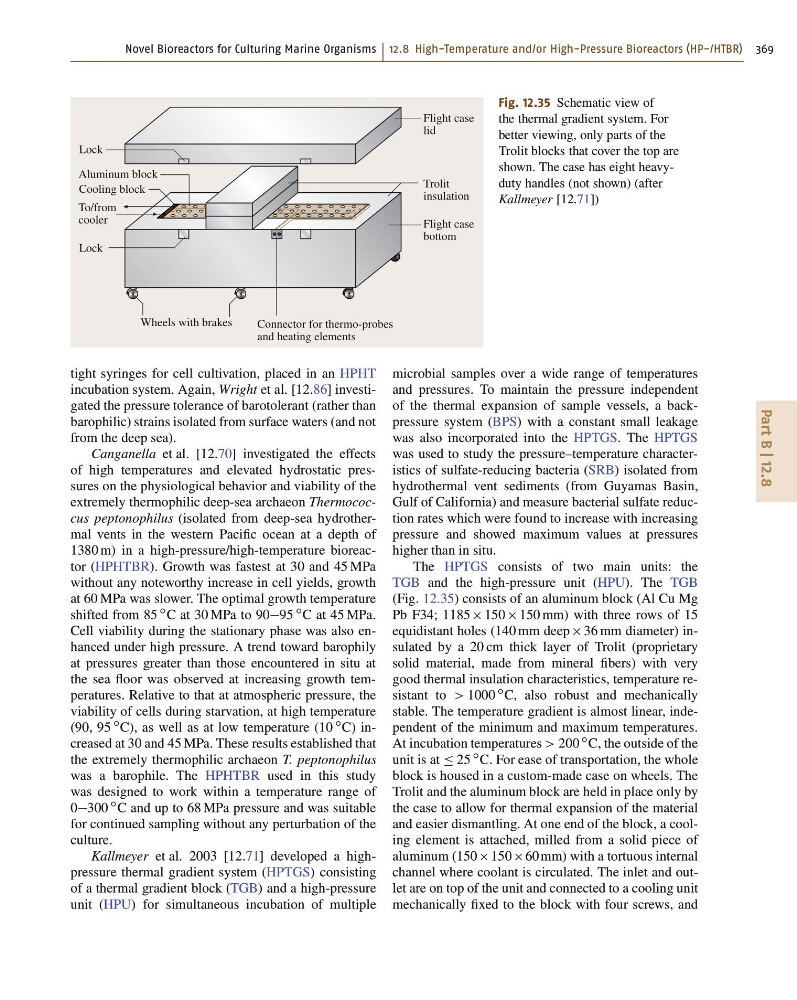
Fig. 12.35 Schematic view of
the thermal gradient system. For
better viewing, only parts of the
Trolit blocks that cover the top are
shown. The case has eight heavyduty handles (not shown) (after
Kallmeyer [12.71])
tight syringes for cell cultivation, placed in an HPHT
incubation system. Again, Wright et al. [12.86] investigated the pressure tolerance of barotolerant (rather than
barophilic) strains isolated from surface waters (and not
from the deep sea).
Canganella et al. [12.70] investigated the effects
of high temperatures and elevated hydrostatic pressures on the physiological behavior and viability of the
extremely thermophilic deep-sea archaeon Thermococcus peptonophilus (isolated from deep-sea hydrothermal vents in the western Pacific ocean at a depth of
1380 m) in a high-pressure/high-temperature bioreactor (HPHTBR). Growth was fastest at 30 and 45 MPa
without any noteworthy increase in cell yields, growth
at 60 MPa was slower. The optimal growth temperature
shifted from 85
ı C at 30 MPa to 9095
ı C at 45 MPa.
Cell viability during the stationary phase was also enhanced under high pressure. A trend toward barophily
at pressures greater than those encountered in situ at
the sea floor was observed at increasing growth temperatures. Relative to that at atmospheric pressure, the
viability of cells during starvation, at high temperature
(90, 95
ı C), as well as at low temperature (10
ı C) increased at 30 and 45 MPa. These results established that
the extremely thermophilic archaeon T. peptonophilus
was a barophile. The HPHTBR used in this study
was designed to work within a temperature range of
0300
ı C and up to 68 MPa pressure and was suitable
for continued sampling without any perturbation of the
culture.
Kallmeyer et al. 2003 [12.71] developed a highpressure thermal gradient system (HPTGS) consisting
of a thermal gradient block (TGB) and a high-pressure
unit (HPU) for simultaneous incubation of multiple
microbial samples over a wide range of temperatures
and pressures. To maintain the pressure independent
of the thermal expansion of sample vessels, a backpressure system (BPS) with a constant small leakage
was also incorporated into the HPTGS. The HPTGS
was used to study the pressure–temperature characteristics of sulfate-reducing bacteria (SRB) isolated from
hydrothermal vent sediments (from Guyamas Basin,
Gulf of California) and measure bacterial sulfate reduction rates which were found to increase with increasing
pressure and showed maximum values at pressures
higher than in situ.
The HPTGS consists of two main units: the
TGB and the high-pressure unit (HPU). The TGB
(Fig. 12.35) consists of an aluminum block (Al Cu Mg
Pb F34; 1185 150 150 mm) with three rows of 15
equidistant holes (140 mm deep 36 mm diameter) insulated by a 20 cm thick layer of Trolit (proprietary
solid material, made from mineral fibers) with very
good thermal insulation characteristics, temperature resistant to > 1000
ı C, also robust and mechanically
stable. The temperature gradient is almost linear, independent of the minimum and maximum temperatures.
At incubation temperatures > 200
ı C, the outside of the
unit is at Ä 25
ı C. For ease of transportation, the whole
block is housed in a custom-made case on wheels. The
Trolit and the aluminum block are held in place only by
the case to allow for thermal expansion of the material
and easier dismantling. At one end of the block, a cooling element is attached, milled from a solid piece of
aluminum (150 150 60 mm) with a tortuous internal
channel where coolant is circulated. The inlet and outlet are on top of the unit and connected to a cooling unit
mechanically fixed to the block with four screws, and
Part B | 12.8
Wheels with brakes
Flight case
lid
Cooling block
Aluminum block
To/from
cooler
Lock
Lock
Trolit
insulation
Flight case
bottom
Connector for thermo-probes
and heating elements
Fig. 12.35 Schematic view of
the thermal gradient system. For
better viewing, only parts of the
Trolit blocks that cover the top are
shown. The case has eight heavyduty handles (not shown) (after
Kallmeyer [12.71])
tight syringes for cell cultivation, placed in an HPHT
incubation system. Again, Wright et al. [12.86] investigated the pressure tolerance of barotolerant (rather than
barophilic) strains isolated from surface waters (and not
from the deep sea).
Canganella et al. [12.70] investigated the effects
of high temperatures and elevated hydrostatic pressures on the physiological behavior and viability of the
extremely thermophilic deep-sea archaeon Thermococcus peptonophilus (isolated from deep-sea hydrothermal vents in the western Pacific ocean at a depth of
1380 m) in a high-pressure/high-temperature bioreactor (HPHTBR). Growth was fastest at 30 and 45 MPa
without any noteworthy increase in cell yields, growth
at 60 MPa was slower. The optimal growth temperature
shifted from 85
ı C at 30 MPa to 9095
ı C at 45 MPa.
Cell viability during the stationary phase was also enhanced under high pressure. A trend toward barophily
at pressures greater than those encountered in situ at
the sea floor was observed at increasing growth temperatures. Relative to that at atmospheric pressure, the
viability of cells during starvation, at high temperature
(90, 95
ı C), as well as at low temperature (10
ı C) increased at 30 and 45 MPa. These results established that
the extremely thermophilic archaeon T. peptonophilus
was a barophile. The HPHTBR used in this study
was designed to work within a temperature range of
0300
ı C and up to 68 MPa pressure and was suitable
for continued sampling without any perturbation of the
culture.
Kallmeyer et al. 2003 [12.71] developed a highpressure thermal gradient system (HPTGS) consisting
of a thermal gradient block (TGB) and a high-pressure
unit (HPU) for simultaneous incubation of multiple
microbial samples over a wide range of temperatures
and pressures. To maintain the pressure independent
of the thermal expansion of sample vessels, a backpressure system (BPS) with a constant small leakage
was also incorporated into the HPTGS. The HPTGS
was used to study the pressure–temperature characteristics of sulfate-reducing bacteria (SRB) isolated from
hydrothermal vent sediments (from Guyamas Basin,
Gulf of California) and measure bacterial sulfate reduction rates which were found to increase with increasing
pressure and showed maximum values at pressures
higher than in situ.
The HPTGS consists of two main units: the
TGB and the high-pressure unit (HPU). The TGB
(Fig. 12.35) consists of an aluminum block (Al Cu Mg
Pb F34; 1185 150 150 mm) with three rows of 15
equidistant holes (140 mm deep 36 mm diameter) insulated by a 20 cm thick layer of Trolit (proprietary
solid material, made from mineral fibers) with very
good thermal insulation characteristics, temperature resistant to > 1000
ı C, also robust and mechanically
stable. The temperature gradient is almost linear, independent of the minimum and maximum temperatures.
At incubation temperatures > 200
ı C, the outside of the
unit is at Ä 25
ı C. For ease of transportation, the whole
block is housed in a custom-made case on wheels. The
Trolit and the aluminum block are held in place only by
the case to allow for thermal expansion of the material
and easier dismantling. At one end of the block, a cooling element is attached, milled from a solid piece of
aluminum (150 150 60 mm) with a tortuous internal
channel where coolant is circulated. The inlet and outlet are on top of the unit and connected to a cooling unit
mechanically fixed to the block with four screws, and